Sunday, June 28, 2026
The Tomb of Krathyguiar’lkjjin Mirethought
So have I heard and do in part believe it. —Horatio, Hamlet
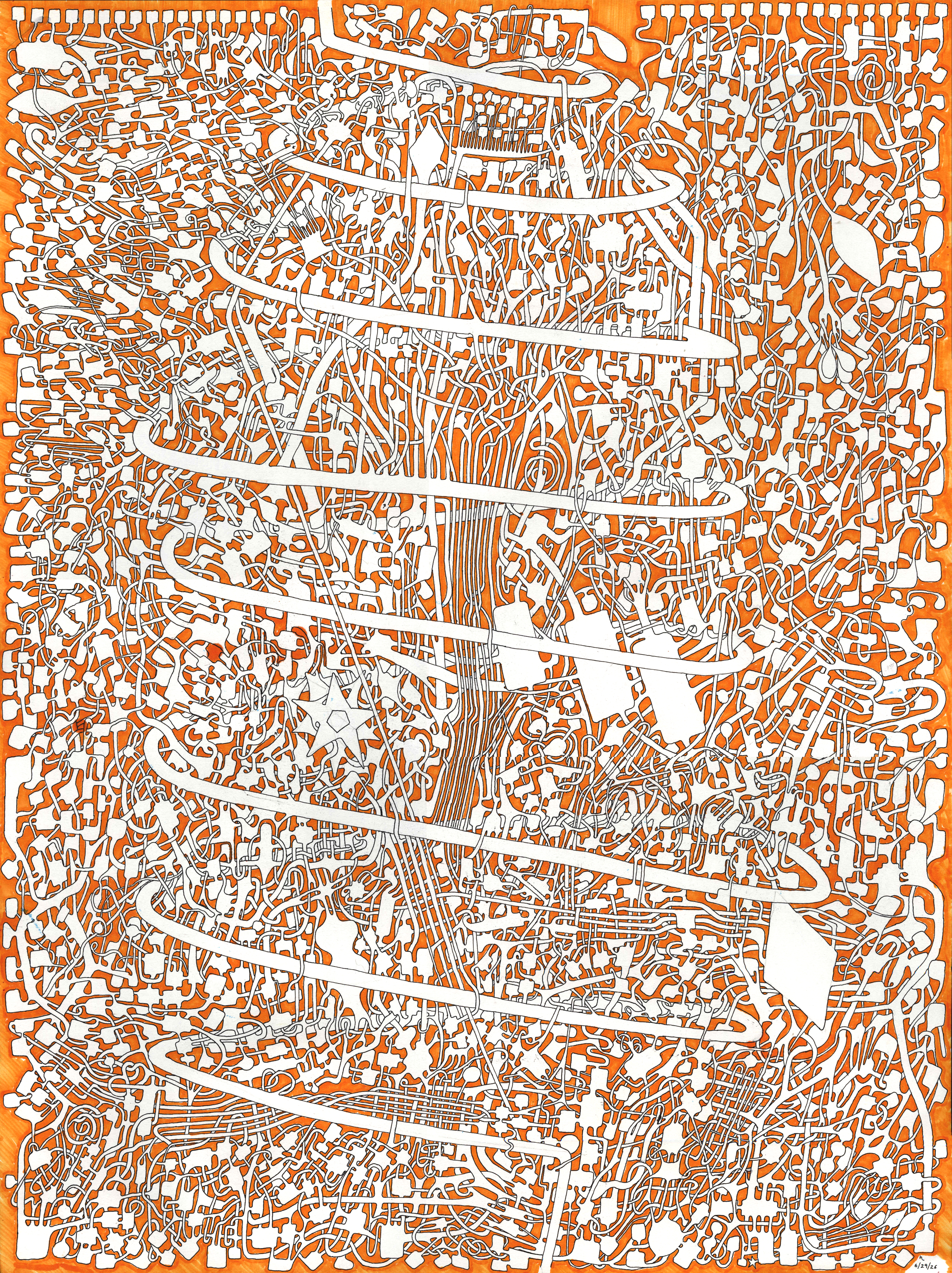
Here is Level ETA, The Tomb of Krathyguiar’lkjjin Mirethought, housing the remains and treasures the deified ruler whose reign was so ancient and influential that it is used as a point of comparison to the weeping heart of the underworld. (ETA is only the tomb of Mirethought–a monument placed relatively near the surface. What remains of his former domain is still deeper and more unspeakably vast.)
Location Within Redux
Obviously there are exits North and South to maps which haven’t been drawn yet, but Upwards is The Palace of the Snail Men. You can spot the spiral ramps coming down if you look closely.
Dangers
There are no opportunistic monsters in the tomb; no creature dares enter, save to pass through. It is all finely polished stone, statues and stellai, polished vessels, various thrones. The main danger is becoming snuffed out by the immensity of the place; getting lost, suffocating, starving, etc.
Smells
- Death
- Heavy musty perfume
- Blood
- Halitosis
- Spring flowers
Sounds
- The quiet of peaceful meditation
- The silence after a murder is over
- The apprehensive silence before standing up to someone in power
- The soundlessness of trying to sneak up on an animal
- The silence after giving up on sex
- The silence of paralyzing fear
- (muffled, far away) The edge of a distant sob
Treasure
There are Great Treasures in the tomb–17 for the King, 17 for the Queen–objects of unimaginable power. They are each placed in their own chamber, lining the north edge of the map.
I don’t have any of these worked out yet, but they’re the sort of objects where touching them turns you into a god or teleports you to mars or fills your insides with maggots or allows you for force any man into servitude for ten generations.
You know, the sorts of things that no reasonable person would ever want, and thus which are highly coveted.
Layout
This is the densest map of its type I’ve ever drawn. For the most part I’m pleased with it for what it is. It is much more difficult to navigate than my usual stuff. Unlike my previous maps, dead-reckoning can only get you so far.
I challenge you you trace a path from the big spiraling passage to one of the treasure rooms at the top. It is possible, I promise!
By my count there are 1,254 rooms, so probably close to 300 points of interest.
More than other levels, ETA will rely on something like setting-writing on my part, and will of necessity need lots of maps/hints/instructions for navigating. It’s a place with a strong story, which is somewhat unusual for me.
A 16-page printable pdf of the map is here, which is how I will use it at the table in actual play.
—-
Redux will be on hold for a while after Monday. I’ve become burnt out, and need to take time away from these games to clear my head. Forget some things, so that I can approach them afresh later. This always happens, where suddenly I can’t stand RPG stuff. I will come back. That always happens, too.
Friday, June 19, 2026
Character Creation Reduces Player Agency
Dear reader, I am not someone who believes the be all end all of tabletop games is player agency. I subscribe to a different idea, that games are social and material processes which are fruitful in themselves; the mere application of rules to a gamestate–even when that application is choiceless and tedious–is worthwhile to me. Monopoly is good, actually.
However, I found myself making an argument about player agency and I’d like to explore it here. For the sake of this post, then, I will take up the position that agency is King: the point of making and playing games is for players to be able to make cool moves. Say this is true.
I argue that, sometimes, character creation reduces player agency. Decision-paralysis and the pressure to make “good” character creation choices can reduce players’ abilities to make cool moves in play at the table.
The argument isn’t very complicated, just that energy and inspiration are components to agency—finite resources—and that choosing to expend them while in the adventure rather than before can be a better idea.
“How can I make this photographer that my Ref handed me useful in this fight against a bugbear?!” is a more interesting and fruitful choice (a cooler move, more agency) than “Should I put my skill points into Tact or Righteousness?”
You could say that allowing the player to choose the photographer in the first place gives them two cool moves instead of the one, and thus that character creation still increases agency. This might be so if we had unlimited time and unending energy, but I think the effort necessary to choose a photographer lessens the coolness of the photographer’s bugbear actions. It feels less efficient to me.
Besides, if that were the case, then we could increase agency infinitely by letting players choose what classes are available, what rules to use, and so on. This would be fun, but in the infinite series of increasing agency the game sort of disappears.
My basic claim is just that often “here’s the situation, make do with the pieces you have to achieve some desired outcome” can indeed enable agency in a way “here are building blocks, assemble them so that you can be prepared for some situations, and then we will have you go into some situations” does not.
Now this is a focus thing, right, like if you’re playing The Character Creation Game, where the goal is to build the best character, obviously eschewing character creation only reduces agency. In the games I generally play the focus is on what one does with the character, so prioritizing player time for doing is what will increase agency.
—
Again, though, my real thoughts are that agency isn’t really the most important part of these games, that process is. From a process perspective, character creation is great.
Thursday, June 18, 2026
Gollie Ghoul’s Garish Garage
Here’s an adventure I wrote for my Extremely Byzantine 5-room Dungeon Jam

Adventure PDF: gggg.pdf
PNG of Map: gggg_map.png
Marathon Nomic Game Report
For some reason I’m having a tremendous amount of writer’s block for analytical writing, so for this report I’ll stick to the facts. Perhaps I’ll add a retrospective later.

Marathon Nomic ran for 24 straight hours, from 19:01 UTC June 13th to 19:01 UTC June 14th. With 7 total playing participants there were 94 proposed changes to the rules. 50 proposals passed, with a total of 53 individual rule-changes and a pass rate of 53%. The initial 31-rule ruleset ballooned to ω by the end thanks to an infinite rule-duplication mechanic, though if you discount those the ruleset ended with 46 rules (18 immutable, 28 mutable).
It produced 6 winners and 1 Chosen Champion of Chaos. One team was formed and disbanded, the Hunter Wyverns.
(For the best sense of the game, look at the Proposal Record first!)
—
All in all Marathon Nomic was a success! 94 turns is a lot of Nomic! Thanks to all who participated. I probably won’t do another one of these.
Monday, June 15, 2026
sorry thats not my job
“Prep scenarios, not plots” is a big ole’ touchstone for playing dungeon or field games in my circles. The idea is that it’s not the referee’s job to plan out players’ adventures for them.
What you should do instead is come up with a situation you find interesting and plop it in front of ‘em. Trust your friends who you’re playing with to take your idea seriously and explore it earnestly—and if you’re playing a Fantasy Roleplaying Game with someone you should be at minimum friendly because otherwise what are you even doing?
It’s a trust thing, right, you have to be willing to risk an imperfect game experience in the hopes that your game companions will put in their own kind of investment and make something with you that none of you could do on your own.
So far so good: eager referees are taking notes down for How To Play D&D.
…
Okay but I have another DM Advice I wanna throw out there in the same vein: when writing or drawing stuff, it’s not your job to make it playable.
In the same way it’s the players’ job to make an adventure out of a scenario, it’s the at-the-table referee’s job to make the map/key into a game.
The writer, on the other hand—the version of yourself who that draws the maps and writes the keys and publishes the rules you run? They shouldn’t worry about playability, or even intelligibility. Their job is just to make something inspiring for the oracular art of playing a board game.
High trust is the way. At each stage of the hobby, you have to have faith that those operating the next stage will pick up what you’re putting down, or at least find something worthwhile and run with it.
Don’t worry about making something that’s effective or principled or in accordance with expectations: make something that’s beautiful and engaging to you right now. Life is too short, and play-time is even shorter, to bother with anxiety about whether your near-future hypothetical self will find your work fun.
its all made up anyway
