Tuesday, September 29, 2026
Untitled Underworld Project
This post is a formal description/advertisement for a new collaborative Untitled Underworld Project. The project is currently active in Phase I, which will run through December 31st, 2026, and is open for joining.
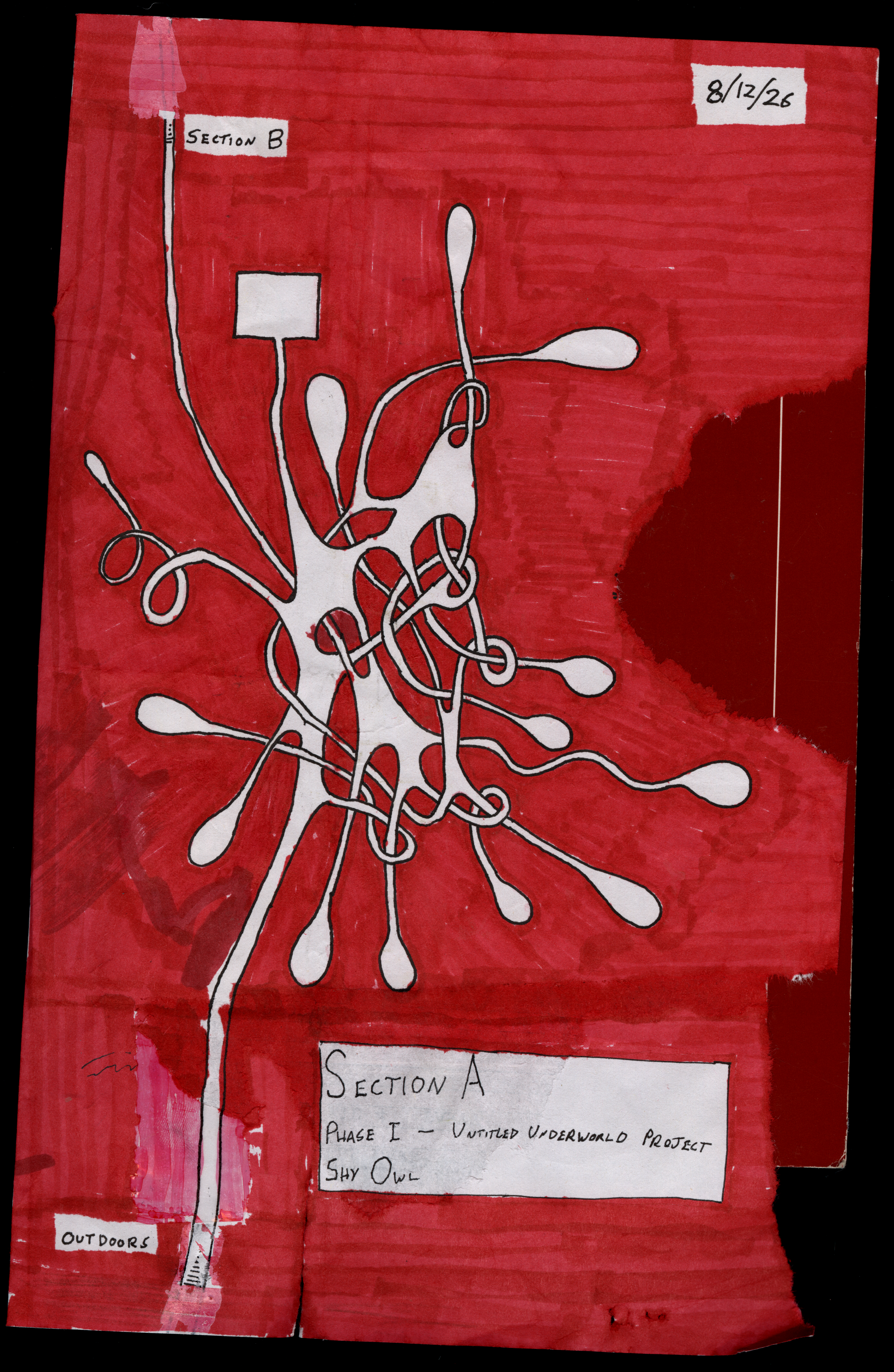
Shy Owl’s map of Section A, for the first phase.
The basic premise of UUP is that it’s a succession fort, but for pen-and-paper underworlds. Each participant in UUP is caretaker of a dungeon section for a period of months, and while it is in their care the participant has full creative control over that section: mapping, keying, running game sessions, writing fiction, composing laws, developing rules systems, re-stocking, simulating, editing, revising, censoring, updating, retrofitting, preserving, letting go stale, whatever.
At the end of the phase, the section gets handed to someone else, who will themselves have full creative control. The idea is that it’s a growing and living corpus of dungeon-making, a collage of creative styles and aims: a living document. (to use a tired but useful phrase)
UPP is inspired by the authority Microscope gives its players over objects in events and periods (near total control) and the iterative-patchwork qualities of Jerry Gretzinger’s Map.
Phases are 3 months. It’s a long and gently paced project. My projected lifespan for the project is maybe 5 years or so; lots of time.
Being a caretaker for one phase shouldn’t commit someone to caretakership for any other phase, and also it’s not necessarily incumbent on participants to “produce” a great deal. It will be good for regions of the underworld to be dormant or slow-altering.
Untitled Underworld Project is open for new participants! Reach out to me if you’d like to claim a section. I suppose my capacity for managing is about 20-30 or so.
Thursday, September 10, 2026
Amoeba D&D — Slime Mold
Awed by the genius of Warenunförmig’s Ocean D&D, I present the burgeoning and mucusy aggregation of a new game, also like Dungeons and Dragons, but different.
Behold Amoeba D&D (AD&D)!
In AD&D, players assume the role of microbes in some fantastic environment. XP is granted for consuming food (often bacteria), and the microbes can go on whatever adventures they wish. The world is quite large when you are very small.
The first class of this new D&D game (and all that exists so far) is the Slime Mold. I present a first draft here, untested and unrefined.

At levels 1-4, a Slime Mold can asexually reproduce, dividing itself into two equal amoeba with ½ experience points. These amoeba function independently, but may be under the control of the player.
At any time, if the sum of the xp of Slime Mold’s is between 15000 and 29999, the bodies can permanently form together to become a Grex, a slug which moves twice as fast.
The final stages of the Slime Mold, Sorocarp and Sporangium are stationary, as the mold builds a towering structure in order to disperse its spores. This is perhaps analogous to a castle in D&D.

Exhortation
All small things owe themselves to Ido, Lord of Microbes. Slime Molds can urge happenings by appealing to Ido. These are called Exhortations, because the slime mold exhorts the world to do something.
Predict Future
Solve Maze
Traverse Tremendous Distance
Resist Fire
Frighten Beetles
Operate Machinery
Farm Bacteria
Interpret Signs
Thursday, June 18, 2026
Marathon Nomic Game Report
For some reason I’m having a tremendous amount of writer’s block for analytical writing, so for this report I’ll stick to the facts. Perhaps I’ll add a retrospective later.

Marathon Nomic ran for 24 straight hours, from 19:01 UTC June 13th to 19:01 UTC June 14th. With 7 total playing participants there were 94 proposed changes to the rules. 50 proposals passed, with a total of 53 individual rule-changes and a pass rate of 53%. The initial 31-rule ruleset ballooned to ω by the end thanks to an infinite rule-duplication mechanic, though if you discount those the ruleset ended with 46 rules (18 immutable, 28 mutable).
It produced 6 winners and 1 Chosen Champion of Chaos. One team was formed and disbanded, the Hunter Wyverns.
(For the best sense of the game, look at the Proposal Record first!)
—
All in all Marathon Nomic was a success! 94 turns is a lot of Nomic! Thanks to all who participated. I probably won’t do another one of these.
Wednesday, April 29, 2026
Additional Treasure Categories
“Our first assignment—“
“Our, that’d be… me and you.”
“—will be to locate and restore to its owner a somewhat tasteless lamp, indeed among lamp collectors considered the crown jewel of tasteless lamps, a lamp so stupefyingly tasteless it makes nonsense of the tasteless lamp category itself. Too horribly tasteless ever to have been photographed. Cameras break, eyeglass prescriptions are drastically rewritten, crowds of spectators run screaming out of exits they then get jammed up in. Tasteless Lamp Quarterly runs out of space to contain the overflow of readers’ indignation. How tasteless it is, this lamp, known in underworld Esperanto as La Lampo Plaj Malbongusto.Through some perverse law of secondary markets, the more vehemently denounced, the more valuable it has become….”
—Thomas Pynchon, Shadow Ticket
In addition to the OD&D treasure categories of Copper, Silver, Gold, Gems, Jewelry, Magic, and Maps, here are new categories, to be assigned a percentage-chance in each treasure type and level.
Beneath each category are subcategories and example, which may be ignored, picked, or determined randomly.
Note that what is listed here is treasure, not mere goods. Every Orc outpost will of course be stocked with ordinary coffee, but the Coffee treasure subcategory indicates coffees of great value.
Ideally each category will have its own table, but in a pinch the jewelry and gem GP values can be used. Sometimes the value will be apparent to only a select few, and many treasures are not easily liquidated.
Comestibles
Cocktails or liquors
Delicacies
Cheeses
Eggs
Spices, herbs, powders
Teas and coffee
Drugs or medicine
Tobacco
Candy and sweets
Collectibles
Rare coins
Stamps
Baseball cards
Nick-knacks
Displayables
Pottery, silverware, china
Sculptures or art installations
Furniture
Statuettes
Appliances (lamps, refrigerators, etc.)
Wearables
Clothes, costumes, accessories
Hats
Wigs, false mustaches, toupee
Makeup, creams, gels, and soaps
Intellectual
Poems
Folk songs or stories
Systems of philosophy
Mathematical proofs
Names
Recipes
Secrets
News
Languages
Infohazard (“the funniest joke in the world”, etc)
Prophecies
Paper
Books
Paintings
Drawings
Prints
Non-treasure maps
Photographs
Historical documents or records
Contracts, bonds, deeds, other legal documents
Playing cards
Non-material
Friends
Sights to see
Employment opportunities
Self realization or actualization
Political office, religious title, or other bestowed role
Awards, accolades, monikers, nicknames
Devices
Hard-to-find spare parts/gizmos
Timepieces: watches, clocks, hourglasses, sundials
Keys
Boxes, bags, jars, containers
Musical instruments
Writing utensils
Beads, marbles, and jacks
Chance
Biological
Animals—pets
Animals—work
Organs and body parts
Bones, skins, teeth, claws, or fingernails
Relics
Hair or feathers
Stuffed or preserved specimens
Living plants
Diseases
Environmental Samples
Rocks/minerals
Water
Air or gasses
Isotopes
Materials
Chemicals
Textiles
Plastics
Foodstuffs
Ores or soils
Equipment
From equipment lists
High technology, etc.
Machinery
Radio transmitters
Computers
Microfilm readers
Printing presses
Lathes
Ovens
Vats
Potions/Scrolls
Potions
Scrolls
Artifacts
—————–
Here is a generator for these categories, with a distribution that seemed decent: https://chartopia.d1 … ev.com/chart/120948/
Print version: https://chartopia.d1 … /chart/120948/print/
And here is an example generator for OD&D Underworld Treasure Level 5, with Additional Categories appearing with a 25% chance: https://chartopia.d1 … ev.com/chart/114820/
Sunday, February 8, 2026
The Mapping Game — Conventional Dungeon Paradigm
Last night I threw together a little game brainstormed with Idraluna I’m calling The Mapping Game–CDP. Like a lot of OSR (and other) projects, it’s mainly D&D but with certain aspects emphasized. Other games de-emphasize mapping in favor of roleplaying, combat, or logistics. The Mapping Game–CDP de-emphasizes those three in favor of the almighty map.
It’s a simple game and has not been playtested, so YMMV. In any case I’m happy with the proof of concept, and may try it out soon on my underworld maps.
Link to PDF here: The Mapping Game — Conventional Dungeon Paradigm Edition
Idraluna has posted about some of the other ideas we had here.
