Thursday, February 5, 2026
Defunct Dungeon Map — A Brief Autopsy
Here is a map of what was an underworld level in my OD&D campaign Redux. It was my second attempt at filling an empty space below the Level EPSILON. As I am currently working on a third attempt, I have decided to retire this map. I’ve never really been satisfied with it, honestly.
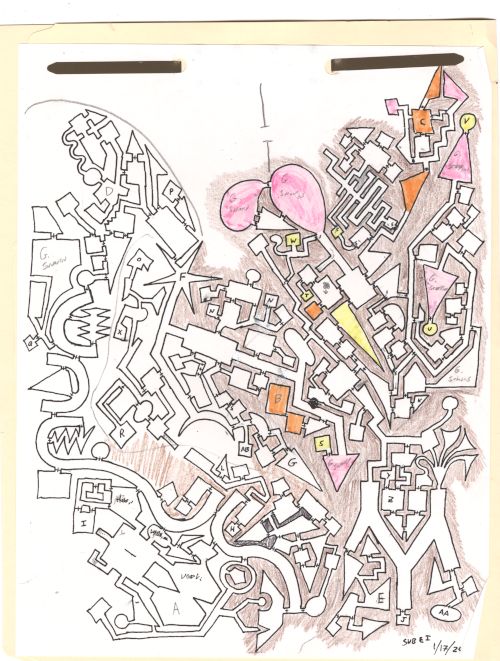
My main problem with this map is that it doesn’t have any striking or defining features. It’s just a bunch of rooms and hallways strung together. While some of these have interesting shapes, and work together locally, nothing in this map leaps out as central, evocative or adventure-worthy. It is a stringy, linear, mess. What is there to do in this map? Go from room to room, pretty much. It feels monotonous to me, lacks a certain spark. Despite having many areas, there aren’t many places to go. I had tried to fix this problem by incorporating several little lairs. Each lair is accessed by a single choke point, however, so the adventure stops there.
Linearity and dead-ends aren’t universally bad dungeon design or anything, though, so why do I have such a problem with it here? I think in part it’s because movement through this map never feels intentional. In a more open layout, movement is intentional because the party has to choose to go in one direction or another. In a well-structured linear map, movement is intentional like a funnel: the structure is driving the party forward, and they can either choose to acquiesce to its meanderings or turn back. Here, the level is neither open enough to allow for strong choices nor intentional enough to draw players forward. Pursuing linearity here does not bring the characters deeper and deeper, into the dread and gloom, it simply takes them vaguely around.
This level has depth in that many of its rooms are stuck behind other rooms, but there is no consistency and little drama. Consider room R or room G–what is there to do but keep going forwards until you inevitably run into them? Perhaps what this map actually needs is more dead-ends–red herrings to force a choice one way or another. Perhaps the balance could be made up for in particularly nasty traps or the like. On the other hand, connecting some of the areas to make satisfying loops would open things up a bit. Perhaps adding some big, domineering rooms as hubs.
Drawing wise, the map is uninspiring. The scale is off in many places. Some of my best maps have been drawn on blank paper; this isn’t one of them. Most of the hallways are supposed to be ~10′ (with a few 20′and 30′ thrown in.) In practice, the map is out of joint with itself. An underdiscussed part of mapmaking is what kind of gestalt experience is evoked in the map reader. This experience can make or break high-stakes creative decisionmaking, which is quite important for D&D. For this map, I find it very flat and blah.
This map never saw much action, thankfully. Once a group dipped a toe in but were quickly chased out by a some Heroes. Perhaps more exploration would have made me more fond of it, but honestly I’m glad none of my players had to slog through it.
Still, this is a completed map–there are lots of little rooms to find. At any rate there’s a lot of space here. I had hoped to stock the place full of exciting contents and call it good–the words “extravagant” and “elegant” are scrawled at the top of the key–I wanted to pick lurid, stifling, incense-and-tapestry vibes. I wanted ancient, shimmering blobs of disused goblets. I wanted the smell of old pillows, faded velvet, fuzz, tarnished silver and brass. What I got instead was writers block. It just doesn’t fit into my dungeon in the way I hoped.
For now, I will place this map into my “old” folder and replace it with something new and bigger. Maybe one day I’ll return and find a use for it. If you are reading this and would like to try your hand at keying or adapting it, please do so and send me what you come up with! (As with everything I post on my blog, you are welcome to use it in your own game, but please do not publish it as your own or feed it to an AI. You are not my friend if you do either of these.)
Saturday, January 31, 2026
Records Requests — How its Going
Here’s how it works: any character, at any time, can submit a Records Request Form to an institution or individual in the world.
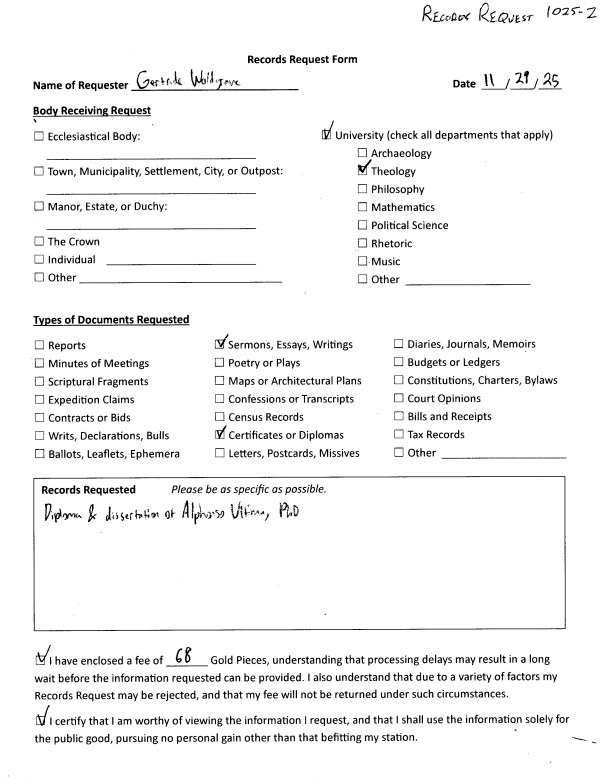
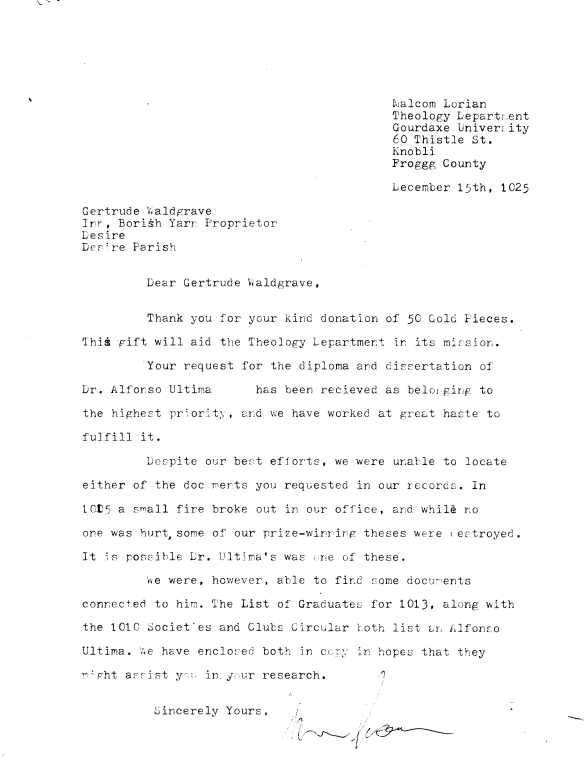
After several weeks the character gets the fulfilled request in the mail. Depending on the amount of gold paid for the fee and the nature of the request the documents received may be useful or not. I post the fulfilled records requests on the campaign website for anyone to view: https://www.reduxodnd.com/records/
The documents mostly answer questions obliquely; they are archival records for the most part, produced for reasons other than adventuring. They are artifacts of a society which exists outside of the adventurers, one full of people who do not know and will never care about player characters. Players have to ask carefully and read carefully to find information they want, and it might not be there at all.
Records Requests in the real world aren’t nearly so fun to fulfill, but here I get to pick out exactly which sorts of documents “exist” meeting the criteria laid out in the form. I can be snarky or evasive, abstruse or helpful to my hearts content. I can sprinkle hints and red herrings, and there’s lots of room to be utterly ridiculous.
I don’t like explaining my world’s lore very much. I’m much more interested in how players react to my world than I am in rambling on and on about it. (What horror stories have been told of DMs for whom a D&D session is a long droning History of Place!) One could break up the lore into multiple conversations with various NPCs, but that’s fairly boring to me as well. Just droning in funny voices instead.
Records Requests let me make a little piece of world information–often quite small–and toss it to players like a hot potato. The players get a tangible document that’s immediately actionable, and I don’t have to worry about it after that.
OD&D can be thought of as several different games working together. There is The Mapping Game (Underworld flavored and Wilderness flavored), The Talking Game, and The Fighting Simulation Game:– Records Requests constitute part of The Paperwork Game. In The Paperwork Game the world is explored through mock bureaucracy. Other components of the Paperwork Game include drawing up plans for your castle, logistics accounting, letters, declarations of war and such, as well as contracts, claims, lawsuits, and so on.
An obvious problem with this practice is managing the volume: can I keep up with producing all the records which are produced in a timely manner? Dungeons and Dragons already takes up a tremendous amount of my time, and writing these documents is quite slow, slower than drawing maps or stocking rooms. There is also greater pressure to get them “right”.
On the other hand, documents will stick around. After a while there’ll be a big corpus of them, each one continuing to make my world rich and navigable. I have been playing with Records Requests for 3 months, and there are about 30 pages of written material. This isn’t a bad start. The material I’ve written has in fact been really helpful in my own understanding of the world, it’s social systems and how it approaches problems.
I have been struggling with finding ways to “pick” documents or document types which 1) are fun to write, 2) are at least somewhat connected to the request, and 3) can be written in a reasonable amount of time. With any kind of game it takes a while to get a feel for things; maybe I’ll get a knack for it as the process continues. If there’s a request for a copy of a novel, for instance, I won’t feel all that obligated to write a whole novel, but I may settle on a review.
There is a sweet spot of verisimilitude I am aiming for with these documents–I’m not doing the full “tea-stained treasure map” document forgery, but I am composing them on a typewriter in a formal style.
You could, perhaps, set up a whole game that’s just records requests and the correspondence between them, but I will leave discussing The Imaginary Historian’s Society for another time.
