Monday, May 18, 2026
Politician - Realm of Yolmi Class
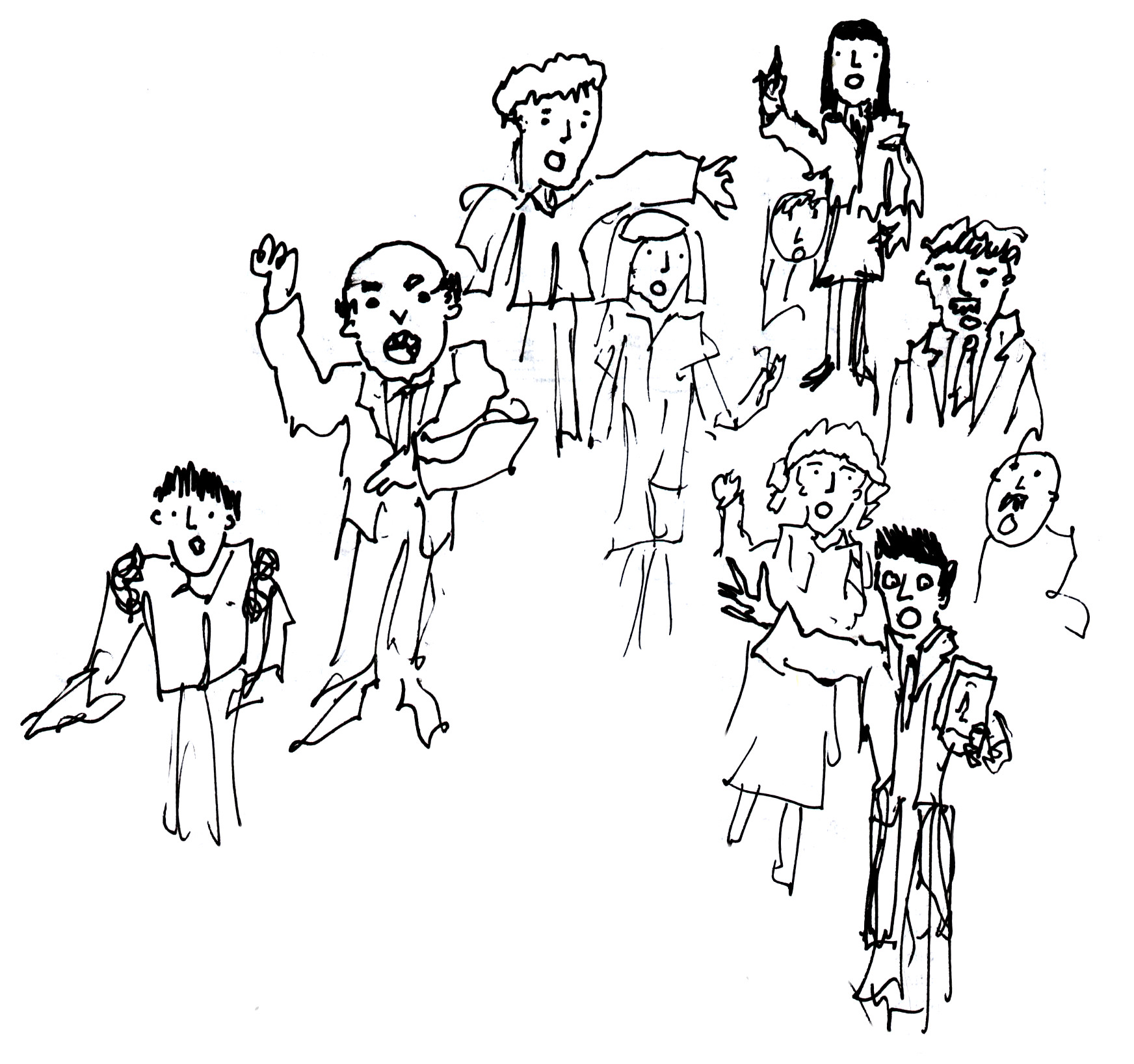
Here is a new class for The Realm of Yolmi. Usually I like my games to have very few classes, but this was fun to make and I think it fits with the vibe. Like Soldiers and Scientists, this class also appears in the creature encounter lists.
Politicians
Politicians have a +20% for all initial creature reaction rolls (though not subsequent ones). This stacks with Personality modifiers, but parties with more than one politician only get the 20% once.
They can employ rhetoric to convince any moderately attentive listeners of any policy position, which succeeds 10% of the time and takes 1 day.
They can use no weapons and wear no armor.
| Level | Name | X.P. Required | Election | Re-Election |
|---|---|---|---|---|
| 1 | Dog Catcher | 0 | - | 70% |
| 2 | Mayor | 1000 | 60% | 65% |
| 3 | Comptroller | 2000 | 50% | 60% |
| 4 | Superintendent | 3000 | 40% | 50% |
| 5 | Attorney General | 4000 | 30% | 55% |
| 6 | Governor | 5000 | 25% | 50% |
| 7 | Representative | 6000 | 20% | 50% |
| 8 | Senator | 7000 | 15% | 40% |
| 9 | Judge | 8000 | 10% | 35% |
| 10 | Vice President | 9000 | 05% | -25% |
| 11 | President, 11th | 10000 | 01% | 25% |
| 12 | President, 12th | 11000 | Re-elected only | -50% |
Presidents above 13th level are re-elected with -70%, 14th with -90%, etc.
Politicians use d6-1 for hit dice, maximum level 10. +2 hp beyond level 10.
Politicians do not achieve higher levels automatically: they must be elected. A politician may attempt to be elected to any higher position if they have the required experience. Elections are modified by the prime requisite % bonus or penalty for the politician’s Personality. If a politician fails to win an election for a particular position, they may try again at a -10% penalty for each previous attempt.
There is a 10% chance each month that a politician’s term is ending, and they must choose to either be elected to a higher position or be re-elected at their current position. Otherwise their political life will be over and they must retire.
Each time a politician is re-elected, the chance of being re-elected again in that position is modified by -10%.
In addition to Personality, election success can be modified by the following activities:
| Activity | Benefit | Cost | Max # |
|---|---|---|---|
| Campaign Posters | 10% | 1d6 * 1000r | 1 |
| Endorsements | 2% * level of politician endorser | Variable | None |
| Speaking Tour | 5% | 3000r | 3 |
| AM Radio | 10% | 2d4 * 2000r | 4 |
| Election Rigging | 20%-80% | 2d4 * 10000r | 1 |
| Public Debate | -50% to 50% modified by raw Personality | None | 2 |
Lobbyists with deep pockets will of course be happy to assist politicians with any of these expenses.
Various political offices will have benefits by virtue of their station: Presidents will be the Commander in Chief of any military encountered 60% of the time; Vice Presidents become Presidents if one dies, Mayors can bestow keys to population centers, Representatives can introduce legislation, etc.
Tuesday, May 12, 2026
Schoolwork
When simulations fail, we lay our hopes at the feet of metaphor.
And metaphor is no thing at all, only an illusion peddled by foolish people lacking the stamina to see things as they are.
To metaphor we sacrifice perceptions out of vain conviction they will be reborn as truths. We slay substance for effervescence, mistaken for essence. Metaphor is all sparkle, only glimmer, mere gleam–gold paint slopped carelessly upon delicate reality. Ostensibly of course done to protect reality—to emphasize its salient aspects—but everyone knows metaphor is garish and spiritually bleak. Only out of fear, fear of true meaning do we cling to the notion.
To gaze upon the face of the world is to gaze into the face of God: infinite and almighty Being. Doing so will ruin us. We know it will ruin us, which is why we invented philosophy and science to cushion the blow: measuring out truth in drips and drams ‘til we work up a tolerance.
—
The problem with metaphor is not that it claims too much, but that it accounts for too little.
Metaphor-mongers insist there is revelation in the differences between similar objects. But to do this they must hold apart pieces of the world, claiming the world as incommensurable with itself, maintaining artificial dichotomies. For metaphor to work you have to deny the fabric of the world, and this is too great a sacrifice.
The hard reality is that things are indeed literally other things. Mathematicians know this. Poets know it, too. Beauty is sharp-edged and ungainly, terrifying beyond belief.
And so the metaphorists try to soften the world, make jelly of human experience. They sneer at absurdities as only illustrating a point. Their toothless arguments they celebrate for the sake of being simulacra. Their aesthetic senses are gooey, murky messes. They applaud seeming as delightfully untrue, and refuse to consider the scary possibility that it might really be. As if shadows were the things worth thinking about.
What a bunch of hogwash. Discard it. The metaphorical is a bankrupt concept: useless, saccharine, and ugly.
Thursday, May 7, 2026
Homework
When you no longer believe in metaphor, all that’s left is simulation.
What happens when the sparkles of clever allusion grow dim, when resonance tends shallow, and the waters of shared cultural familiarity show signs of drought? How can we proceed through the desert, for who knows how long, until we reach the oasis of the next shared cultural moment?
To persevere through such perils games have developed Simulationism, a method for carrying on despite madness and incoherence, maugre flagging zeal, irrespective of creative famine. A simulation continues to tell you what happens next long after excitement has let out its last gasp.
Simulation sustains faith that an imagined place can correspond to a real one. It justifies the experience of wonder we sometimes get in glimmers and glances. Simulation lets us maintain our toys without having to moor them so directly to our psyche, protected from hurricanes of moodiness and earthquakes of self-doubt.
But simulation comes at a cost. It is a simple cost, no more than is fitting. The cost of simulation is making the imaginary real through time and labor. The debt can be paid in one of two ways: Counting or Scale.
To counting belong dice and statistics, models, maps, and scientific expertise. To scale belong big groups of players, swathes of literature, and so on. Expenses pile up, and have a knack of compounding with interest.
Physical and mental limitations will conspire against simulations eventually, not because there is too little, but because there is too much. There is only so far simulation can take us before collapsing under the weight of its own success into burnout.
We must hope, then, that before this happens a new oasis will have been found, another wellspring of spontaneous connective fantasy delight.
When simulations fail, we lay our hopes at the feet of metaphor.
Tuesday, May 5, 2026
Nomic and Material-Procedural Play
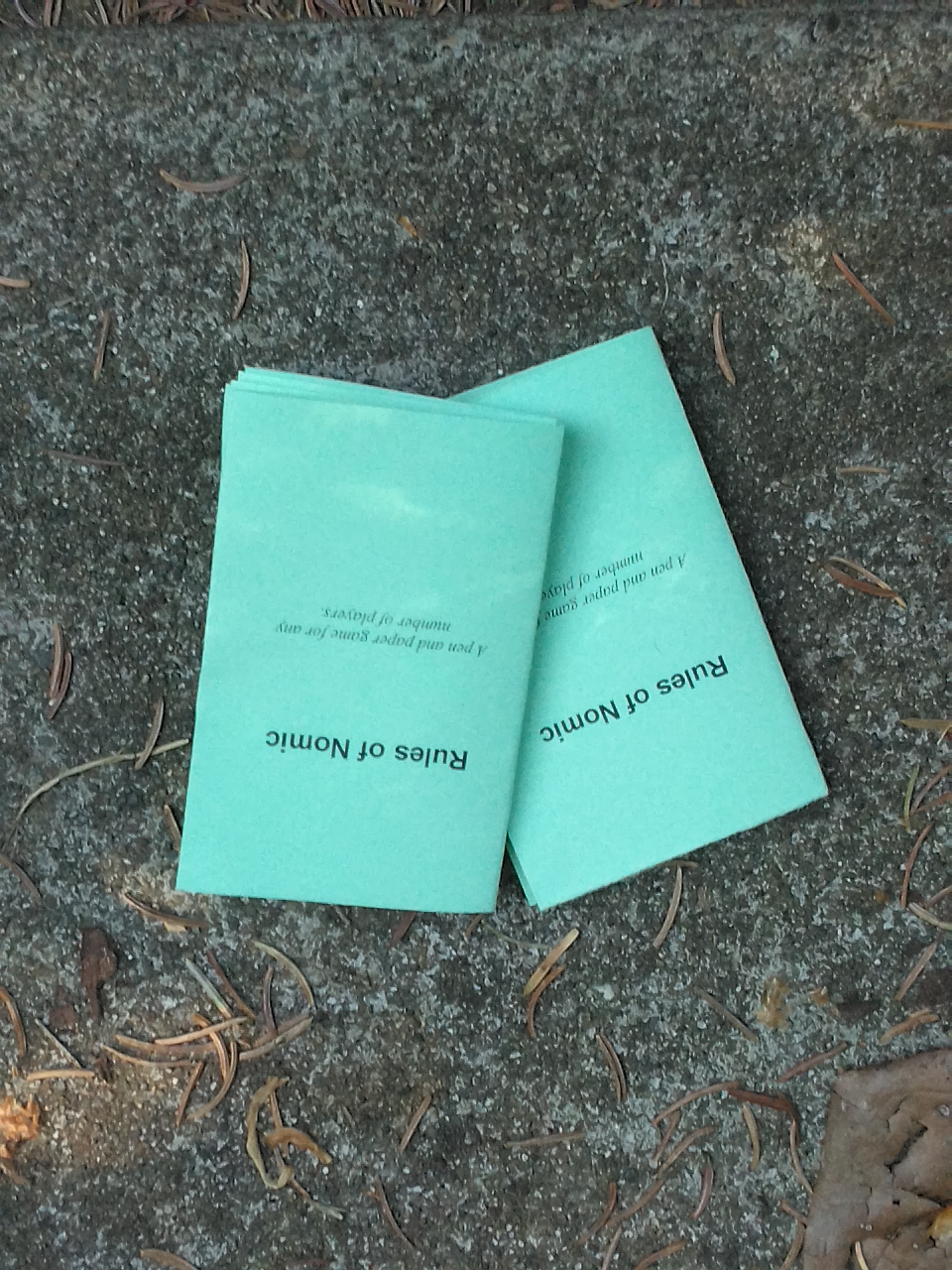
Anyone who talks to me about games hears about Nomic sooner or later. I bring it up all over the place, in any conversation having to do with rules as such. My excitement over Nomic—this zeal for letting people know about Peter Suber’s fabulous little game—approaches proselytism, even. I make Nomic zines and leave them places to be found like religious tracts.
What’s so special about Appendix 3 of a dreary philosophy book which navel-gazingly investigates paradoxical legal self-reference? How do those 5 pages of awkward and stringent voting rules relate to the OSR, a movement which, famously, likes to keep things loose?
Nomic presents a conception of games which I find convincing and beautiful. It seems to teach that games are fundamentally procedural and necessarily material, even (or especially) those which rely upon imagination and goodwill to function.
I have seen Nomic inspire investment in its participants more immediately and intensely than in any other game. This is fun to experience, of course, but it is also instructive about what play is and can be. Frankly, Nomic is easier to play than D&D. It has no prep, requires fewer assumptions, and gets interesting more quickly.
—————————————————————————–
On first glance Nomic is a “play however you want” sort of game: the purest implementation of that unbounded and limitless creative freedom which we say we appreciate in tabletop game spaces. Like D&D, anything can be achieved in Nomic. There is no hard limit to player agency. We all like those kinds of games, at least in principle. But Nomic is more than this.
The short-form description of Nomic most commonly deployed, “A game where players vote on what the rules should be” is not inaccurate, but it can be misleading. Nomic is not a game where players decide upon the rules, but one where players must follow rules procedures to change them.
Initially, for instance, even unanimous agreement is insufficient to make arbitrary changes to the Nomic ruleset. At least two separate unanimous votes spread across two turns are necessary to amend most rules. And unanimous consent is difficult to secure even for popular rule-change proposals, even for players disposed towards friendship: the most points are awarded to players who vote against winning proposals. Very often players want very badly for a proposal to pass, campaign for it, promise they will vote for it, and then vote against it anyway.
Rather than the limitless freedom of full malleability, Nomic gives players the experience of rebuilding a plane while they are flying it – the players are stuck within its structure and must work together against the ruleset to get anywhere at all.
Players win by achieving 100 points. Since each turn a player is compelled to submit a proposal, and each time a proposal fails they are penalized 10 points, players must propose popular rule-changes to make any progress. Nomic is strange in that it is an extraordinarily low trust game which also depends upon rule mutability.
Of course, the players could fairly easily decide to abandon the low trust aspects, doing away with winning entirely. With enough political will anything is possible. What’s key here, though, it that that decision would be a play decision: it would already be a series of moves within the game. All that convincing, the calling upon shared trust, the promises of creative flourishing without threats of victory, all of these actions would be playing Nomic, as strategic and defined by the rules as any other moves.
The gameplay of Nomic takes place entirely within the real world. Immersion comes from investment in things players are actually doing. So much of the game is discussing — through the medium of the game — what the game should be. It is constantly “almost there”, just about in a state where the main problems are fixed and play can continue smoothly. The solutions are always one or two turns away.
Invariably things drag. Players come to the table with different goals which must be sorted out and negotiated. The process of actually writing up sensible rules-text is a task all its own, vulnerable to all sorts of oversights, errors, and vagaries. Actually voting is, as I’ve said, subject to incentive structures and other procedural hangups.
So patient struggle is the substance of Nomic: being in a space with my fellow players trying to negotiate ourselves out of the present situation. The possibilities are endless and delightful, not because of frictionless liberty, but because of the elaborate friction-full texture that emerges from written procedures, physical realities, and human minds all trying to operate at tension with one another.
The boundaries that make Nomic a game are emergent from the situation at hand. Nomic shows that play happens in the fringes between possibility and activity. Games are a substantive gamestate and processes for altering this gamestate.
I have found myself paying closer attention to the actual physical and social processes going on in other games. I enjoy them more. The ordinary procedures like taking out the board and setting up the pieces, parsing a poorly written rules-passage, waiting for a late player to arrive–all of these things are play, all already the game. This activity is about process and the surprises that come from taking ridiculous processes seriously.
So anyway you should play Nomic. I may set up a game soon.
Saturday, May 2, 2026
Yolmi Illustrations 1
Furthering Yolmiposting, here are some illustrations based on the monster descriptions in The Realm of Yolmi. These drawings are frankly not at all what I first envisioned when I read the descriptions, but they seem to be what’s come out of me trying to draw them. A fun exercise, whether or not these drawings become canon to my imagination.
See also Yolmi Illustrations 2.
Ke
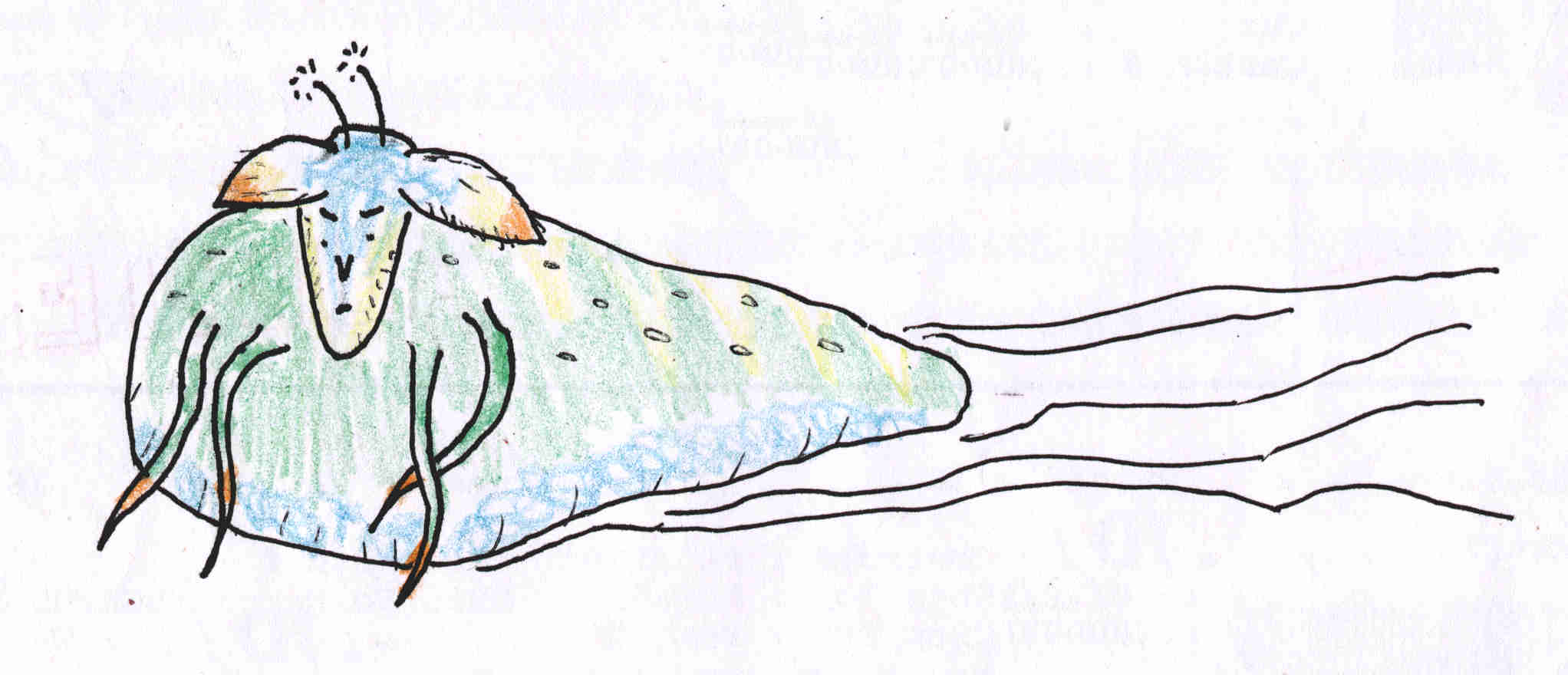
Move: 2”
Creatures with a horrible disposition who spit quik-glue which roots one to the ground and attracts lightning half the time. If asked what the substance is, they will reply it is merely tree sap and conclude in laughter. - p. 50
Ki
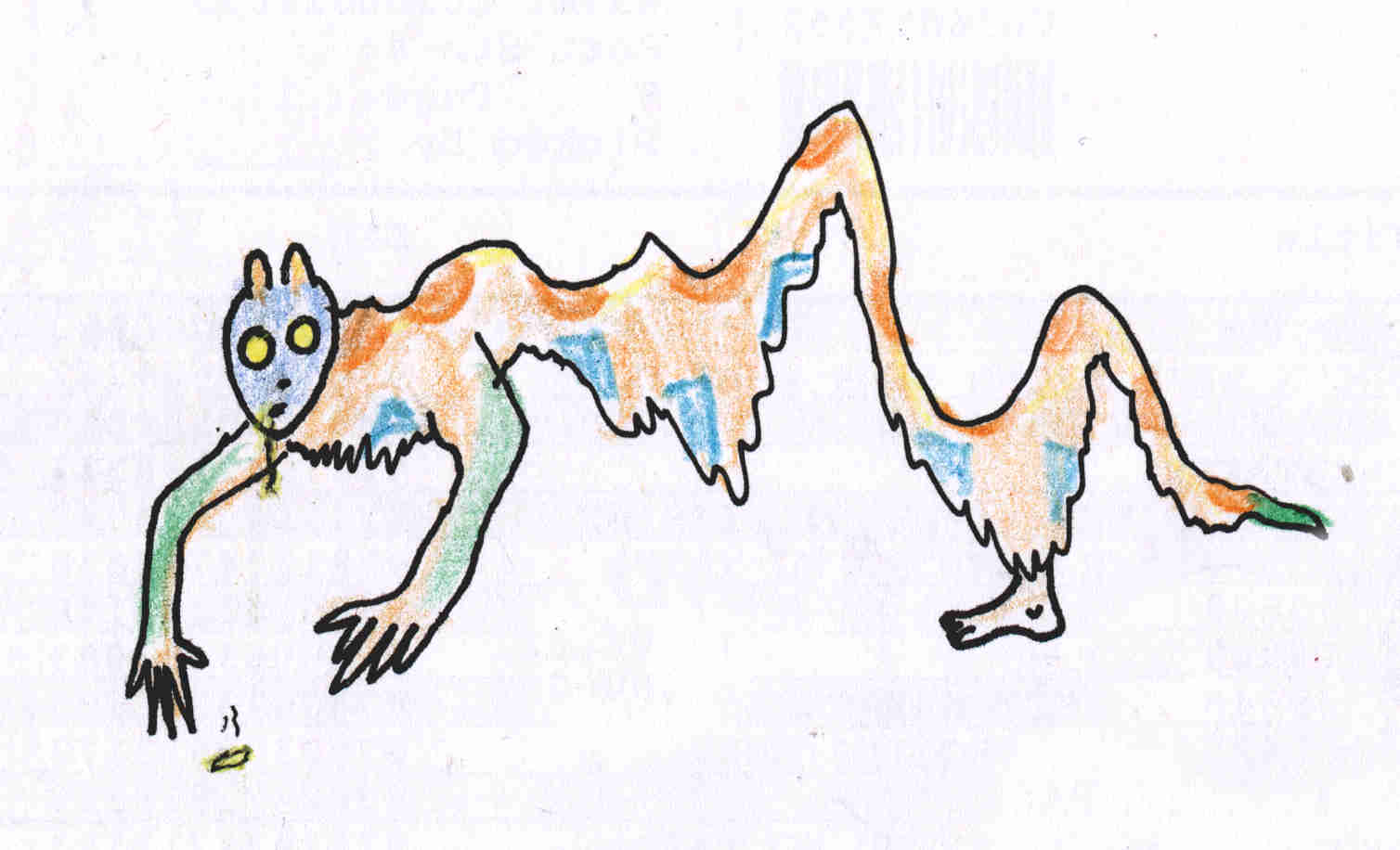
Move: 3”
Akin to the Ke, these creatures spit caustic acid up to a range of 20”. When asked what the substance is, they will laugh and say it is in the imagination. Only the most gauche of Adventurers will be fooled, however, because the substance smells strongly of sulphur. - p. 50
Reakles
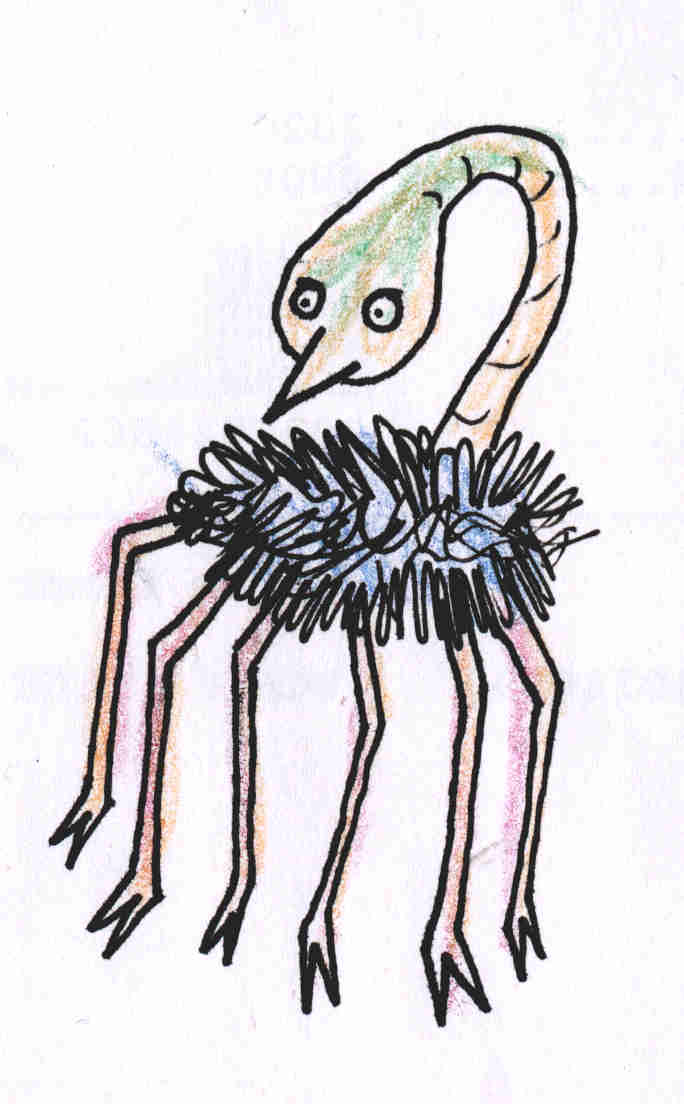
Move: 15”
These moth-brained, ostrich-like creatures are incredibly stupid. In fact, when attacked they feel they must have been naughty; otherwise, why would they be attacked. Consequently they will kill themselves. If simply spoken to they will break off their leg as “punishment.” - p. 50
Regik
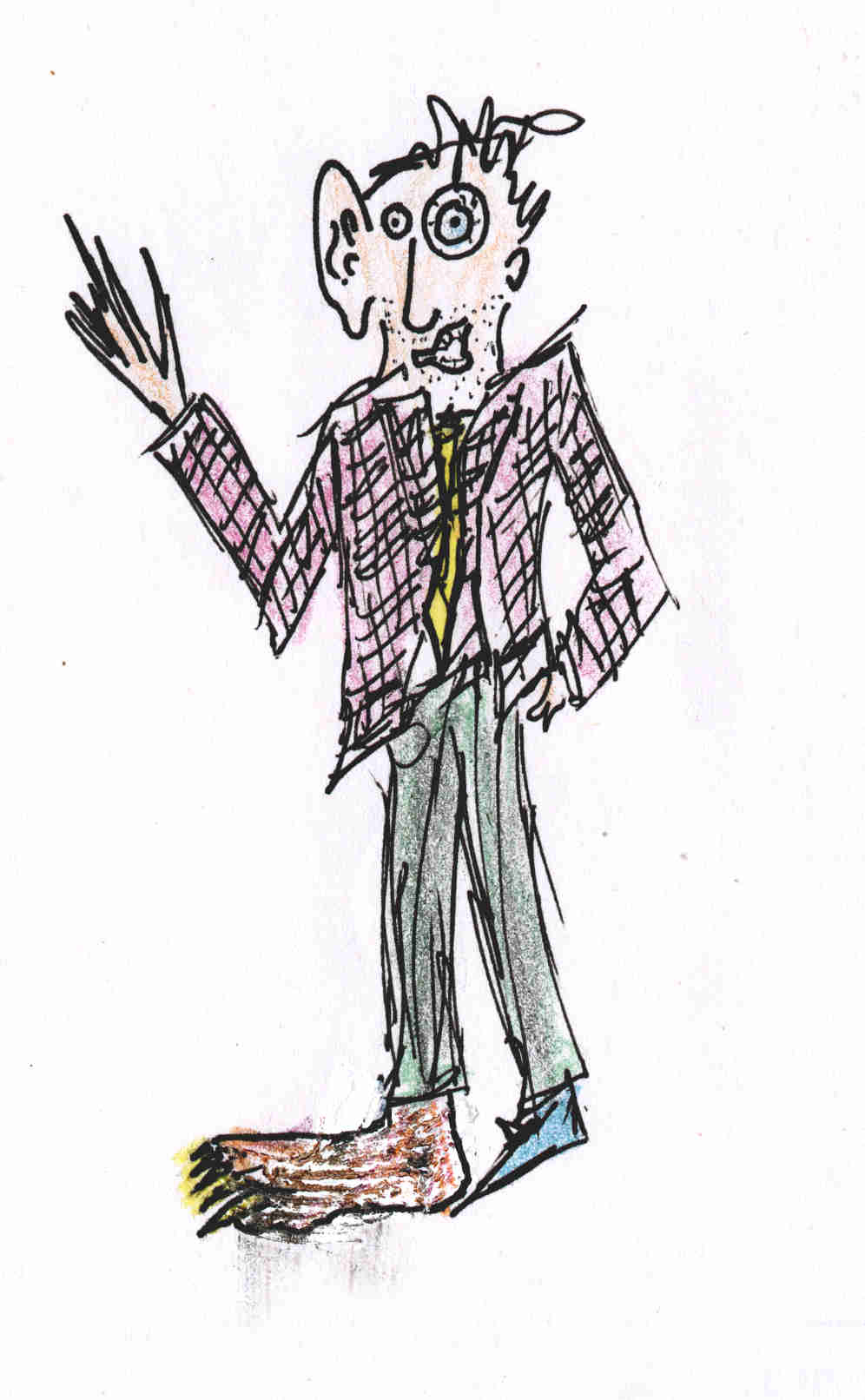
Move: 6”
These creatures used to be Used Car Salesmen. Any one they encounter will be subject to a long sales pitch and unless the prospect buys a totally worthless car for over 6000 Rupniks, the Regik will go mad, singing meaningless songs and kick the prospect in the head. - p. 50
Simul
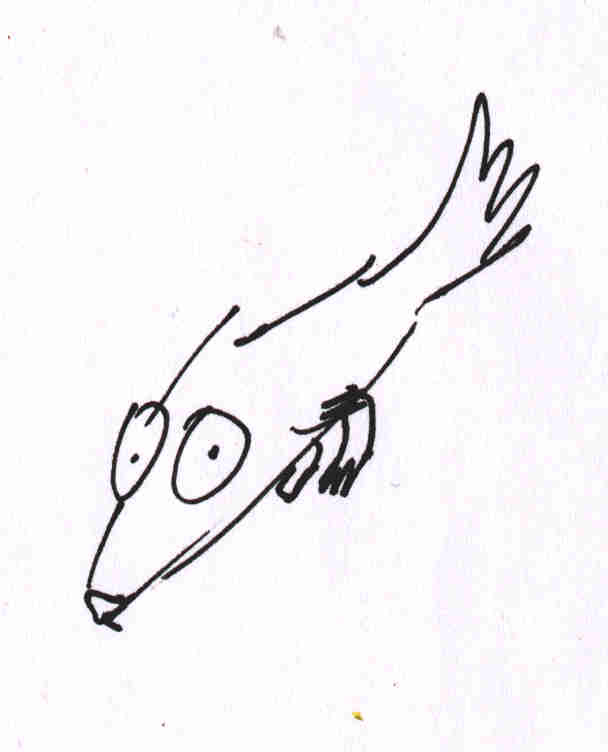
Move: 12”
These are fish with feet. They are eager to please and will instantly change appearance to anything the Adventurer is thinking of. Alas, when touched, they revert. - p. 51
What I’m Reading
Plastic, Prism, Void
Violet Allen
Tear Gas
by Anna Feigenbaum

Master and Commander
Patrick O’Brian