Tuesday, May 5, 2026
Nomic and Material-Procedural Play
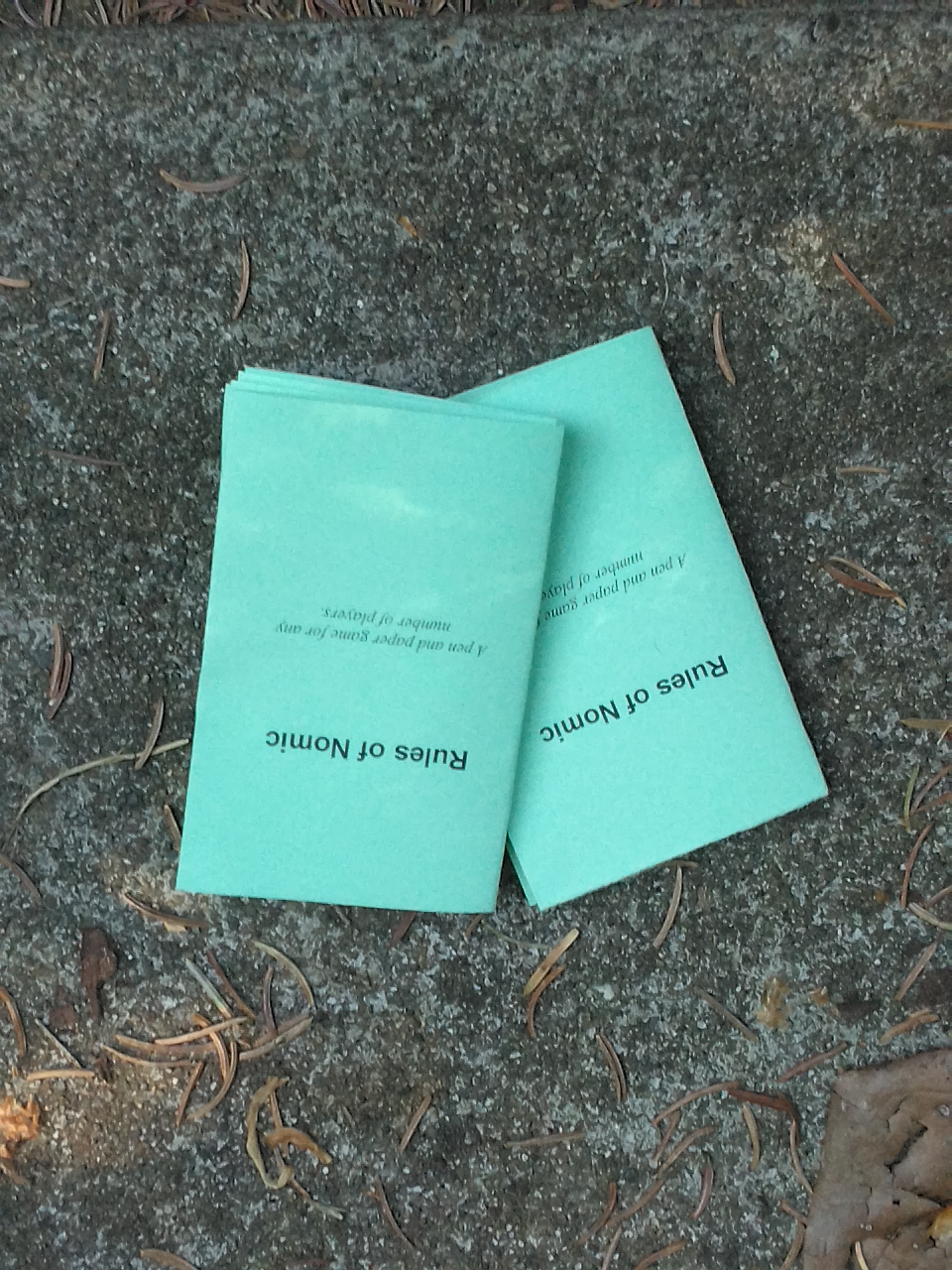
Anyone who talks to me about games hears about Nomic sooner or later. I bring it up all over the place, in any conversation having to do with rules as such. My excitement over Nomic—this zeal for letting people know about Peter Suber’s fabulous little game—approaches proselytism, even. I make Nomic zines and leave them places to be found like religious tracts.
What’s so special about Appendix 3 of a dreary philosophy book which navel-gazingly investigates paradoxical legal self-reference? How do those 5 pages of awkward and stringent voting rules relate to the OSR, a movement which, famously, likes to keep things loose?
Nomic presents a conception of games which I find convincing and beautiful. It seems to teach that games are fundamentally procedural and necessarily material, even (or especially) those which rely upon imagination and goodwill to function.
I have seen Nomic inspire investment in its participants more immediately and intensely than in any other game. This is fun to experience, of course, but it is also instructive about what play is and can be. Frankly, Nomic is easier to play than D&D. It has no prep, requires fewer assumptions, and gets interesting more quickly.
—————————————————————————–
On first glance Nomic is a “play however you want” sort of game: the purest implementation of that unbounded and limitless creative freedom which we say we appreciate in tabletop game spaces. Like D&D, anything can be achieved in Nomic. There is no hard limit to player agency. We all like those kinds of games, at least in principle. But Nomic is more than this.
The short-form description of Nomic most commonly deployed, “A game where players vote on what the rules should be” is not inaccurate, but it can be misleading. Nomic is not a game where players decide upon the rules, but one where players must follow rules procedures to change them.
Initially, for instance, even unanimous agreement is insufficient to make arbitrary changes to the Nomic ruleset. At least two separate unanimous votes spread across two turns are necessary to amend most rules. And unanimous consent is difficult to secure even for popular rule-change proposals, even for players disposed towards friendship: the most points are awarded to players who vote against winning proposals. Very often players want very badly for a proposal to pass, campaign for it, promise they will vote for it, and then vote against it anyway.
Rather than the limitless freedom of full malleability, Nomic gives players the experience of rebuilding a plane while they are flying it – the players are stuck within its structure and must work together against the ruleset to get anywhere at all.
Players win by achieving 100 points. Since each turn a player is compelled to submit a proposal, and each time a proposal fails they are penalized 10 points, players must propose popular rule-changes to make any progress. Nomic is strange in that it is an extraordinarily low trust game which also depends upon rule mutability.
Of course, the players could fairly easily decide to abandon the low trust aspects, doing away with winning entirely. With enough political will anything is possible. What’s key here, though, it that that decision would be a play decision: it would already be a series of moves within the game. All that convincing, the calling upon shared trust, the promises of creative flourishing without threats of victory, all of these actions would be playing Nomic, as strategic and defined by the rules as any other moves.
The gameplay of Nomic takes place entirely within the real world. Immersion comes from investment in things players are actually doing. So much of the game is discussing — through the medium of the game — what the game should be. It is constantly “almost there”, just about in a state where the main problems are fixed and play can continue smoothly. The solutions are always one or two turns away.
Invariably things drag. Players come to the table with different goals which must be sorted out and negotiated. The process of actually writing up sensible rules-text is a task all its own, vulnerable to all sorts of oversights, errors, and vagaries. Actually voting is, as I’ve said, subject to incentive structures and other procedural hangups.
So patient struggle is the substance of Nomic: being in a space with my fellow players trying to negotiate ourselves out of the present situation. The possibilities are endless and delightful, not because of frictionless liberty, but because of the elaborate friction-full texture that emerges from written procedures, physical realities, and human minds all trying to operate at tension with one another.
The boundaries that make Nomic a game are emergent from the situation at hand. Nomic shows that play happens in the fringes between possibility and activity. Games are a substantive gamestate and processes for altering this gamestate.
I have found myself paying closer attention to the actual physical and social processes going on in other games. I enjoy them more. The ordinary procedures like taking out the board and setting up the pieces, parsing a poorly written rules-passage, waiting for a late player to arrive–all of these things are play, all already the game. This activity is about process and the surprises that come from taking ridiculous processes seriously.
So anyway you should play Nomic. I may set up a game soon.
Add comment
Fill out the form below to add your own comments
