Thursday, June 18, 2026
Gollie Ghoul’s Garish Garage
Here’s an adventure I wrote for my Extremely Byzantine 5-room Dungeon Jam

Adventure PDF: gggg.pdf
PNG of Map: gggg_map.png
Monday, June 8, 2026
Level Zeta III (-1,0)
Here is a further map of my Redux dungeon–This is Level Zeta III (-1,0), a continuation of level Zeta III.
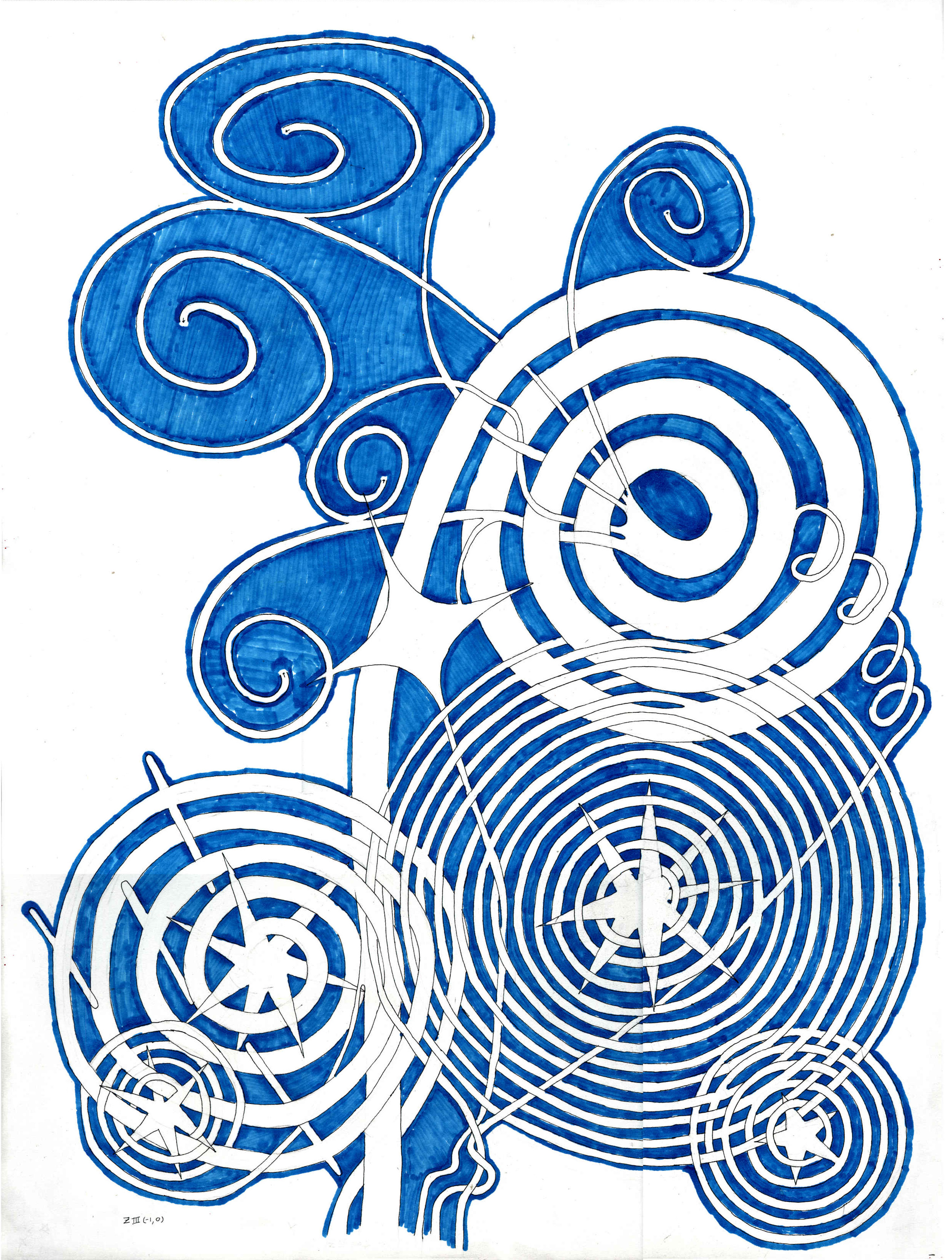
It is located directly north of Zeta III (0,0); here is them bolted together:
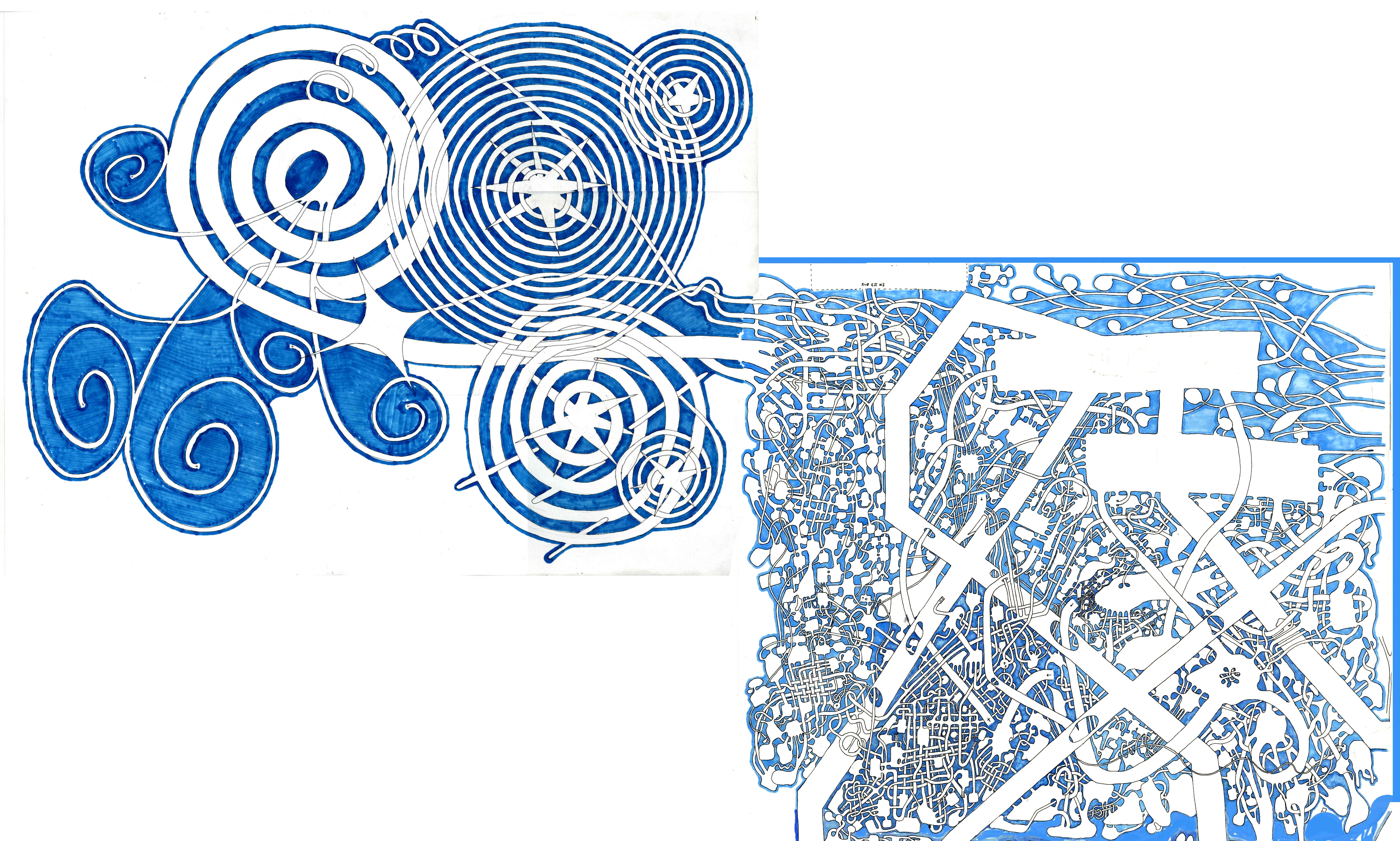
There’s not much to say about this map other than I had the idea and pretty quickly made it happen. I’m happy with most of it, thought the shading kind of falls apart near the top–this is the fault of the alcohol pens I’m using. It took me all of today to draw, which is the fastest I’ve done one of these. Perhaps some of that speed shows up as sloppiness in parts. A good way to spend a Sunday tho.
This map is a little less dense than my usual maps, although no less colossal. You might notice that it only has 5 rooms. A 5 room dungeon is incomplete without a key, so here is one:
The Palace of the Snail Men
(The name was coined by enthusiastic human explorers–of course, the Snail Men do not call it that. Nor do they call themselves “Snail Men”.)
The Snail Men are caretakers and denizens of the treasures here. They are 10-18′ tall snails. The Snail Men are divine beings–to strike their shell while they are living, or to touch it without consent, is death (Save or die). HD 6, Mv. 3”, AC 4 (flesh, shell is invulnerable). They are slow, hitting only 1 in 3 turns. They can retract into their shell and remain so for many months. Number appearing 2-24.
4-pointed star — The Shattered Egg Humperdinck
Humperdinck set up a wall, he did,
and clambered himself upon it.
But as he labored a shale-stone slid
and shatter’d poor Humperdink’s bonnet.
Pieces of the shell still tower 15”, althout all the yolk has long since been sucked dry. A pilgrimage spot for wry nobles and vagrant philosophers.
5-pointed star — Strands of Light
This room is webbed with strands of Pure Light, spun by the Great Spider Uxorlantha nearly 3500 years ago. The room is lightly brit, and one finds themselves full of airy thoughts here. Stealing strands of light is possible, but would be a great crime.
6-pointed star — The þ Toad
The þ Toad is spiky and grumpy and knows everything there is to know about slime and muck. Bring the þ Toad a sample of any kind of gross sludge and it will explain at length where it came from, who lived there, etc.
The þ Toad eats giant insects, but will make do with people in a pinch.
9HD, 6”, powerful tongue
7-pointed Star — Empty
An empty room is its own reward.
8-Pointed Star — Myocallix Machine
The machine is 50” tall and is constantly and thunderously motionless. The work it does is constant and overwhelming–one cannot stand to be in the room for more than a few minutes–but it is entirely unclear what it is doing. Lights flash on and off, but there is no product, no input controls. There are no vents, no screws, only monolithic steel and the sense that great work is being done.
Whatever it’s doing, it’s probably best not to try and put a stop to it.
————-
A friend suggested I start a Byzantine 5-room Dungeon Jam inspired by this map
Thursday, April 2, 2026
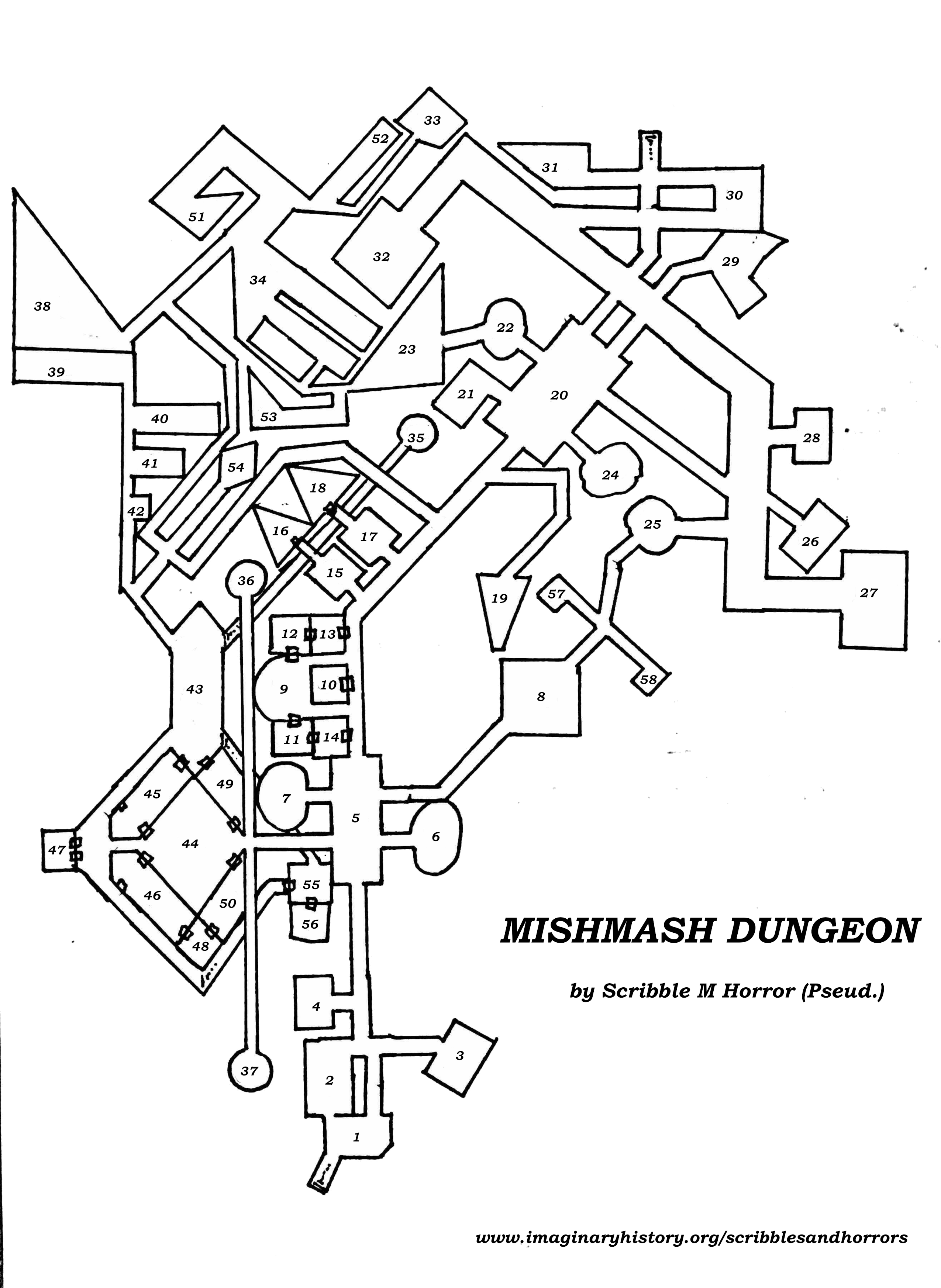
Mishmash Dungeon
Idraluna and I have put together an adventure! Here is Mishmash Dungeon, a further experiment in my Mishmash thoughtworld.
The dungeon map is drawn by me:
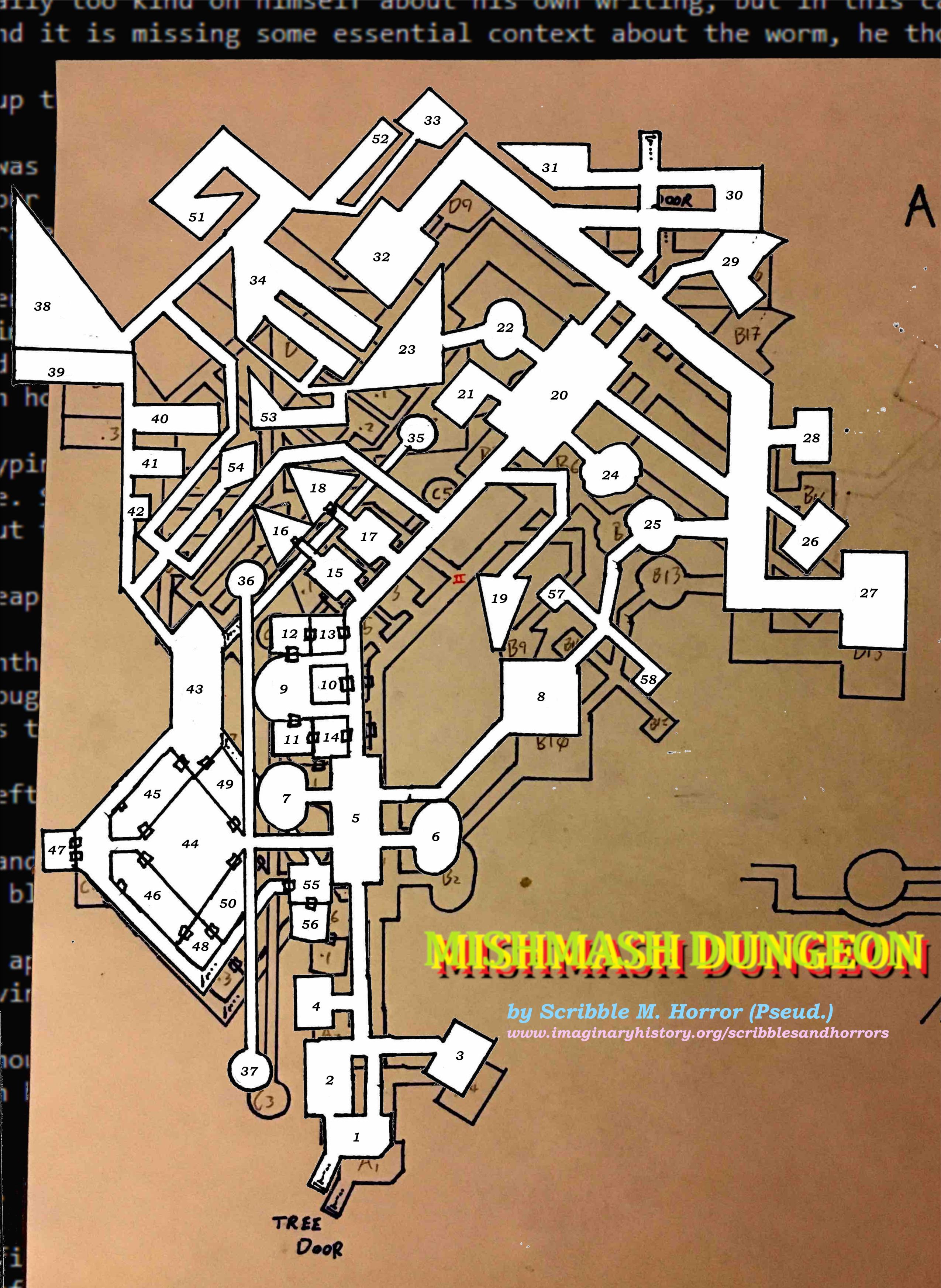
The dungeon key consists of fragments loosely selected from whatever reading material Idraluna and I had on hand. The point was to come up with a big mess of little snippets.
A crucial part of this project, in my mind, is approaching the randomly selected text here with the same rigor as you would a more responsibly written adventure. The key is not merely inspirational: the idea is to read it as substantial, or to try even if it doesn’t seem that way at first.
It was a lot of fun to make, and I’m excited to see how it holds up in play.
PDF of Key here: mishmash-dungeon-lvl1.pdf
Full color map: mishmash-dungeon_notprintable.png
Printable map: mishmash-dungeon_printable.png
Friday, March 13, 2026
Keying and Running Redux Alpha
In this post I share my notes for Redux level Alpha. It’s in response to what are reasonable questions about how my large and oddly shaped dungeon maps work in actual play. It’s also a record of my personal prep and playstyle. I don’t pretend to be presenting anything terribly novel here–there’s no shiny method or clever innovation in how I run things. This is just what the most well travelled corner of my underworld looks like after 30-odd sessions of 3LBB campaign play.
It is a companion piece to Redux Setup, which covers some physical aspects of how I run my game.
The Notes
Here is a pdf which contains my complete notes for Redux Alpha, redacted to exclude what hasn’t seen play action, or what might be spoilers. Only about 3 pages of notes are witheld:
In addition to these notes, here are documents authored by Alfonso Ultima, Phd. These were kept in the folder until discovered, then handed to the players:
Ultima_Has-God-Spoken-to-You.pdf
Ultima_How-to-Make-Decisions.pdf
Ultima_Guilt-and-Forgiveness.pdf
For comparison with actual logs of sessions played, here is a pdf of all 9 Redux sessions up through March 1026 where action took place at least partially in Alpha:
The Map
Construction and Development
Alpha began life as a fairly straightforward map drawn on graph paper. It looked like this:
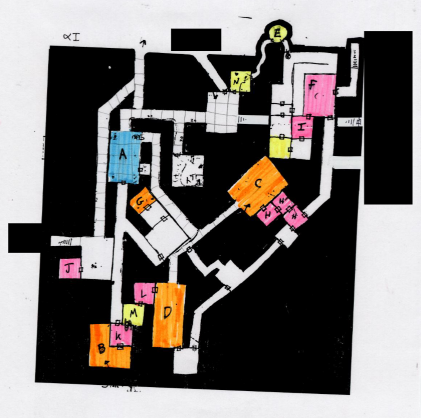
This map never saw play. By the time I got a group together, I had replaced with this, the current Alpha:
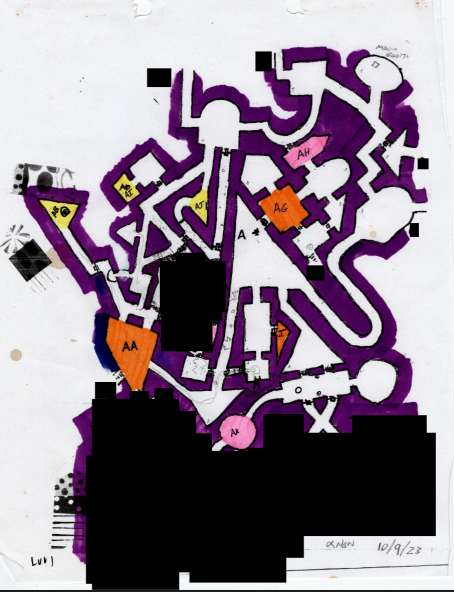
I drew the new map on an index card, then printed out a full-page version to key. The highlighting indicates results from the U&WA tables: pink for Monster, orange for Monster and Treasure, yellow for Treasure only.
When I drew Alpha I was very cognizant about playability. I wanted the level to be accessible and exciting. It’s not too big, and each of the paths one can take leads somewhere slightly different. The large triangular room makes a pretty good landmark for deciding to explore other areas.
The multiple loops mean that Alpha is pretty good for telegraphing unexplored space. It’s been useful for players to work their way completely around an area. This has also meant that chases are pretty fun–there are several ways to get back to safety, and players have been able to make intelligent decisions in order to avoid danger.
Alpha is connected to lots of other levels. There are two downwards stairways and an elevator (though nobody’s ventured down them), to the north and to the east are other levels. To the south, well, less said about the south the better.
The Alpha Mapping Game
I gave players this initial map of the area. You can see plainly that it is wrong in several places, but it gives hints about the general layout.
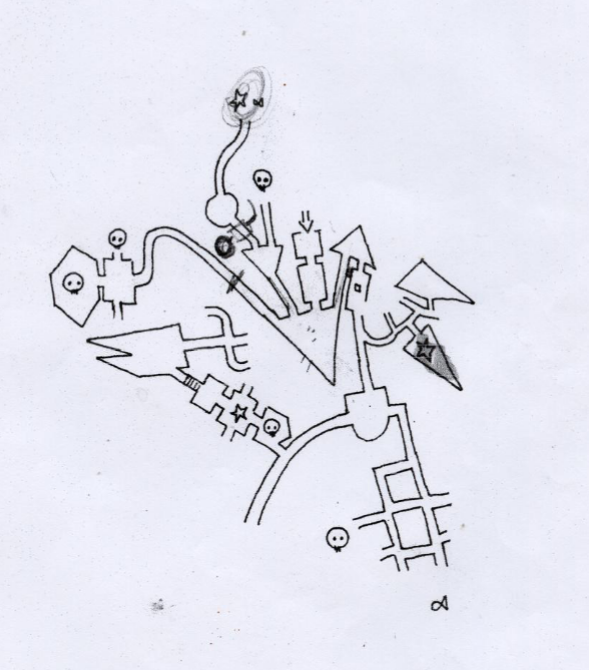
This map proved to be quite frustrating to players when they discovered it was incorrect. To my surprise, instead of realizing the map was wrong, they decided they were in the wrong place! Eventually they figured it out, though. The point was to aid players in drawing their own maps, not to have them use the given one.
Here is the most up-to-date player map, drawn by Idraluna and posted with his permission:
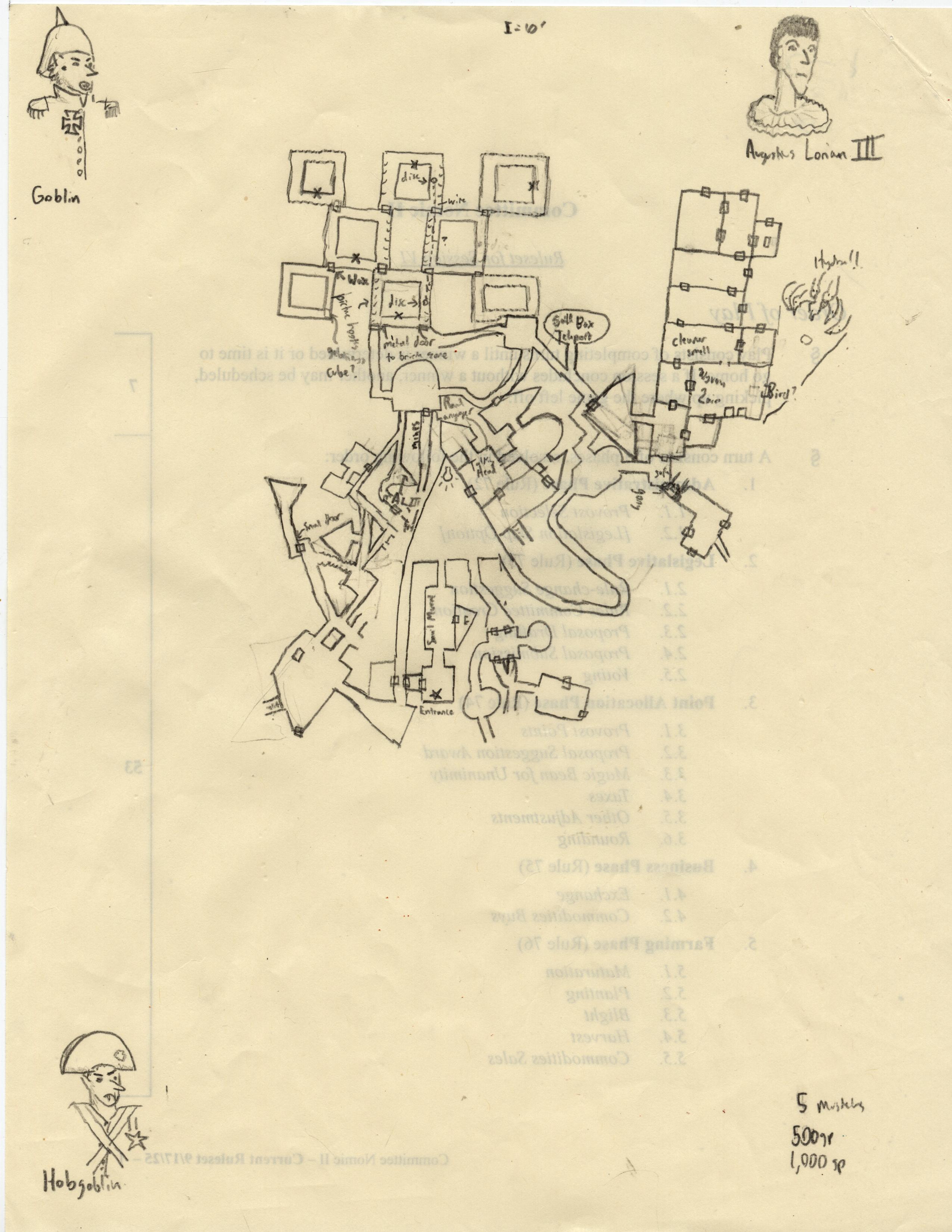
You can compare this with the referee map and see that it is incredibly accurate. I have had zero trouble with players mapping Alpha.
My referee map doesn’t have any markings, but it is draw to scale, so I eyeball the distances and relay them. When a room is difficult to describe, I will draw it out on a piece of scratch paper and show it to the players for them to copy down. I keep an eye on their maps, and if they draw something which doesn’t fit what the characters are seeing, I correct it.
I don’t correct errors on the player map if the characters aren’t there to see it, and if a player makes assumptions (say, connecting a hallway on the map without having actually gone down it) they are on their own.
Keying
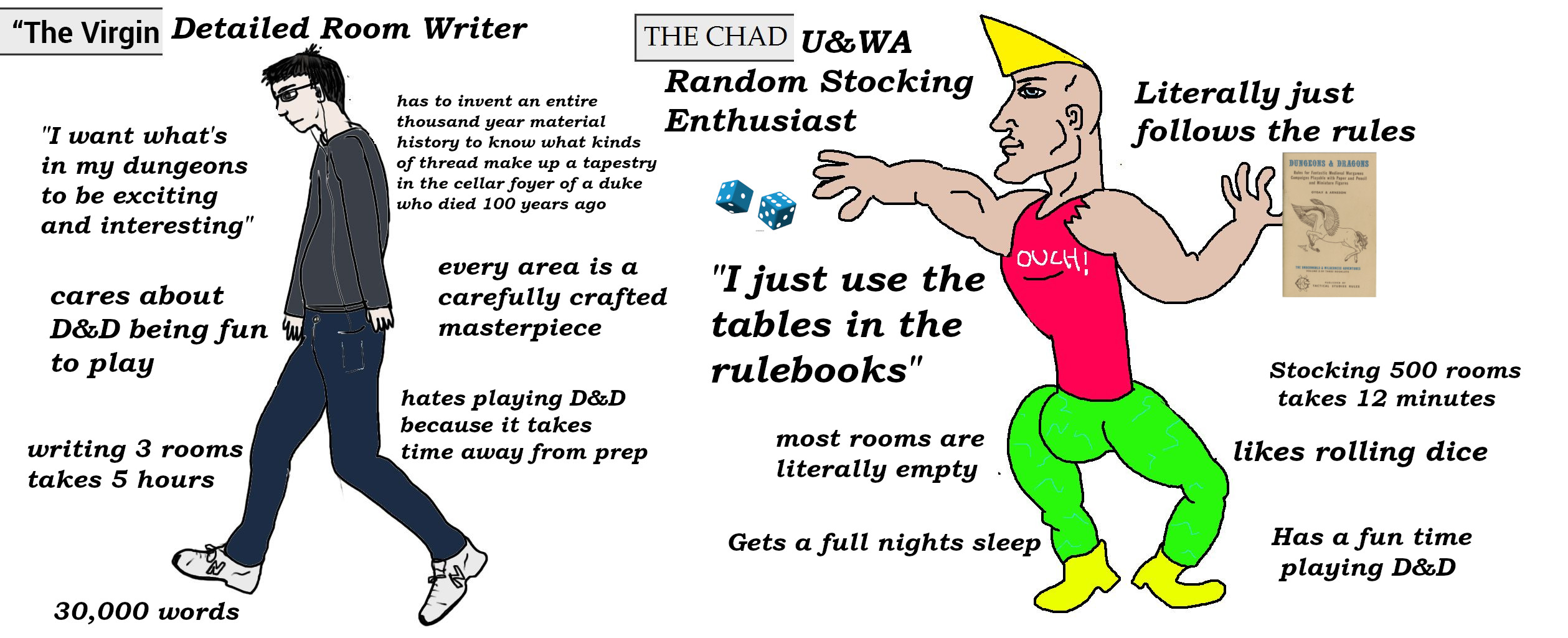
This meme demonstrates the duality within my soul
Initial keying was done mainly with the U&WA tables, with a few areas grandfathered in from the earlier keyed version of the map. I really like the random distribution, because frequently the dice will place content in places I never expected. For treasure especially, the U&WA tables are great for insisting that something is there, definitely in that place. Once I have a baseline distribution, I can go in and add more detail/embellishments.
In general I take fairly sparse notes, but add concrete detail in specific areas. Redux Alpha has a lot of writing associated with it, but most of this writing is Dr. Ultima’s essays and pamphlets.
Select Wandering Monsters
My wandering monster table has undergone several modifications. When a monster type has been cleared from the level I cross it off the list. Alpha uses a simple two-tiered table with monsters inhabiting Alpha and those from elsewhere.
Ruff-fish
The Ruff-fish are a plain rip-off of a vignette in Yevgenia Belorusets’ Modern Animal, where a priest has been preaching to a group of fish, and they respond with the curious inverted collective-individual dialogue.
They are a chorus, and so to produce the chorus I have the players all read aloud from the script together. I’ve had a lot of fun with these encounters. It’s pretty much strictly non-combat, but it forces players to be immersed in what’s happening before them.
The problem comes when players ask the Ruff-fish questions. I haven’t been able to come up with many satisfying ways for dialog with these creatures, so for the most part they say their piece and move on.
Dr. Alfonso Ultima, PhD
Dr. Ultima’s writings have been a really fun part of Redux. Started with a pamphlet, and he has also written numerous essays which get left around. The man himself has been fairly elusive; the players are still puzzling over what his deal is. He was the subject of a Records Request.
Select Keyed Areas
A - Lightbulb headed monstrosity (ON)
The LBHMs were inspired by the “protagonist” character from MAD GOD. They have lightbulbs for heads and lots of HD. When their pull-cord is pulled, the light is on, and the LBHM sits immobile.
This was a really great feature for the early sessions. It was something of a mystery, it lit up the central room for ease of description, and, it’s largely harmless unless disturbed in an obvious way. Eventually the PCs’ curiosity got the better of them, and they killed it, which is sort of sad.
?? - Goblins
My goblins have uniforms and equipment reminiscent of WWI Germans. The concept is something like outposts of units, so they have been building out various defenses. Including booby traps (usually poison gas behind doors or paintings), obstacles like barbed wire and land mines.
Goblin rifles are really dangerous at long range, but closing the distance seems to work well, as they aren’t wearing armor. So far bullets have been stopped by shields in NRACS, but I might want to change that soon.
AB - Treasure of the Snail Knight
Search for the actual treasure is still ongoing. In typical Referee fashion I assumed it would be much easier to find than it actually was. There is a looted treasure room, which contained a huge and heavy brass snail shell. Much interest was had during the session where the party slowly dragged it out and hoist it up the shaft into the air.
?? - Magic Booth
A simple teleported added well after the initial keying. Having a cool-shaped empty room was really handy for this purpose.
The Living Dungeon
Huge portions of what’s “true” about the dungeon have few or no written notes.
Perhaps the biggest one of these is that Alpha starts with stairways to a room, then a rough 40′ shaft downwards into the center of the level. There are no notes of this room or shaft because I know it’s there. This fact about the world shows up in player notes and expedition logs, but not my referee map or notes. The space in which play occurs–call it an imaginary world if you like–does not exist except in the actual interactions at the table. It’s not written down anywhere fully, it’s not in my head, not really. It emerges through social play.
Monday, March 9, 2026
Level Zeta III
The gift of creative energy has been bestowed upon me, and so here is a deeper part of my underworld: Redux Zeta III (0,0).
No, this is not a disentanglement from, but a progressive knotting into
- Gravity’s Rainbow, p. 1
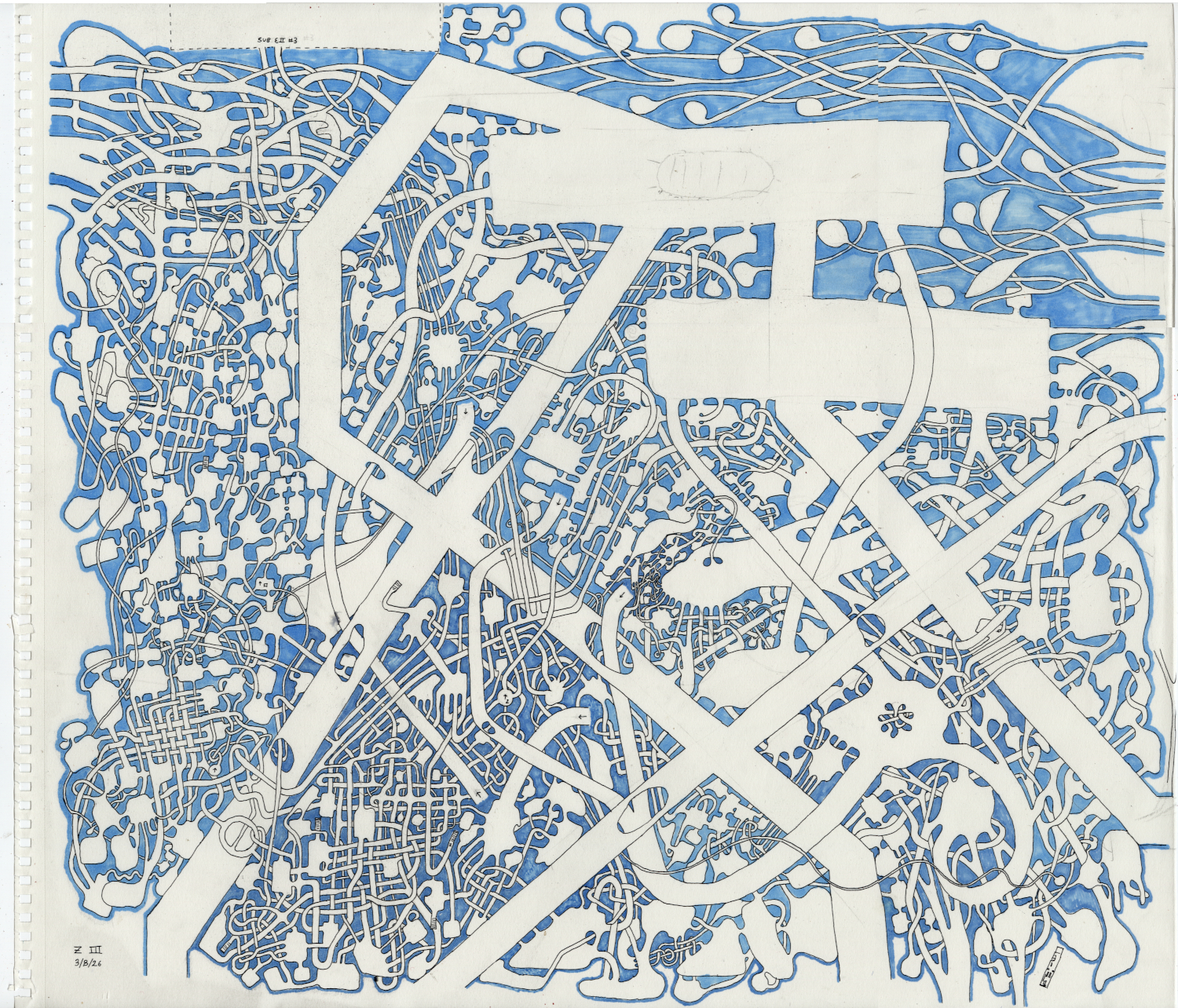
Zeta III is three levels beneath Epsilon and two levels beneath Delta-Zeta I. Its main connections are with Zeta I and Zeta II. 5 of the arms of Zeta I’s large star descend via slopes two levels to Zeta III: these are those curvy 30’ passageways. You can also see the two gargantuan rectangular rooms–Zeta III is the floor of those rooms.
The scale is the same as my other maps, though it’s not on graph paper. For reference the three parallel passageways in the upper left are each 20’ wide. The smallest corridors tangled in the center are about 2’ wide.
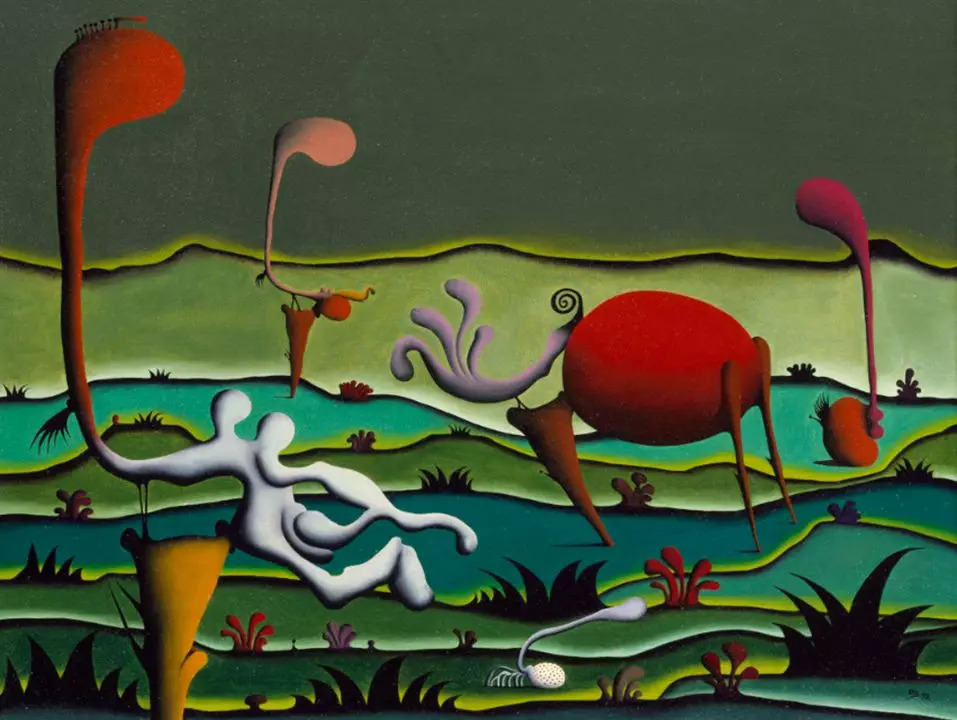
Unlike Delta-Zeta I, I have many concrete ideas about Zeta III’s denizens. In the colossal rectangular open spaces are huge roly-poly’s. The large 100’ hallways are the domain of the Ormyul. The many densely packed chambers on the left hand side of the map contain an extensive library. The larger 15’ passages are home to Snail Men. The balance will be made up with creatures similar to those found in this painting–surreal sorts of colored blob creatures.
I suspect a workable method of mapping Zeta III will be a node map with lines representing corridors and nodes representing rooms or intersections. In part because in many ways the way it’s drawn is already a node map, just with added embellishments.
I’ve been making maze drawings with overlapping passages since middle school. I’d always wanted to find a way to make them D&D maps, but the logic never quite made sense to me. Still stuck in my foolish notions about dungeons having to make some kind of sense I wasn’t in a place where I could make something satisfying. For some reason I’m there now. It’s strange how as we get older, we come into age for certain things.
I’m definitely not the first person to draw maps like this. The ones here are beyond astonishing and beautiful. I tried to mimic some of the elements from those, with “windows” cut out of the bigger spaces and lots of parallel passages. I couldn’t hold a candle to their precision, though, and moved into my own chaotic knotwork.
I found myself experimenting with a bunch of different styles here. The 100’ passages sort of break the map up into sections, and in each one it appears I’ve tried something a little different. I won’t say this was intentional–it just sort of happened. Some of the styles I like more than others. I’m especially intrigued to explore more flora-like structures, with leaves, vines, and flowers.
The blue shading adds a lot. I didn’t intentionally choose TSR module blue, I was just looking for a somewhat neutral color which would provide good contrast, which I suppose is why they chose it.
There’s lots I’m happy with in this map, though I sort of hate how the big 100’ passageways look. They don’t fit in with the rest, and I feel like they are awkwardly in the way. This was sort of intentional–I wanted them to be separate from the main tangle, blocky and sharp obstacles–but I feel like they just sort of look bad. I drew too early in the process, and too hastily I think.
It is possible that they will look less bad once I give them somewhere to go–you can see how the map extends off three edges; more maps of this type will need to be drawn up. Perhaps its just that they’re such a huge structure you need to zoom out farther for them to make sense.
I have plenty more paper.
—
I ran a session of The Realm of Yolmi using this map, detailed here: Escape From Special Operations Complex #903 Session Report