Friday, March 13, 2026
Keying and Running Redux Alpha
In this post I share my notes for Redux level Alpha. It’s in response to what are reasonable questions about how my large and oddly shaped dungeon maps work in actual play. It’s also a record of my personal prep and playstyle. I don’t pretend to be presenting anything terribly novel here–there’s no shiny method or clever innovation in how I run things. This is just what the most well travelled corner of my underworld looks like after 30-odd sessions of 3LBB campaign play.
It is a companion piece to Redux Setup, which covers some physical aspects of how I run my game.
The Notes
Here is a pdf which contains my complete notes for Redux Alpha, redacted to exclude what hasn’t seen play action, or what might be spoilers. Only about 3 pages of notes are witheld:
In addition to these notes, here are documents authored by Alfonso Ultima, Phd. These were kept in the folder until discovered, then handed to the players:
Ultima_Has-God-Spoken-to-You.pdf
Ultima_How-to-Make-Decisions.pdf
Ultima_Guilt-and-Forgiveness.pdf
For comparison with actual logs of sessions played, here is a pdf of all 9 Redux sessions up through March 1026 where action took place at least partially in Alpha:
The Map
Construction and Development
Alpha began life as a fairly straightforward map drawn on graph paper. It looked like this:
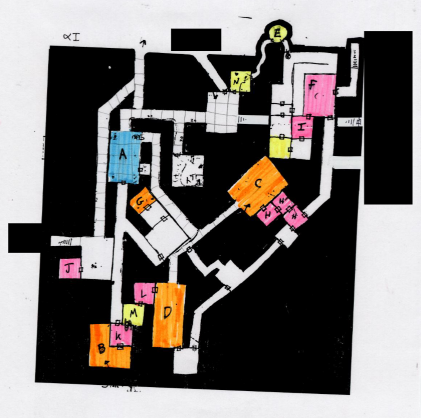
This map never saw play. By the time I got a group together, I had replaced with this, the current Alpha:
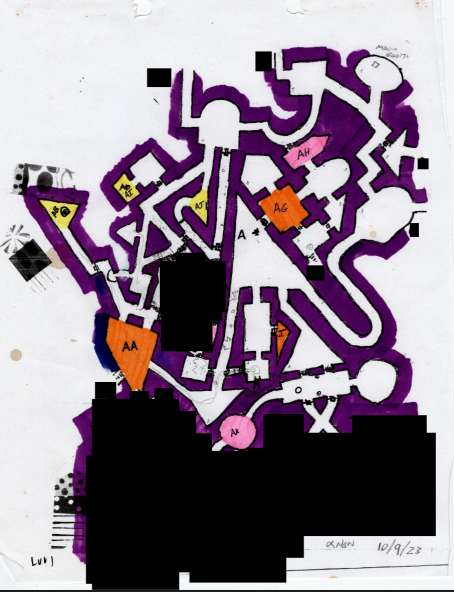
I drew the new map on an index card, then printed out a full-page version to key. The highlighting indicates results from the U&WA tables: pink for Monster, orange for Monster and Treasure, yellow for Treasure only.
When I drew Alpha I was very cognizant about playability. I wanted the level to be accessible and exciting. It’s not too big, and each of the paths one can take leads somewhere slightly different. The large triangular room makes a pretty good landmark for deciding to explore other areas.
The multiple loops mean that Alpha is pretty good for telegraphing unexplored space. It’s been useful for players to work their way completely around an area. This has also meant that chases are pretty fun–there are several ways to get back to safety, and players have been able to make intelligent decisions in order to avoid danger.
Alpha is connected to lots of other levels. There are two downwards stairways and an elevator (though nobody’s ventured down them), to the north and to the east are other levels. To the south, well, less said about the south the better.
The Alpha Mapping Game
I gave players this initial map of the area. You can see plainly that it is wrong in several places, but it gives hints about the general layout.
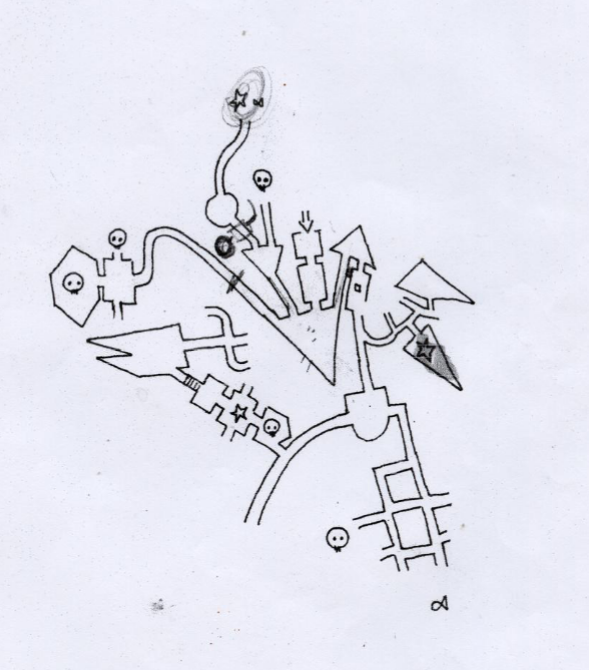
This map proved to be quite frustrating to players when they discovered it was incorrect. To my surprise, instead of realizing the map was wrong, they decided they were in the wrong place! Eventually they figured it out, though. The point was to aid players in drawing their own maps, not to have them use the given one.
Here is the most up-to-date player map, drawn by Idraluna and posted with his permission:
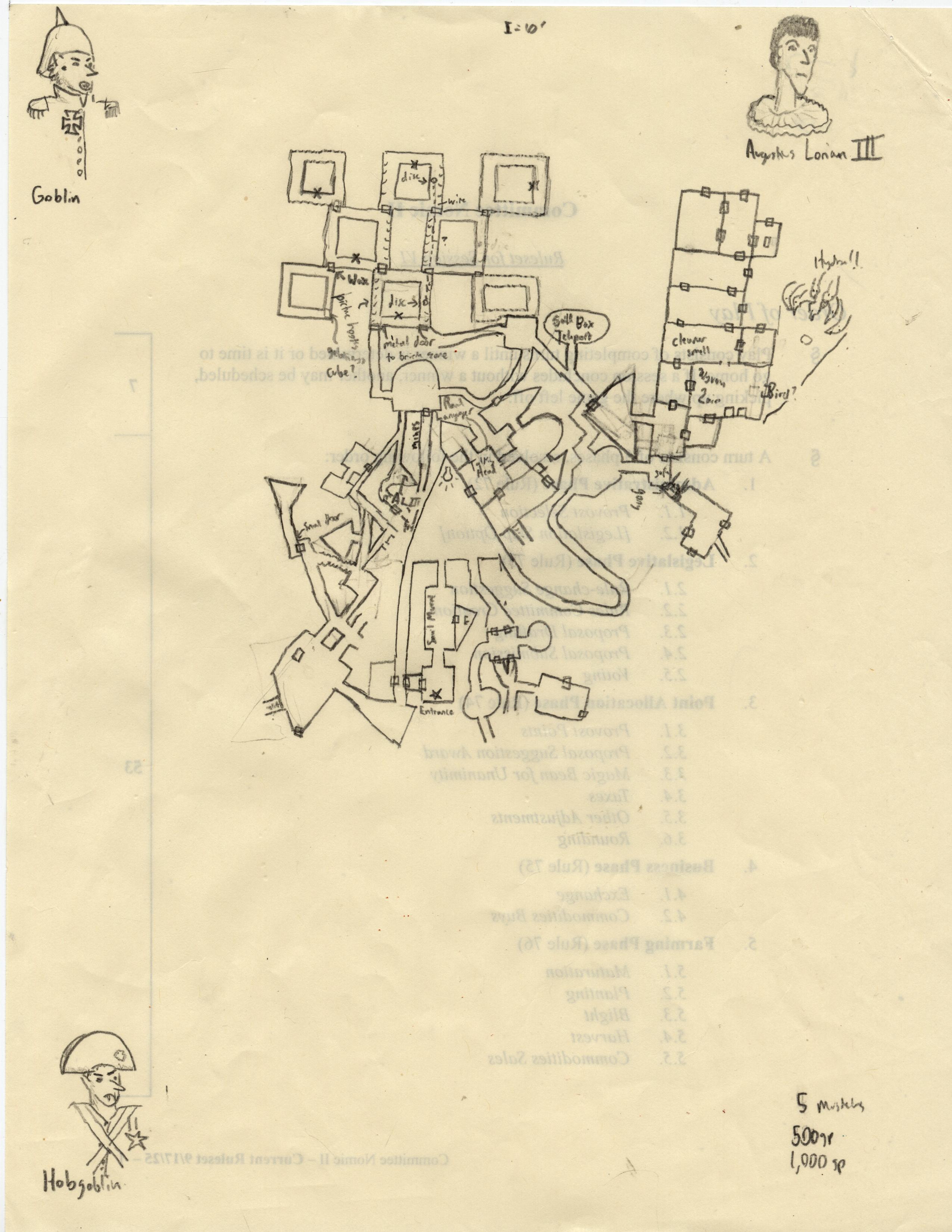
You can compare this with the referee map and see that it is incredibly accurate. I have had zero trouble with players mapping Alpha.
My referee map doesn’t have any markings, but it is draw to scale, so I eyeball the distances and relay them. When a room is difficult to describe, I will draw it out on a piece of scratch paper and show it to the players for them to copy down. I keep an eye on their maps, and if they draw something which doesn’t fit what the characters are seeing, I correct it.
I don’t correct errors on the player map if the characters aren’t there to see it, and if a player makes assumptions (say, connecting a hallway on the map without having actually gone down it) they are on their own.
Keying
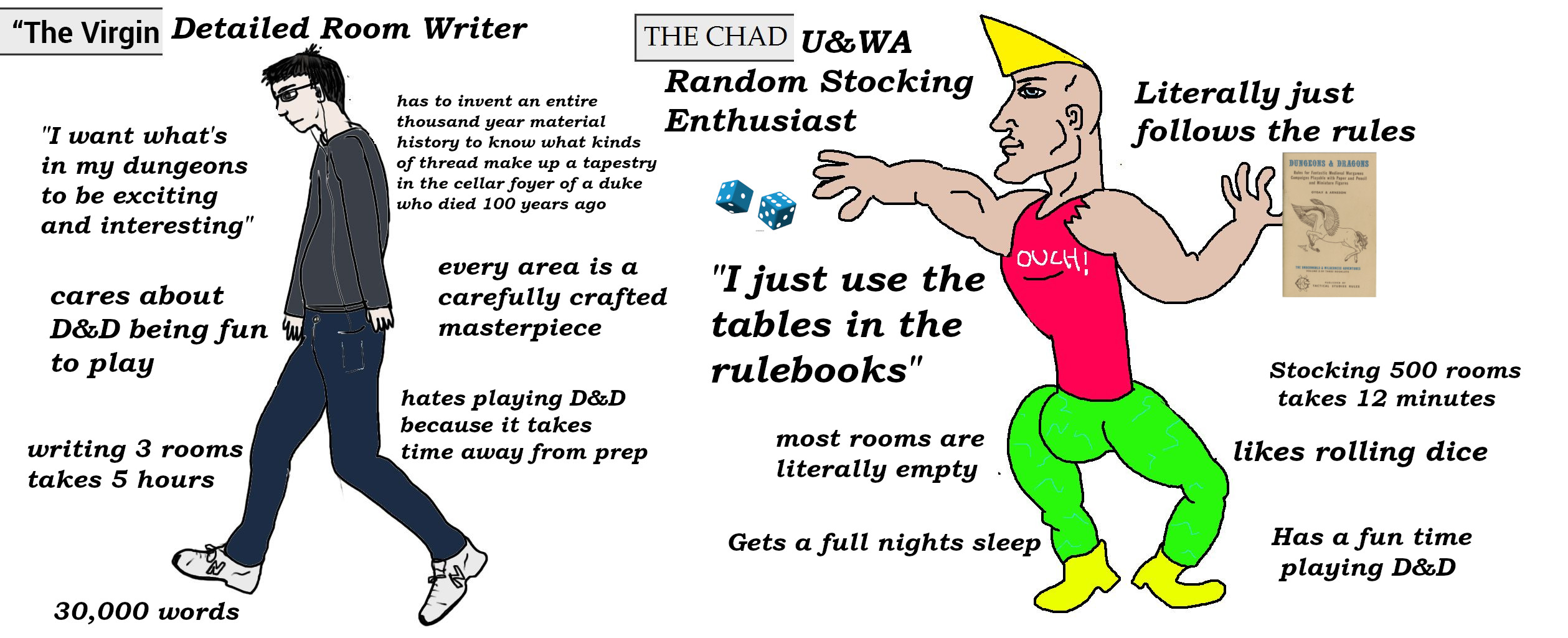
This meme demonstrates the duality within my soul
Initial keying was done mainly with the U&WA tables, with a few areas grandfathered in from the earlier keyed version of the map. I really like the random distribution, because frequently the dice will place content in places I never expected. For treasure especially, the U&WA tables are great for insisting that something is there, definitely in that place. Once I have a baseline distribution, I can go in and add more detail/embellishments.
In general I take fairly sparse notes, but add concrete detail in specific areas. Redux Alpha has a lot of writing associated with it, but most of this writing is Dr. Ultima’s essays and pamphlets.
Select Wandering Monsters
My wandering monster table has undergone several modifications. When a monster type has been cleared from the level I cross it off the list. Alpha uses a simple two-tiered table with monsters inhabiting Alpha and those from elsewhere.
Ruff-fish
The Ruff-fish are a plain rip-off of a vignette in Yevgenia Belorusets’ Modern Animal, where a priest has been preaching to a group of fish, and they respond with the curious inverted collective-individual dialogue.
They are a chorus, and so to produce the chorus I have the players all read aloud from the script together. I’ve had a lot of fun with these encounters. It’s pretty much strictly non-combat, but it forces players to be immersed in what’s happening before them.
The problem comes when players ask the Ruff-fish questions. I haven’t been able to come up with many satisfying ways for dialog with these creatures, so for the most part they say their piece and move on.
Dr. Alfonso Ultima, PhD
Dr. Ultima’s writings have been a really fun part of Redux. Started with a pamphlet, and he has also written numerous essays which get left around. The man himself has been fairly elusive; the players are still puzzling over what his deal is. He was the subject of a Records Request.
Select Keyed Areas
A - Lightbulb headed monstrosity (ON)
The LBHMs were inspired by the “protagonist” character from MAD GOD. They have lightbulbs for heads and lots of HD. When their pull-cord is pulled, the light is on, and the LBHM sits immobile.
This was a really great feature for the early sessions. It was something of a mystery, it lit up the central room for ease of description, and, it’s largely harmless unless disturbed in an obvious way. Eventually the PCs’ curiosity got the better of them, and they killed it, which is sort of sad.
?? - Goblins
My goblins have uniforms and equipment reminiscent of WWI Germans. The concept is something like outposts of units, so they have been building out various defenses. Including booby traps (usually poison gas behind doors or paintings), obstacles like barbed wire and land mines.
Goblin rifles are really dangerous at long range, but closing the distance seems to work well, as they aren’t wearing armor. So far bullets have been stopped by shields in NRACS, but I might want to change that soon.
AB - Treasure of the Snail Knight
Search for the actual treasure is still ongoing. In typical Referee fashion I assumed it would be much easier to find than it actually was. There is a looted treasure room, which contained a huge and heavy brass snail shell. Much interest was had during the session where the party slowly dragged it out and hoist it up the shaft into the air.
?? - Magic Booth
A simple teleported added well after the initial keying. Having a cool-shaped empty room was really handy for this purpose.
The Living Dungeon
Huge portions of what’s “true” about the dungeon have few or no written notes.
Perhaps the biggest one of these is that Alpha starts with stairways to a room, then a rough 40′ shaft downwards into the center of the level. There are no notes of this room or shaft because I know it’s there. This fact about the world shows up in player notes and expedition logs, but not my referee map or notes. The space in which play occurs–call it an imaginary world if you like–does not exist except in the actual interactions at the table. It’s not written down anywhere fully, it’s not in my head, not really. It emerges through social play.
Thursday, March 5, 2026
Redux Setup
The Filing Cabinet: A Vertical History of Information is a book by Craig Robertson which describes in detail the technological and social history of the filing cabinet. The whole cabinet apparatus information retrieval system, Robertson argues, developed as a confluence of technological capabilities, economic incentives, prevailing styles, and modes of social enforcement. The filing cabinet is not a neutral “best” way of storing paper documents; it is only one of many different technologies which could achieve similar aims. The ubiquity of files is because the filing cabinet was chosen by the corporate west as its information retrieval mainstay–instantaneous access to compartmentalized data maintained by a gendered office division of labor. This legacy lives on in the skeuomorphic files and folders of computer systems.
It’s a good idea to pay attention to how we physically deal with records. The material reality shapes our understanding and use of information. We should make informed organizational choices.
Emphatically, this does not mean that referees need to take “better” notes, or be “more organized” in accordance with some objective ideal. A one size fits all solution is worse than useless here. What I mean is: we should pay attention to the kinds of documenting structures we use, and be willing to explore new ones if the old ones are causing trouble. Conversely, we should work to actively maintain structures which work well.
So, here is my paper setup for my in-person Redux OD&D campaign. For context, the campaign runs once a week at a local gaming store in an open table format. I will go over all my physical components of play, and how I keep and maintain my notes.
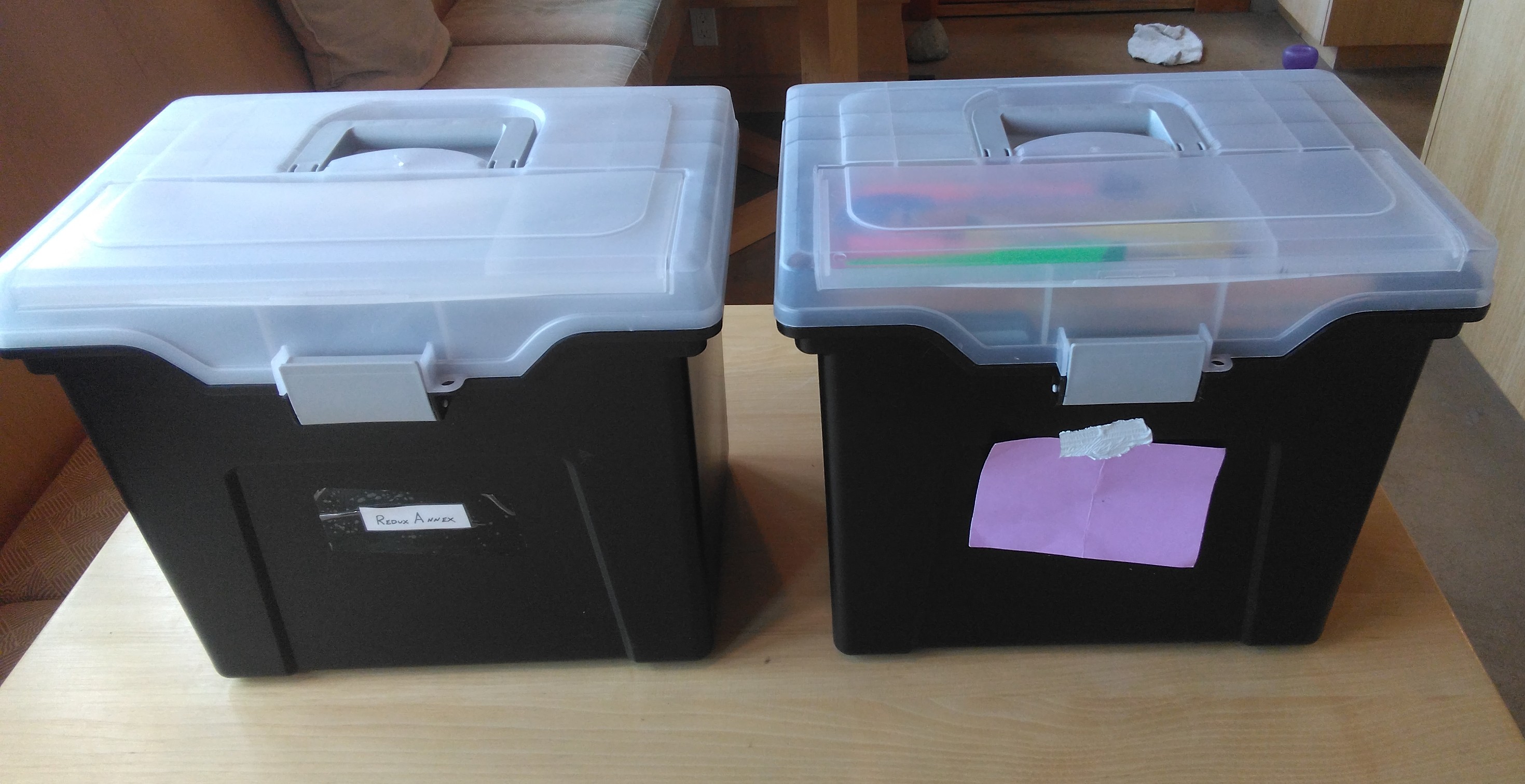
I don’t use a binder or a laptop at the table. The whole of Redux fits into these two document boxes. One contains entirely paper (this is the more important box), and the other contains dice, a rulebook, hole-punch, miniatures, pencils, pencil shavings, and paper clips.
Equipment
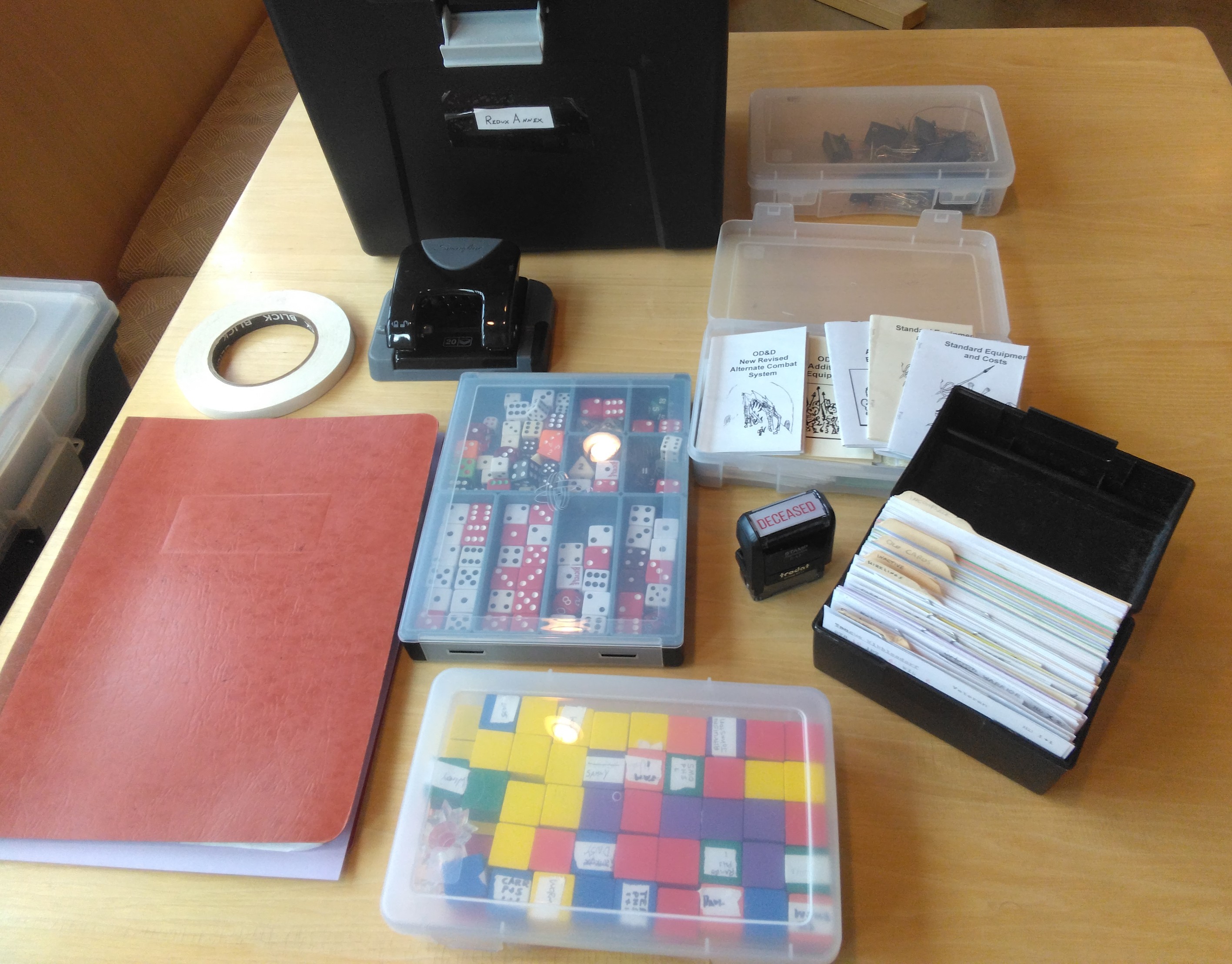
- My rulebook (left) is my printed out OD&D all bound together. I mostly just use it for quick reference.
- I printed little reference zines (upper right), which I distribute in the center of the table. Most rules-reference is done using these.
- Character sheets are index cards in an index card box. Ideally these should be organized in some fashion, but generally they are not.
- For miniatures I use little cubes with names written on them. Ideally, these are color-coded. Since there are so many characters, it has been a little fiddly and frustrating to make sure everyone has a cube with their name on it. The combat system NRACS works really well with these simple miniatures.
- NRACS uses lots of d6s so I have a bunch of these in two colors.
- I’m very glad to have a little box for pencils, but I definitely need to get more of them.
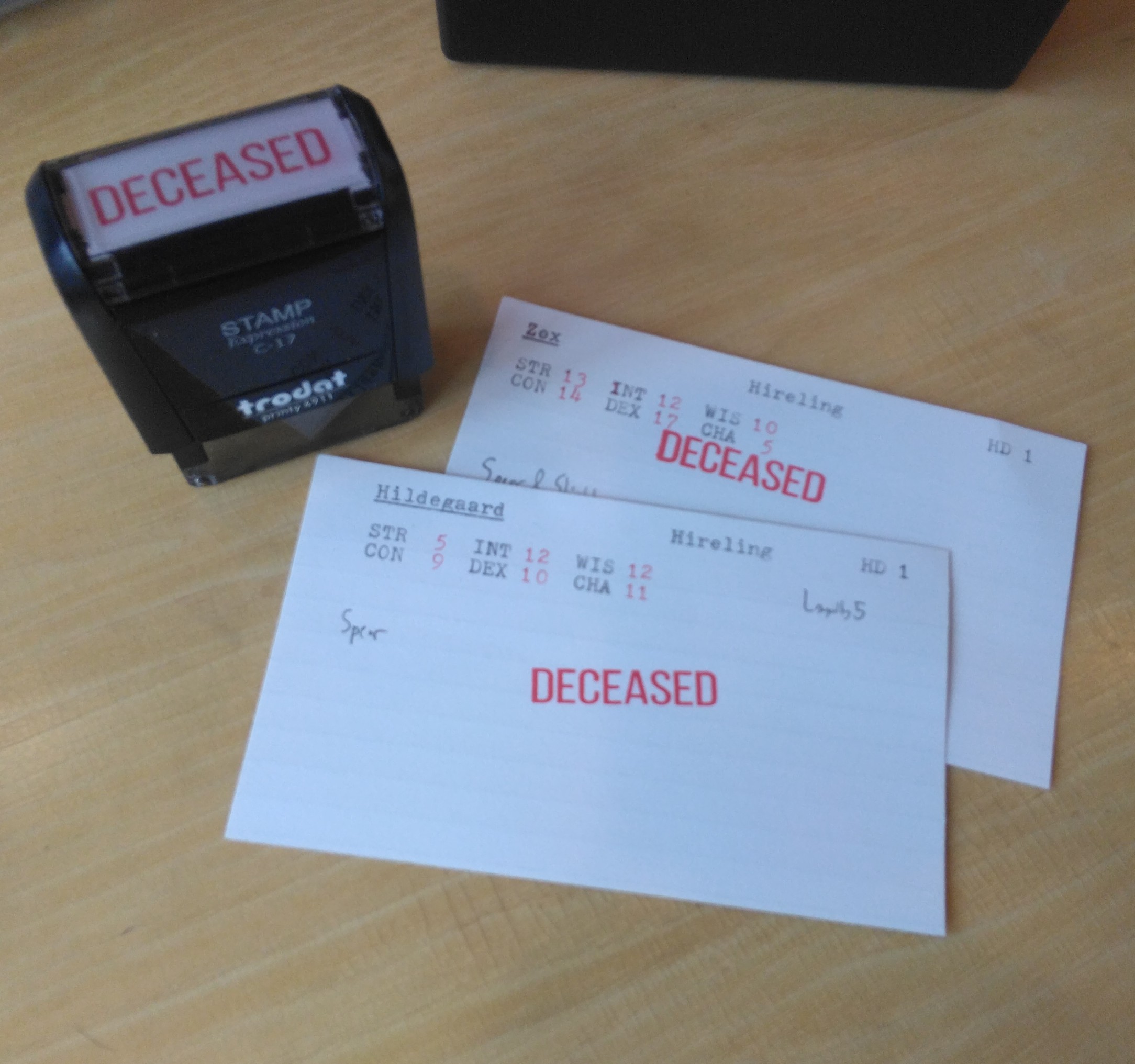
- The “deceased” stamp was a wonderful birthday gift from a dear friend of mine. It’s really satisfying to use–a little ritual for a legitimately sad thing. I generally have the controlling players use it on their characters, of course.
Documents
Each dungeon level or section is its own folder. I like these fastener folders.
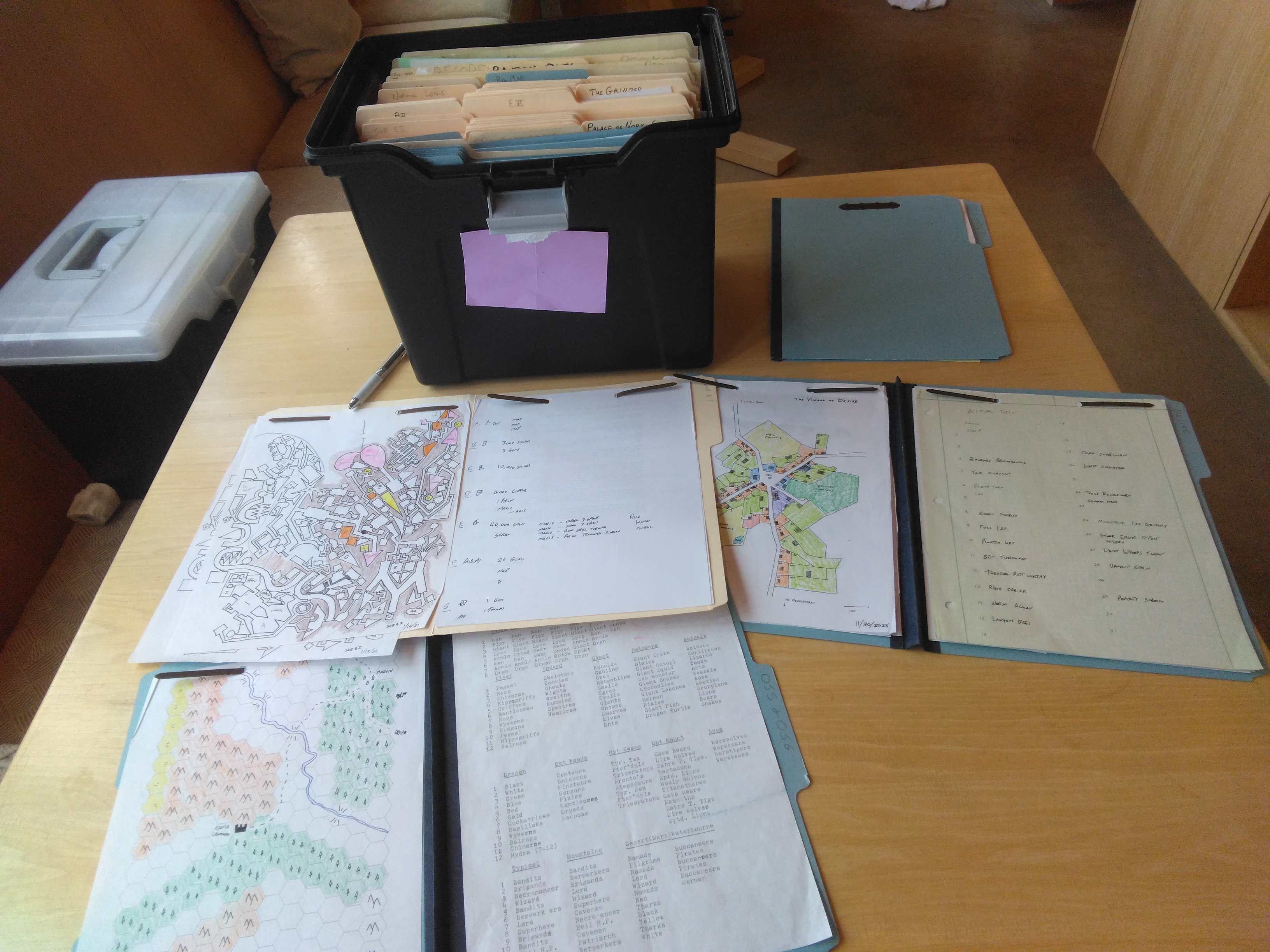
When laid open, to the left is the dungeon/wilderness map and to the right is first the Wandering encounter table, and then the key and other notes beneath it. Usually there are illustrations here, and also occasionally handouts.
I don’t use a Referee’s screen; instead I cover the map with a piece of paper (usually my notes for the session). In play, then, the folder lies flat with the map covered and the wandering monster table exposed. I mostly only need to take quick peeks.
Generally play outpaces my ability to write things down, so for the most part my notes are the barest essentials generated using UW&A. Occasionally there are some more detailed writeups or drawings. When I draw a new version of a map or write up a new key, I just insert it at the top of it’s half of the folder–this makes it so the older notes are “deeper”.
I’ve found that my drawings in particular are really useful, and that I will frequently want to show the drawings to my players–the fastener-folder setup make picking up the whole thing and clumsily flashing my scribbles for all to see doable and fun.
I shared some typical notes from these folders in my post Keying and Running Redux Alpha
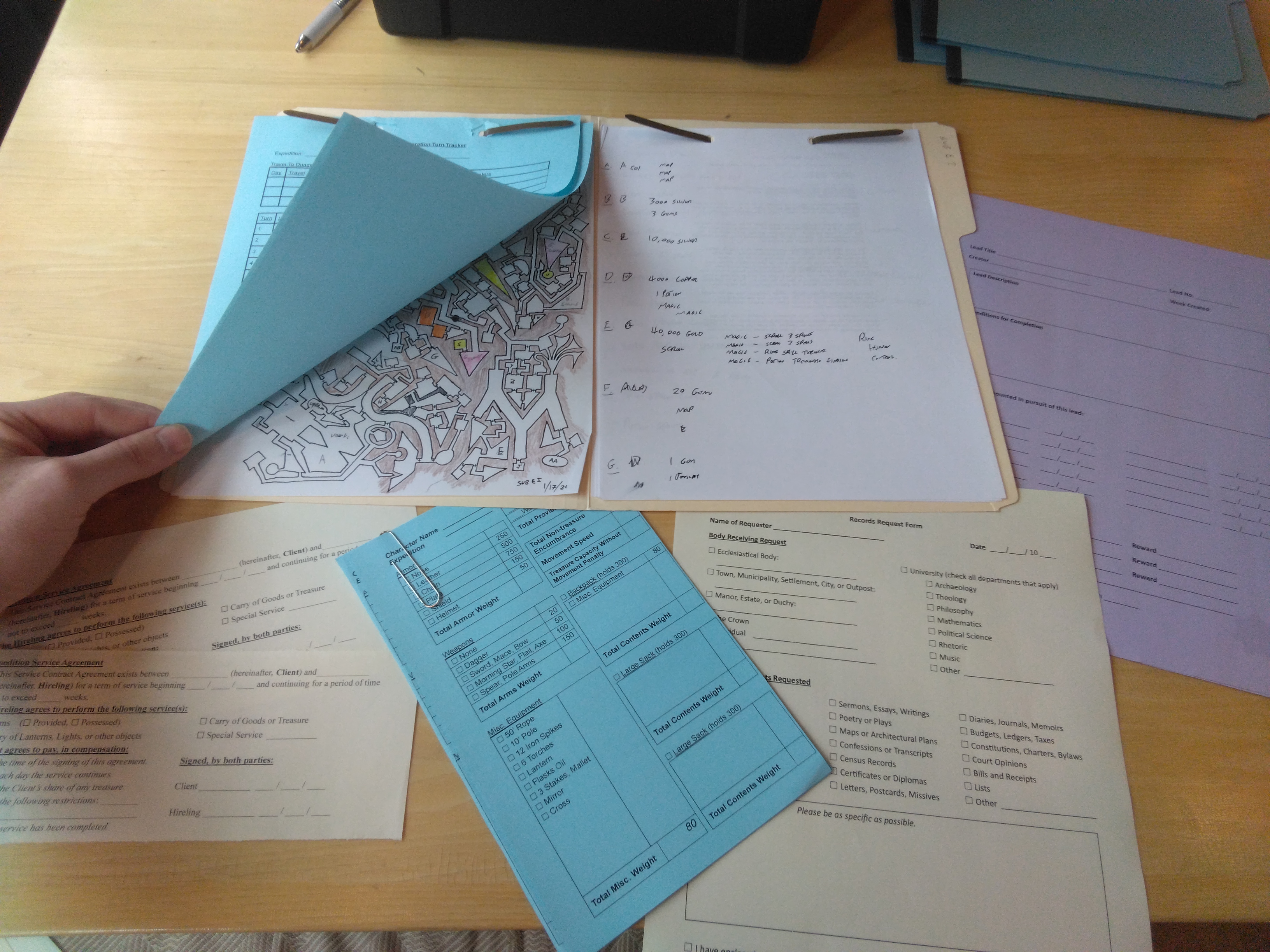
I use a lot of paper tracking documents: Writs of Free Arms, Clerical Assignments, Equipment Trackers, Hireling Contracts, Session Log Sheets, not to mention the ordinary player maps, other contracts, letters, handouts, and so on. In addition to dungeon/wilderness maps and keys, then, I keep simple folders for:
- blank paper (usually scratch paper from other projects)
- player notes (all together in one big stack)
- expedition logs by season (includes at-session notes alongside typed up and printed logs)
- Records Requests by season
- Active Leads
- Completed leads
Out of an abundance of optimism I have also been carrying around the Outdoor Survival board, in here, but I should really probably put that back where it belongs.
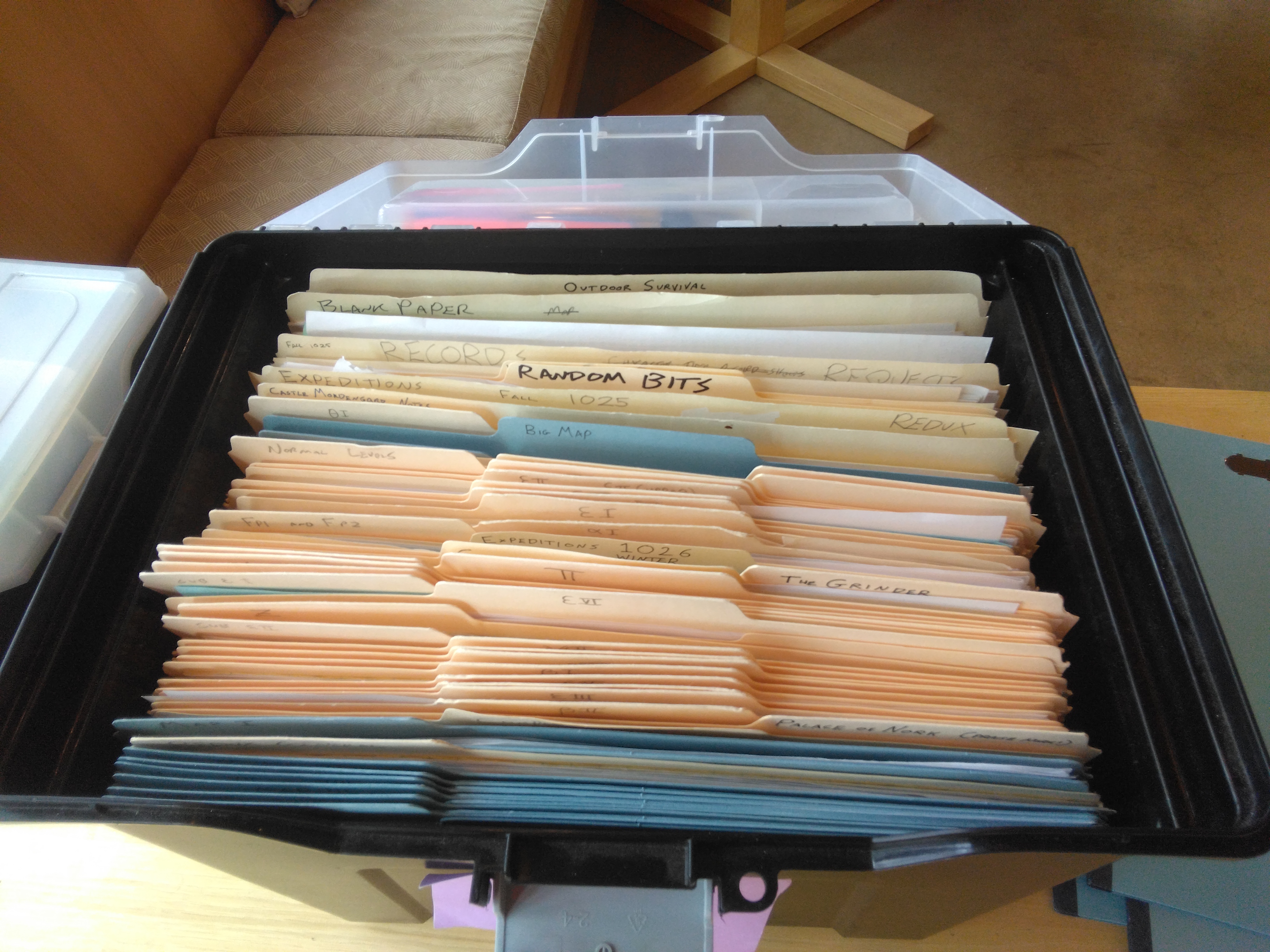
For the most part I hold on to player character cards and player-drawn maps. I don’t enforce this–people can take them home if they want to–but it has seemed to make sense for all the actionable pieces of the campaign to be together. This adds a further layer of custodial responsibility onto me the referee.
Tradeoffs
My system works well for quickly accessing the layout of a dungeon and the contents of a room. It is quite fast for navigation, and I like the elegance of just a flat folder at the table with no screen intervening. I feel very immersed in the world.
I like how my setup accumulates paper as it goes on–new maps get slotted in atop old ones, refreshed keys loom over earlier ones. It’s a chaotic overlapping mess in places, which is a good thing.
It is somewhat fiddly with all the pieces of paper and folders–not infrequently I misplace one and have to go digging for it. It has also happened at least once that I misplaced an entire folder, and so had to run a whole session without the relevant map on hand. (Thankfully I had posted an image of the map on my blog, and so was able to run things smoothly.)
Relying on multiple pre-printed forms means I have to maintain a stock of sheets, which adds complexity to prep.
The boxes are heavy and cumbersome to travel with. I am quite lucky in that I have access to a car and parking nearby to the game location. This setup would probably be unworkable if I were reliant upon public transportation to get to my games.
Monolithic sprawl and onerous bureaucracy is sort of the vibe I’m going for with Redux, so these tradeoffs make sense for the way I play. So far my notes have been effective at letting me run my game how I want to.
Preservation
When I moved after college I lost an entire campaign’s worth of maps and notes, which was a tremendous blow. For Redux, I’ve tried to be a little better about keeping backups.
I now scan pretty much every map I draw. Digital records are more fragile than paper ones, but they are easier to duplicate. I frequently print off copies of scanned maps and use those at the table. Occasionally I will hide copies of things in books to be discovered later.
Writing campaign logs and posting them on the internet is likewise a “second home” for the campaign. Online presence has its own dangers, though. What is online is scoured by AI and swept up into the vast panopticon police state of the 21st century. I don’t really want to expose my whole creative self to those winds. I also have a responsibility to my player’s privacy and their creative work–it would be unethical to post player-drawn maps or illustrations without their permission.
I won’t be able to preserve everything–RPGs are pretty ephemeral stuff–but I’m trying to avoid a total loss. As long as I won’t ever have to start all over from scratch again, I’ll have succeeded.
Links
I made this post after reading Idraluna’s What I want to read. I would like to link to other posts demonstrating the binder/note setup for games. Please send them my way!
Thursday, February 5, 2026
Defunct Dungeon Map — A Brief Autopsy
Here is a map of what was an underworld level in my OD&D campaign Redux. It was my second attempt at filling an empty space below the Level EPSILON. As I am currently working on a third attempt, I have decided to retire this map. I’ve never really been satisfied with it, honestly.
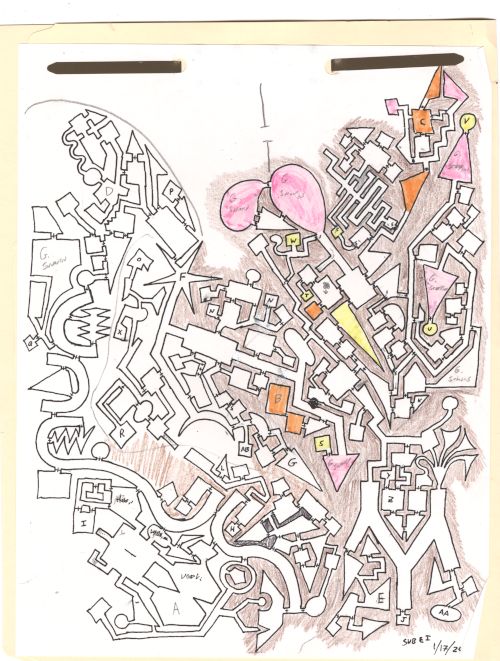
My main problem with this map is that it doesn’t have any striking or defining features. It’s just a bunch of rooms and hallways strung together. While some of these have interesting shapes, and work together locally, nothing in this map leaps out as central, evocative or adventure-worthy. It is a stringy, linear, mess. What is there to do in this map? Go from room to room, pretty much. It feels monotonous to me, lacks a certain spark. Despite having many areas, there aren’t many places to go. I had tried to fix this problem by incorporating several little lairs. Each lair is accessed by a single choke point, however, so the adventure stops there.
Linearity and dead-ends aren’t universally bad dungeon design or anything, though, so why do I have such a problem with it here? I think in part it’s because movement through this map never feels intentional. In a more open layout, movement is intentional because the party has to choose to go in one direction or another. In a well-structured linear map, movement is intentional like a funnel: the structure is driving the party forward, and they can either choose to acquiesce to its meanderings or turn back. Here, the level is neither open enough to allow for strong choices nor intentional enough to draw players forward. Pursuing linearity here does not bring the characters deeper and deeper, into the dread and gloom, it simply takes them vaguely around.
This level has depth in that many of its rooms are stuck behind other rooms, but there is no consistency and little drama. Consider room R or room G–what is there to do but keep going forwards until you inevitably run into them? Perhaps what this map actually needs is more dead-ends–red herrings to force a choice one way or another. Perhaps the balance could be made up for in particularly nasty traps or the like. On the other hand, connecting some of the areas to make satisfying loops would open things up a bit. Perhaps adding some big, domineering rooms as hubs.
Drawing wise, the map is uninspiring. The scale is off in many places. Some of my best maps have been drawn on blank paper; this isn’t one of them. Most of the hallways are supposed to be ~10′ (with a few 20′and 30′ thrown in.) In practice, the map is out of joint with itself. An underdiscussed part of mapmaking is what kind of gestalt experience is evoked in the map reader. This experience can make or break high-stakes creative decisionmaking, which is quite important for D&D. For this map, I find it very flat and blah.
This map never saw much action, thankfully. Once a group dipped a toe in but were quickly chased out by a some Heroes. Perhaps more exploration would have made me more fond of it, but honestly I’m glad none of my players had to slog through it.
Still, this is a completed map–there are lots of little rooms to find. At any rate there’s a lot of space here. I had hoped to stock the place full of exciting contents and call it good–the words “extravagant” and “elegant” are scrawled at the top of the key–I wanted to pick lurid, stifling, incense-and-tapestry vibes. I wanted ancient, shimmering blobs of disused goblets. I wanted the smell of old pillows, faded velvet, fuzz, tarnished silver and brass. What I got instead was writers block. It just doesn’t fit into my dungeon in the way I hoped.
For now, I will place this map into my “old” folder and replace it with something new and bigger. Maybe one day I’ll return and find a use for it. If you are reading this and would like to try your hand at keying or adapting it, please do so and send me what you come up with! (As with everything I post on my blog, you are welcome to use it in your own game, but please do not publish it as your own or feed it to an AI. You are not my friend if you do either of these.)
Saturday, January 31, 2026
Records Requests — How its Going
Here’s how it works: any character, at any time, can submit a Records Request Form to an institution or individual in the world.
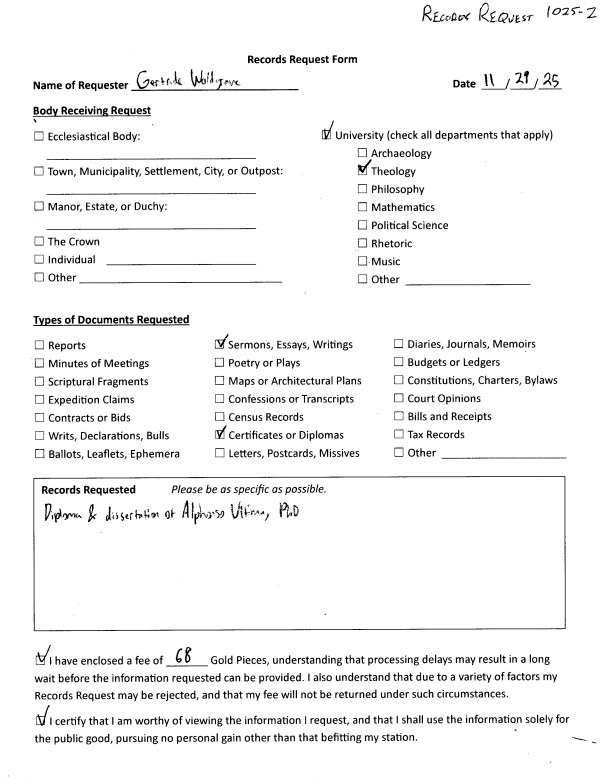
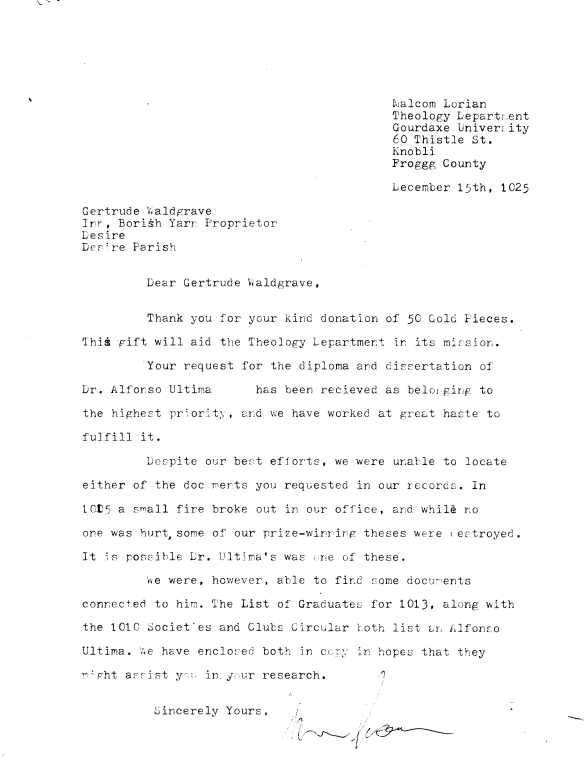
After several weeks the character gets the fulfilled request in the mail. Depending on the amount of gold paid for the fee and the nature of the request the documents received may be useful or not. I post the fulfilled records requests on the campaign website for anyone to view: https://www.reduxodnd.com/records/
The documents mostly answer questions obliquely; they are archival records for the most part, produced for reasons other than adventuring. They are artifacts of a society which exists outside of the adventurers, one full of people who do not know and will never care about player characters. Players have to ask carefully and read carefully to find information they want, and it might not be there at all.
Records Requests in the real world aren’t nearly so fun to fulfill, but here I get to pick out exactly which sorts of documents “exist” meeting the criteria laid out in the form. I can be snarky or evasive, abstruse or helpful to my hearts content. I can sprinkle hints and red herrings, and there’s lots of room to be utterly ridiculous.
I don’t like explaining my world’s lore very much. I’m much more interested in how players react to my world than I am in rambling on and on about it. (What horror stories have been told of DMs for whom a D&D session is a long droning History of Place!) One could break up the lore into multiple conversations with various NPCs, but that’s fairly boring to me as well. Just droning in funny voices instead.
Records Requests let me make a little piece of world information–often quite small–and toss it to players like a hot potato. The players get a tangible document that’s immediately actionable, and I don’t have to worry about it after that.
OD&D can be thought of as several different games working together. There is The Mapping Game (Underworld flavored and Wilderness flavored), The Talking Game, and The Fighting Simulation Game:– Records Requests constitute part of The Paperwork Game. In The Paperwork Game the world is explored through mock bureaucracy. Other components of the Paperwork Game include drawing up plans for your castle, logistics accounting, letters, declarations of war and such, as well as contracts, claims, lawsuits, and so on.
An obvious problem with this practice is managing the volume: can I keep up with producing all the records which are produced in a timely manner? Dungeons and Dragons already takes up a tremendous amount of my time, and writing these documents is quite slow, slower than drawing maps or stocking rooms. There is also greater pressure to get them “right”.
On the other hand, documents will stick around. After a while there’ll be a big corpus of them, each one continuing to make my world rich and navigable. I have been playing with Records Requests for 3 months, and there are about 30 pages of written material. This isn’t a bad start. The material I’ve written has in fact been really helpful in my own understanding of the world, it’s social systems and how it approaches problems.
I have been struggling with finding ways to “pick” documents or document types which 1) are fun to write, 2) are at least somewhat connected to the request, and 3) can be written in a reasonable amount of time. With any kind of game it takes a while to get a feel for things; maybe I’ll get a knack for it as the process continues. If there’s a request for a copy of a novel, for instance, I won’t feel all that obligated to write a whole novel, but I may settle on a review.
There is a sweet spot of verisimilitude I am aiming for with these documents–I’m not doing the full “tea-stained treasure map” document forgery, but I am composing them on a typewriter in a formal style.
You could, perhaps, set up a whole game that’s just records requests and the correspondence between them, but I will leave discussing The Imaginary Historian’s Society for another time.


