Sunday, February 8, 2026
The Mapping Game — Conventional Dungeon Paradigm
Last night I threw together a little game brainstormed with Idraluna I’m calling The Mapping Game–CDP. Like a lot of OSR (and other) projects, it’s mainly D&D but with certain aspects emphasized. Other games de-emphasize mapping in favor of roleplaying, combat, or logistics. The Mapping Game–CDP de-emphasizes those three in favor of the almighty map.
It’s a simple game and has not been playtested, so YMMV. In any case I’m happy with the proof of concept, and may try it out soon on my underworld maps.
Link to PDF here: The Mapping Game — Conventional Dungeon Paradigm Edition
Thursday, February 5, 2026
Defunct Dungeon Map — A Brief Autopsy
Here is a map of what was an underworld level in my OD&D campaign Redux. It was my second attempt at filling an empty space below the Level EPSILON. As I am currently working on a third attempt, I have decided to retire this map. I’ve never really been satisfied with it, honestly.
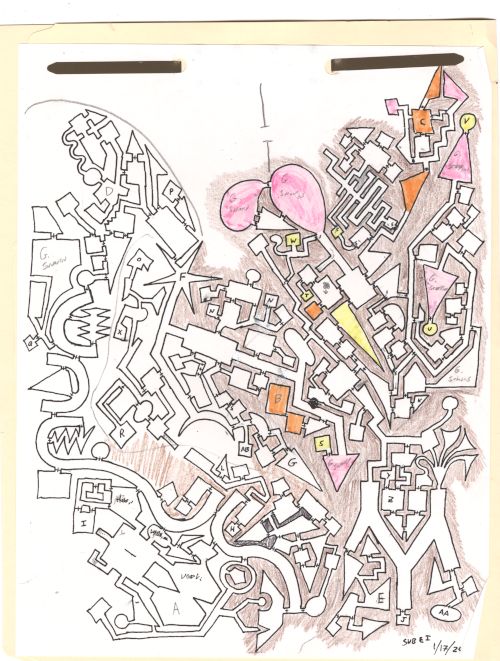
My main problem with this map is that it doesn’t have any striking or defining features. It’s just a bunch of rooms and hallways strung together. While some of these have interesting shapes, and work together locally, nothing in this map leaps out as central, evocative or adventure-worthy. It is a stringy, linear, mess. What is there to do in this map? Go from room to room, pretty much. It feels monotonous to me, lacks a certain spark. Despite having many areas, there aren’t many places to go. I had tried to fix this problem by incorporating several little lairs. Each lair is accessed by a single choke point, however, so the adventure stops there.
Linearity and dead-ends aren’t universally bad dungeon design or anything, though, so why do I have such a problem with it here? I think in part it’s because movement through this map never feels intentional. In a more open layout, movement is intentional because the party has to choose to go in one direction or another. In a well-structured linear map, movement is intentional like a funnel: the structure is driving the party forward, and they can either choose to acquiesce to its meanderings or turn back. Here, the level is neither open enough to allow for strong choices nor intentional enough to draw players forward. Pursuing linearity here does not bring the characters deeper and deeper, into the dread and gloom, it simply takes them vaguely around.
This level has depth in that many of its rooms are stuck behind other rooms, but there is no consistency and little drama. Consider room R or room G–what is there to do but keep going forwards until you inevitably run into them? Perhaps what this map actually needs is more dead-ends–red herrings to force a choice one way or another. Perhaps the balance could be made up for in particularly nasty traps or the like. On the other hand, connecting some of the areas to make satisfying loops would open things up a bit. Perhaps adding some big, domineering rooms as hubs.
Drawing wise, the map is uninspiring. The scale is off in many places. Some of my best maps have been drawn on blank paper; this isn’t one of them. Most of the hallways are supposed to be ~10′ (with a few 20′and 30′ thrown in.) In practice, the map is out of joint with itself. An underdiscussed part of mapmaking is what kind of gestalt experience is evoked in the map reader. This experience can make or break high-stakes creative decisionmaking, which is quite important for D&D. For this map, I find it very flat and blah.
This map never saw much action, thankfully. Once a group dipped a toe in but were quickly chased out by a some Heroes. Perhaps more exploration would have made me more fond of it, but honestly I’m glad none of my players had to slog through it.
Still, this is a completed map–there are lots of little rooms to find. At any rate there’s a lot of space here. I had hoped to stock the place full of exciting contents and call it good–the words “extravagant” and “elegant” are scrawled at the top of the key–I wanted to pick lurid, stifling, incense-and-tapestry vibes. I wanted ancient, shimmering blobs of disused goblets. I wanted the smell of old pillows, faded velvet, fuzz, tarnished silver and brass. What I got instead was writers block. It just doesn’t fit into my dungeon in the way I hoped.
For now, I will place this map into my “old” folder and replace it with something new and bigger. Maybe one day I’ll return and find a use for it. If you are reading this and would like to try your hand at keying or adapting it, please do so and send me what you come up with! (As with everything I post on my blog, you are welcome to use it in your own game, but please do not publish it as your own or feed it to an AI. You are not my friend if you do either of these.)
Thursday, January 22, 2026
How to Locate a Secret Room
Idraluna Archives’s writeup The Mapping Game is a wonderful description of an aspect of D&D which is sometimes under-investigated.
My two cents to throw out into the world is a few thoughts about how to place secret doors in places where mappers might infer them.
For this exercise, I’m assuming secret doors which are impossible to find unless characters actively take several turns searching the walls for them (except for elves, of course.) The idea is that, solely through the dungeon topology, players get a hunch.
They are arranged from easiest to hardest to locate. I’m not too worried about secret rooms being missed–all that means is there’s treasure left for next time. If it’s a really important secret door, you can put a bookcase, statue, or fireplace in front of it. (Or a big flashing sign reading “SECRET DOOR HERE”, which would be fairly nasty, especially if the secret door was actually 50′ to the right.)
Void Space
This method is works for high-density dungeons, and it’s the simplest. Consider the following hypothetical player-drawn map:
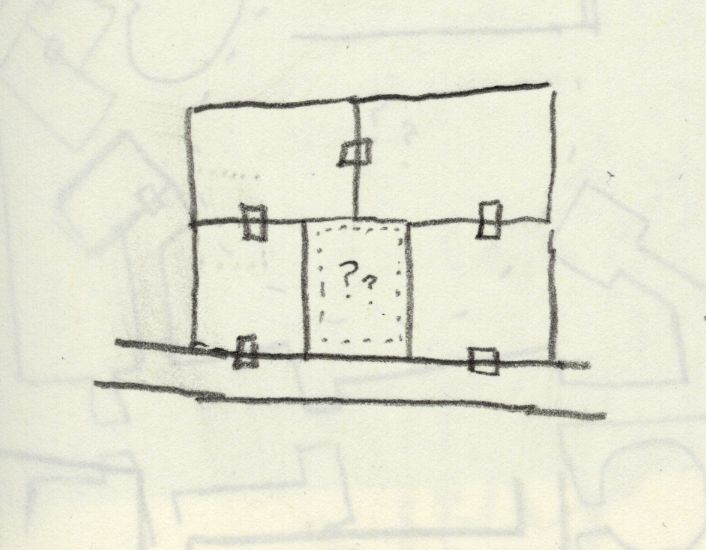
The rooms make a simple loop, but conveniently leave space for another rectangular room in the center. How could there not be a room there?
Pattern Interruption
Here you simply present a pattern and then supply its absence.
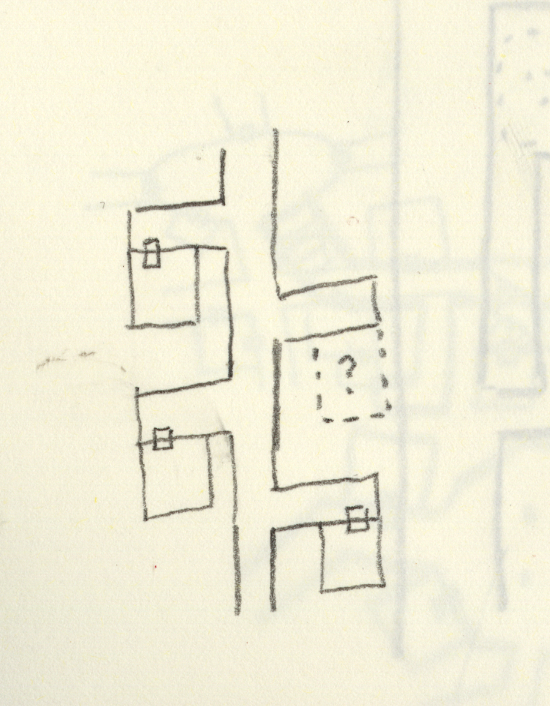
The pattern can be anything, but the key is to establish a trend and then buck it. Why would it suddenly change? Something fishy is going on…
Distance Discrepancies
In the novel House of Leaves by Mark Z. Danielewski one guy discovered his house is several inches bigger on the inside than the outside. While we can’t expect player characters to measure dungeons with such precision, it is possible for distance discrepancies to be noticed. Hey, this room is smaller than I’d expect it to be!
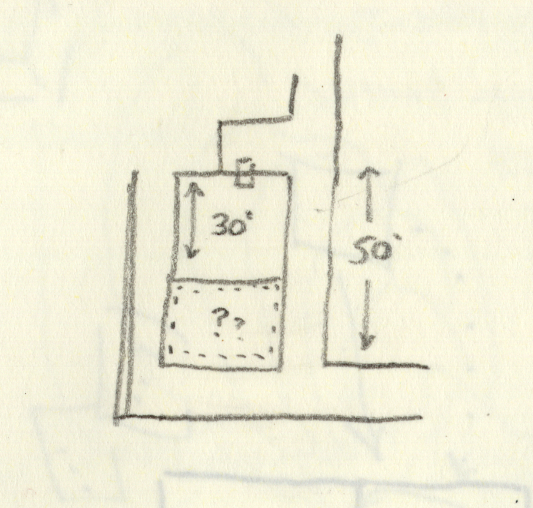
This can also be used with long parallel dead-end passages.
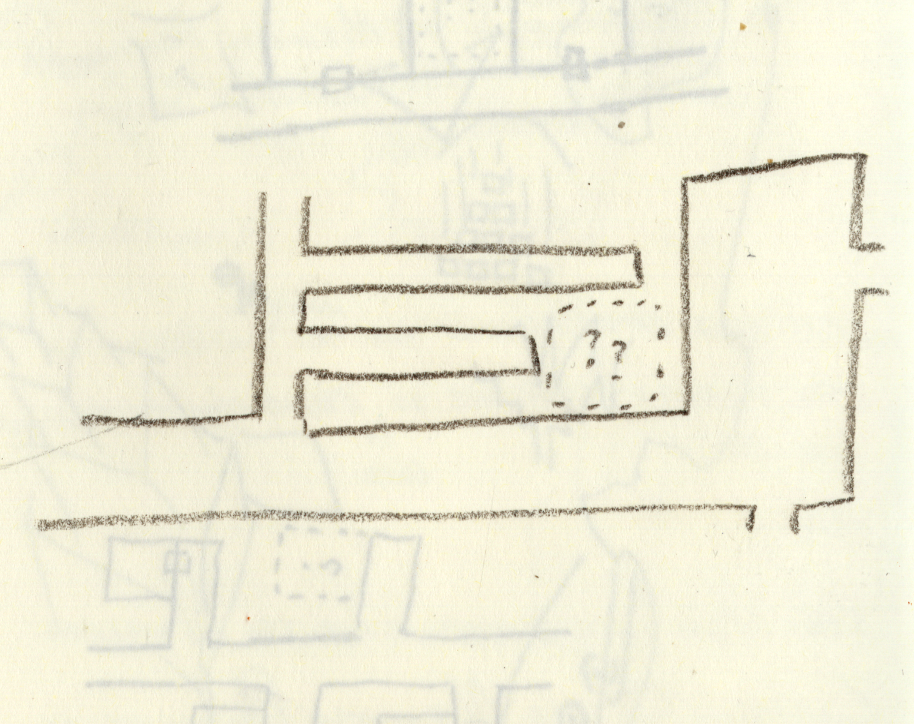
The Pincer Move
This method operates on a larger scale, where two apparent dead ends end up facing each other. Useful for telegraphing an entire secret area. Really the Pincer Move is a variation of Void Space.
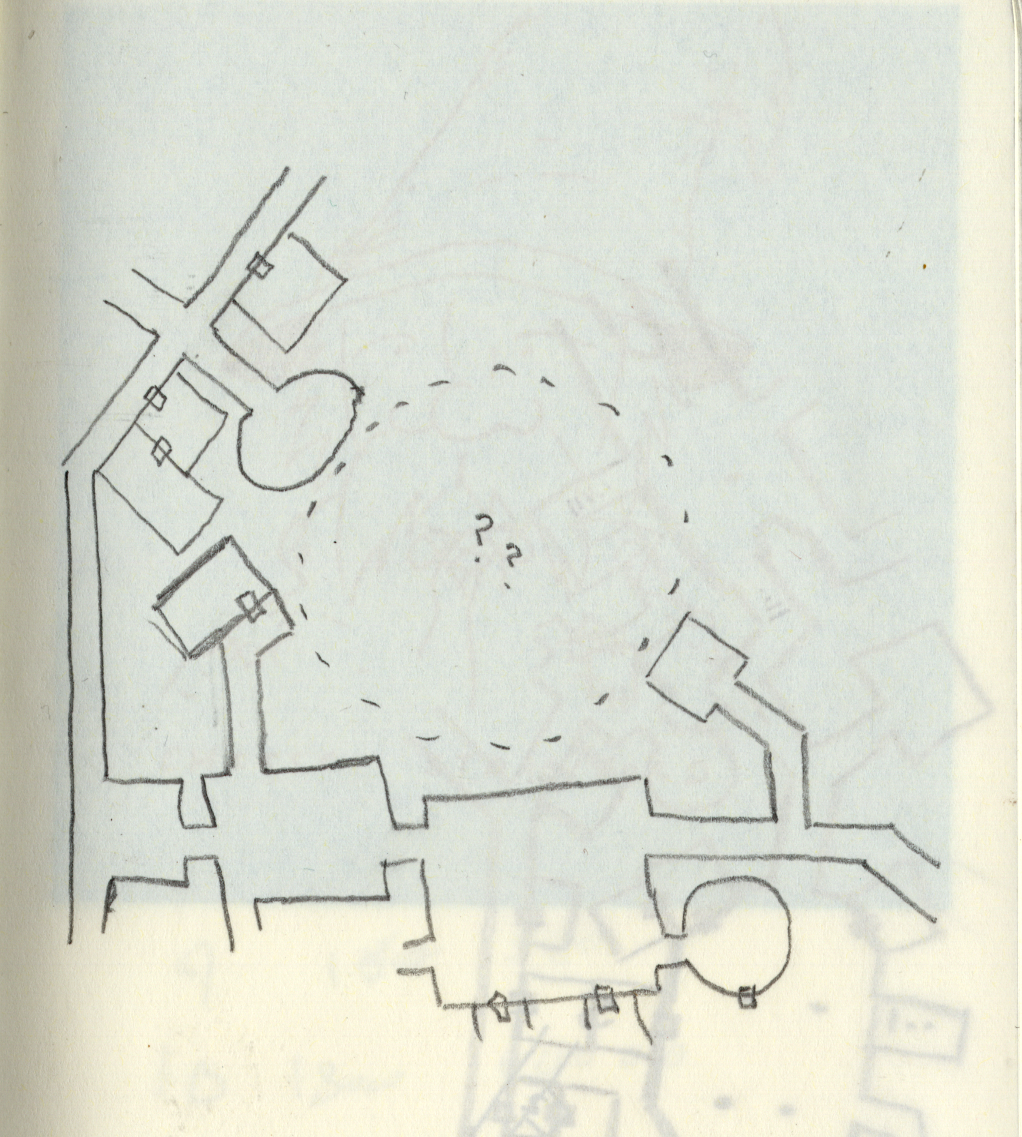
What on earth could be over there?
Shortcuts
Dungeons wind their way around each other in a frustrating fashion. To facilitate getting form one place to another quickly, (after an area has been cleared) I add shortcuts. Here we have a round-about way, and the room in the center would be a perfect point of egress into the adjacent area. A secret door conveniently located there will probably be missed, but if a thouhgtful party is poking around for shortcuts, it might be an excellent discovery. Monsters will also use it, of course, which may also tip the party off. There’s gotta be an easier way to get through!
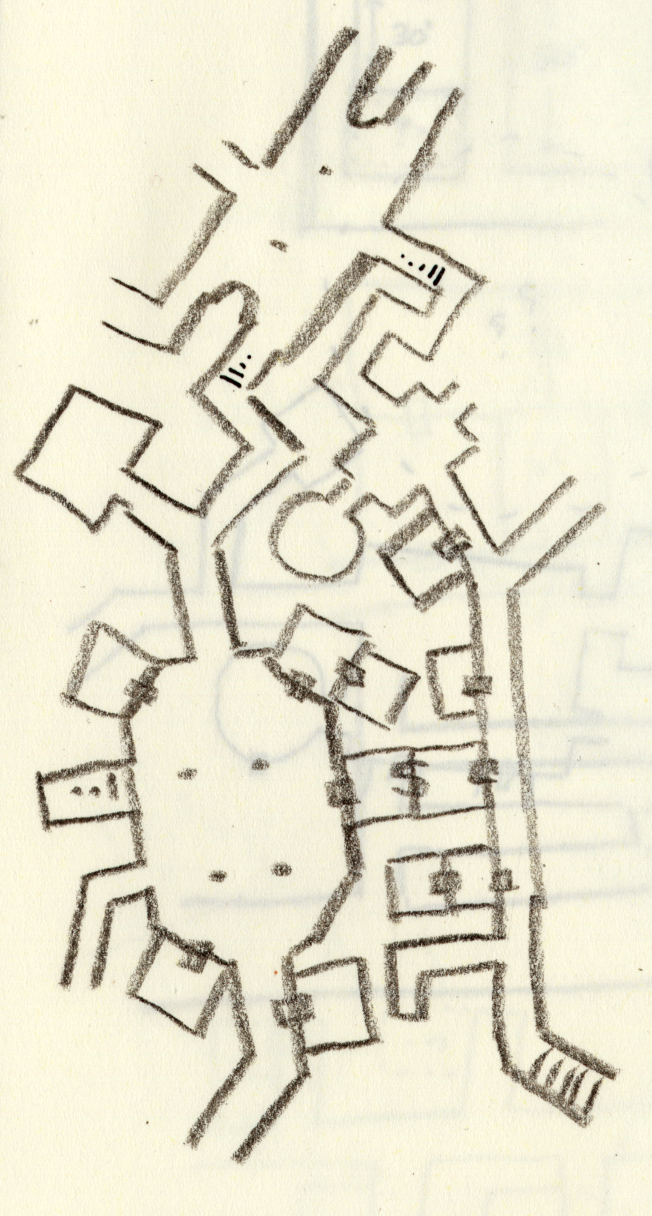
(Shortcuts can also be made solely with ordinary doors, as well. Since moving through passageways is less noisy and dangerous than rooms, hiding a shortcut behind several ordinary doors is viable.)
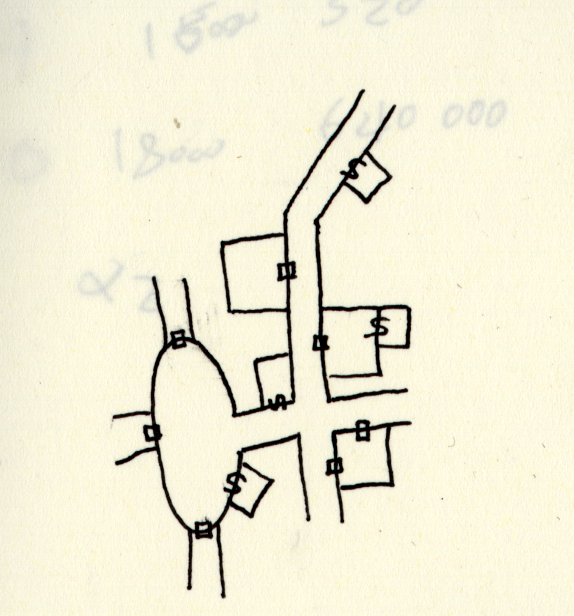
Random Location
These kinds of secret rooms are very difficult to locate using only the Mapping Game. Spells, hints, door mechanism clues, rumor, and old fashioned luck are needed to find secret doors like these.
Saturday, July 24, 2021
Level Epsilon
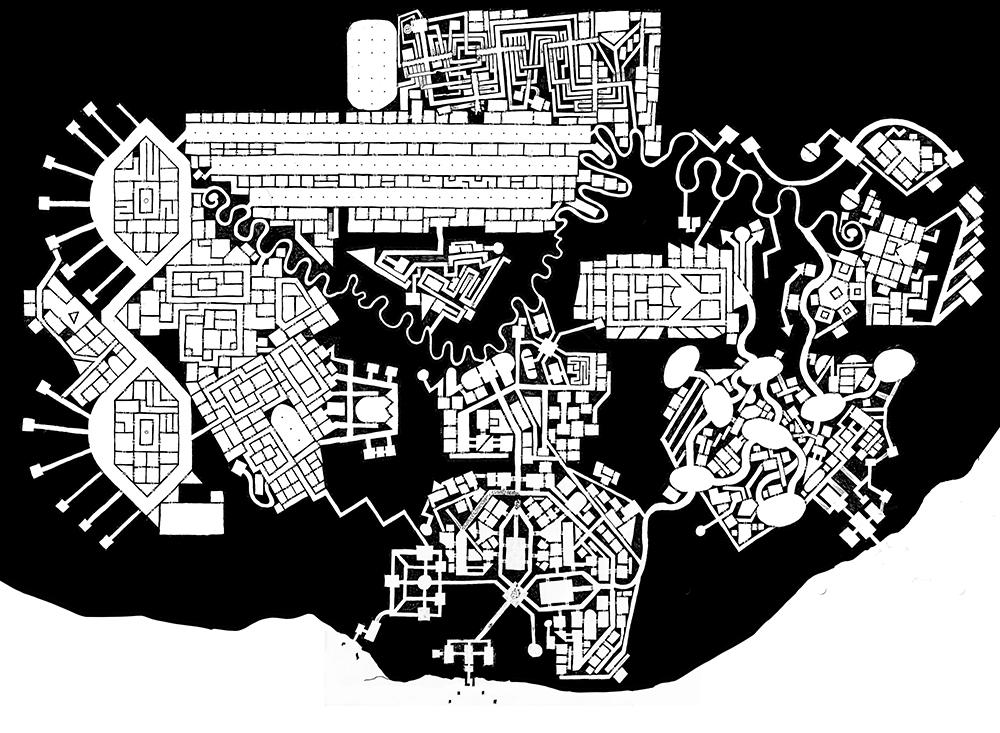
This is Level EPSILON. It is the first map in my underworld that is completely drawn. Level Epsilon is also a “first level” in the sense that it is one of the levels accessible from the surface, and is a likely place for first level adventurers to explore. There are plenty other entrances to the underworld which could serve this function as well, though.
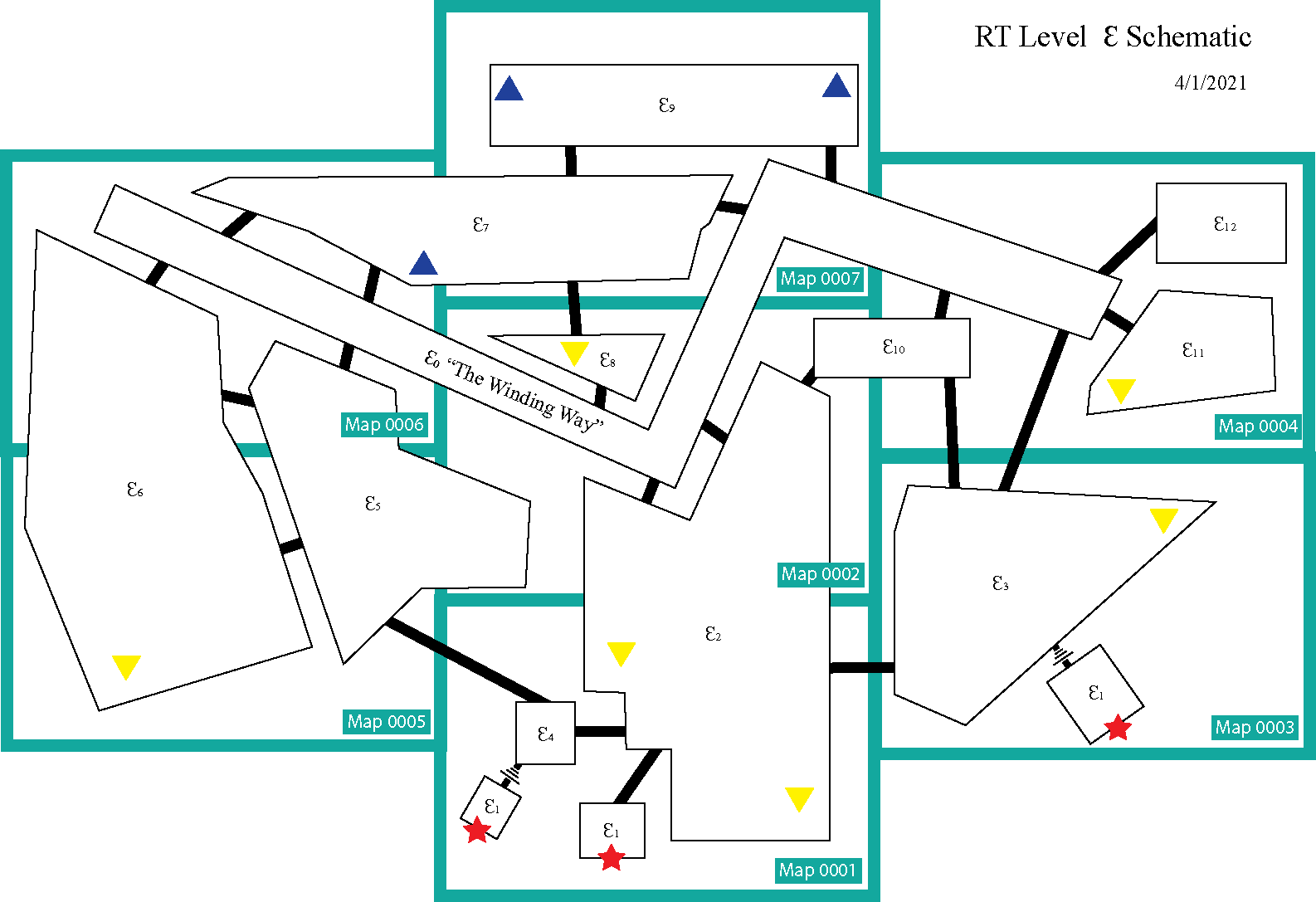
Before sitting down and actually drawing the map I worked out a outline of the different areas, and choke points between them. I had some idea of what this level needed to do:
- Connect to levels NU, PI, and ZETA below and to level ALPHA-EPSILON above
- Serve as an introduction to OD&D and my campaign
- Have plenty of space for getting lost in and exploring
- Harbor a couple of big secrets for the party to accidentally uncover
I also had a couple of concepts I knew I wanted to include:
- Stuff all around–rooms and hallways are crowded, full to the brim with junk
- “The Players” a theatre-themed monster group
- Skeletons, because I like skeletons
- animal-men of some kind
- “The Winding Way”, a distinct architectural feature that is mysterious, but also helpful for navigation
With these in mind, I divided the sections up more or less arbitrarily. I made sure that every section connected to “The Winding Way” at least once, and made other connections as seemed necessary.
I then went to work on the actual maps themselves. It took about 3 hours for each map, over the course of a couple weeks. I sketched in pencil the outlines of the sections as described in the outline, and more or less let myself go. The result was dungeon sections that were very separated from one another–almost like little islands. While choke points are good, I might experiment with smaller sections and more choke points closer together in the future.
The architectural styles of each of the sections turned out to be very distinct from one another. I didn’t exactly intend this at the beginning, but it’s nice. Each section has a different wandering monster table, so it makes sense that it has a different “feel” as well.
All in all, I’m pleased with the way this map turned out. I am excited to begin keying it, and to have people adventure within.


