Thursday, March 26, 2026
Creatures: The Redactor
There is no being more frightening to have players encounter than The Redactor. Other monsters do hit point damage or attack with level drain or simply eat up valuable session time with tediousness. The Redactor is more malevolent and irreversible than these. The Redactor devours referee notes.
The Redactor has 5 HD, moves at a speed of 20”, and cannot be harmed.

When The Redactor attacks, each hit dealt corresponds to the complete blacking out referee notes, either 1 line or paragraph (for text) or 2 square inches (for maps and illustrations) (Determined randomly, perhaps by where the dice fall on the page.)
If The Redactor hits with three simultaneous 6s, an entire page of referee notes is destroyed.
Destroyed here means shredded and thrown away. It means gone, not set aside, not retired, not crumpled up playfully only to be carefully unfolded later. The referee must rip the page out there and then and tear it into tiny pieces, or burn it, or shred it, or eat it. Digital files must be deleted and overwritten. All copies, originals, backups, and collages of that page must likewise be destroyed–no trace can be left. No photocopy or photograph or partial residue is safe. Best efforts must be made to take down shared or published material. As much as possible, all material traces of the page contents must be wiped away. What remains will be only memory.
Player notes are entirely unaffected by Redactor attacks.
The Redactor can be appeased if willingly offered pages of player-made notes–between 1 and 6 pages of maps or 3-30 pages of text will satisfy it. Otherwise it will hound the party relentlessly, steadily eliminating the substance of the game itself.
There are stories of referees who have lost entire campaigns to The Redactor when players did not realize what was happening until it was too late. They could not find their way out of the underworld because the referee map was gone and stairways were improperly marked. Page by page, the campaign sank into oblivion.
There are further stories–more unsettling–of games which continue on long after The Redactor has eaten everything up, of referees who sit without pencil or paper, only dice, running the game by memory alone while players scribble furiously, nearly hidden behind stacks of loose leaf and binders, the glut of their copious notes.
Tuesday, March 24, 2026
Yes and No, but… ?
It is time for another combative theory shitpost upstream from play.
Dungeons and Dragons is not improv theater. I call it a wargame because that’s sort of what it calls itself and others call it a roleplaying game which is fine, but D&D is not improv theater and it’s not group storytelling in the way that writing a novel is personal storytelling. D&D is a game: a game is a structure of rules and conventions in which participants take playful action.
It would be quite reasonable for you to @ me with complaints that my playstyle isn’t everyone’s, or that the way some people play D&D actually does resemble improv. I won’t dispute that there are many different ways to understand games, and I have absolutely no interest in telling people that they are playing a game wrong. When I say Dungeons and Dragons I just mean what Dungeons and Dragons is to me as I’ve experienced it.
The term “Yes, and” seems to come from improv theater, and my vague understanding of it is that it’s a method for getting actors all on the same page during a scene. “Yes, and” is a solution to two problems during spontaneous performance.
1) Yes there’s no time to discuss what the reality of the scene is, so the actors agree to take what’s been given as accurate. Whatever performance a scene partner gives, whatever facts or implications are presented, that’s Yes. It’s already existent in the scene, and we just gotta go with it.
2) , and the thing about scenes in theater is that stuff happens in them. There has to be action of some kind, otherwise the characters are likely to hang around listlessly. To prevent a situation of passive “yes”s, the “, and” insists that a performer pushes the situation beyond what it was before. It’s not enough to confirm your partner’s reality; you must also move that reality along.
This framework is great for performances on stage or in living rooms. It’s fun to do in practice, and it makes for entertaining shows. I don’t, however, think it is a very good way to think about what a referee does in the game Dungeons and Dragons.
Yes
Firstly, D&D is asymmetric. Unlike improv, the players and ref have different roles with vastly different relationships to the imaginary world. “Yes, and” makes sense between equals co-creating a scene, but in D&D, where the ref has binders full of secret places and pages of hidden rules the “yes” principle doesn’t hold.
At best a referee “Yes” in the mode of “Yes, and” is somewhat condescending and one-sided. Can a player “Yes, and” a ruling the referee makes? Certainly not in the same way! Really what’s being presented is something like permission: the referee deigns to give permission for players to take some novel action or do some cool thing. Framing such rulings as “Yes, and…” puts the referee in the uncomfortable position of constantly having to dispense narrative control when players ask for it, or, worse, sometimes deciding not to.
I think a better approach this is for players to have narrative power from the start. Not delegated by the referee, not affirmed by them, but simply there, in the rules. Players can take game actions without the referee’s permission. On what authority can they take these actions? Why, the rules! Sure, the referee is here in a new precarious role, making decisions about the rules and how to apply them reasonably-–this takes sensitivity, kindness, and common sense-–but in my opinion it’s more honest to the situation and fair to the participants. The rules mediate between the referee and the players.
Narrative power is inherently vested in the players through the actions they can take; there is no need for the referee to mete out control to players in an attempt to acquiesce to the “Yes, and…” principle. I hope I’m making the distinction I see here clear.
, and…
Secondly, D&D is a game, not a performance. Obviously there are performative aspects to D&D–its very worth it to do funny voices in front of your friends–but even this kind of affect is distinct from anything onstage with an observing-only audience.
It is okay, for instance, for games to be boring or tedious. It’s okay for not much to happen, or for much of what happens to be banal discussion. The process of playing a game is far more important than whatever stories come out of it. A game is more akin to rehearsal than performance: there is no audience.
Framing the referee as an entertainer is a mistake, I think, because that robs players of their agency in a game situation. The dungeon is not a show the referee is putting on; it’s a game space full of interesting things which the player characters can inhabit. The pressure to “, and…” anything in service of some kind of entertainment ideal can push the referee to avoid otherwise fruitful scenarios. Sometimes an empty room is just an empty room, and it’s important to allow players to feel the full weight of that reality, with all its implications and incongruity.
“Yes, and…” frames the whole affair as an improv experience aimed solely at being exciting to viewers, and I just don’t think that’s what pen-and-paper games are good at.
This post was directly inspired by Permissiveness in RPGs, a post which I entirely agree with I think.
Saturday, March 21, 2026
Interlude
Here is a picture I took the other day.
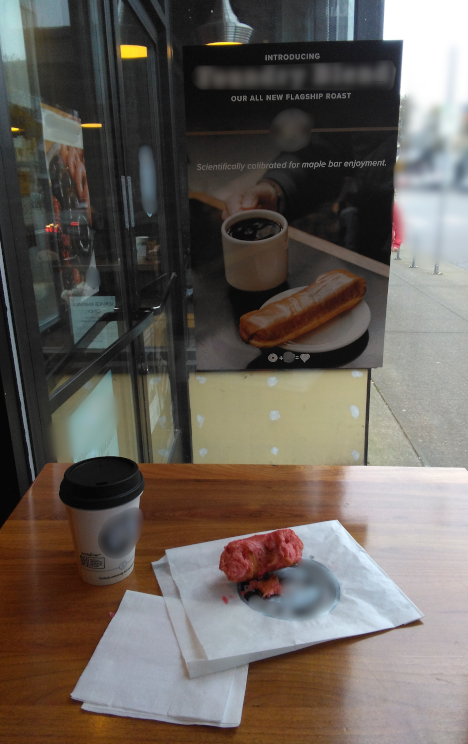
While enjoying my coffee and my donut there was directly before me–displayed specifically for someone in my position to view–an idealized version of the very experience I was currently having. An odd encounter!
I understand advertising: the point of the poster is to make people who aren’t having coffee and donuts want some. The donut shop commodifies the experience of having a donut, and they sell this experience in order to make profit for their owners. It does not matter to the shop whether the experience is enriching to me or my community; all it cares about is ensuring that as many people as possible will pay for it as often as possible.
But what was this image to me, the fool who had already succumbed to the desire, who was actively consuming the commodity being sold?
Maybe the point is to demonstrate to me the buyer that my experience and the advertised one is the same. The store is saying “See? We aren’t lying. You get what you see in our pictures. We are a trustworthy establishment” It’s not as though the donut shop was actively swindling me–the donut was good enough; the coffee was hot. As you can see, it was like the picture.
Maybe it’s simple contempt. The only images a donut shop bothers to produce are advertisements, and so that’s the only decor they have. Once someone has purchased a donut-having experience, the shop does not bother one iota about giving that experience anything more. There are chairs, tables, and a bathroom out of begrudging accommodation for human needs, but it is not selling a “sitting at a table” experience: it is selling a donut and coffee one. All its decorative aims are devoted to this end, and this end alone. Everything else is superfluous, and, as long as it’s not intolerable, it is allowed.
I wonder about other images around me which I embody as I encounter them: The little white “crossing person” whom I become when the light changes, and that pants-wearing figure at the public restroom (after all what better image to represent pissing and shitting than gendered clothing?)–these are instructional symbols, attempting to tell me what to do and who to be.
What is easier to create nowadays than an image? What comes more naturally in everyday 21st century life than media depiction? Everything must have a picture attached–and to ensure making pictures is even easier corporations have developed AI-slop to fill this need, this constant need to present images and commodify experiences, to make sure that we are caught in an impenetrable forest of pictures all of the god-damn time.
Importantly for my rhetorical aims, this blog post itself centers a picture which I made with the camera that is always in my pocket in case I need to make an image out of something I see in my everyday experience. My daily pocket loadout has me constantly poised to capture, repackage, and share the world around me.
I have been trying to be better about being bored, about sitting in one place and letting myself simply be. I guess I’d prefer the donut shop window have no pictures at all and let me sit there and look through the glass. No decor for me, thanks, I just want to spend my lunch break in a real place.
Of course all places are real places if you have experiences in them, even commodified ones, even imaginary ones. You can be bored anywhere if you’re thoughtful enough.
Friday, March 13, 2026
Keying and Running Redux Alpha
In this post I share my notes for Redux level Alpha. It’s in response to what are reasonable questions about how my large and oddly shaped dungeon maps work in actual play. It’s also a record of my personal prep and playstyle. I don’t pretend to be presenting anything terribly novel here–there’s no shiny method or clever innovation in how I run things. This is just what the most well travelled corner of my underworld looks like after 30-odd sessions of 3LBB campaign play.
It is a companion piece to Redux Setup, which covers some physical aspects of how I run my game.
The Notes
Here is a pdf which contains my complete notes for Redux Alpha, redacted to exclude what hasn’t seen play action, or what might be spoilers. Only about 3 pages of notes are witheld:
In addition to these notes, here are documents authored by Alfonso Ultima, Phd. These were kept in the folder until discovered, then handed to the players:
Ultima_Has-God-Spoken-to-You.pdf
Ultima_How-to-Make-Decisions.pdf
Ultima_Guilt-and-Forgiveness.pdf
For comparison with actual logs of sessions played, here is a pdf of all 9 Redux sessions up through March 1026 where action took place at least partially in Alpha:
The Map
Construction and Development
Alpha began life as a fairly straightforward map drawn on graph paper. It looked like this:
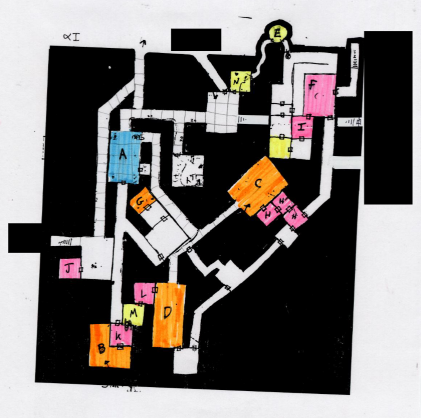
This map never saw play. By the time I got a group together, I had replaced with this, the current Alpha:
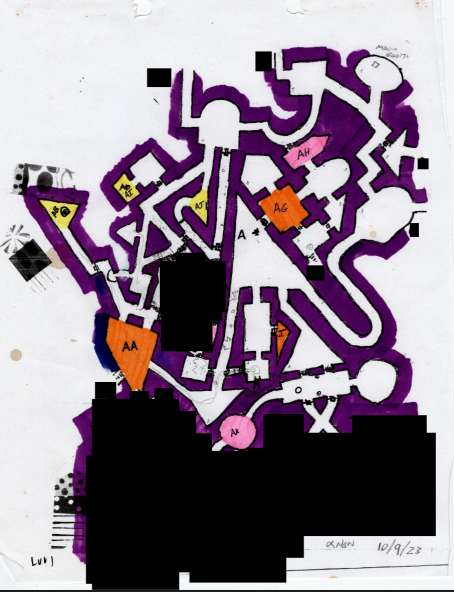
I drew the new map on an index card, then printed out a full-page version to key. The highlighting indicates results from the U&WA tables: pink for Monster, orange for Monster and Treasure, yellow for Treasure only.
When I drew Alpha I was very cognizant about playability. I wanted the level to be accessible and exciting. It’s not too big, and each of the paths one can take leads somewhere slightly different. The large triangular room makes a pretty good landmark for deciding to explore other areas.
The multiple loops mean that Alpha is pretty good for telegraphing unexplored space. It’s been useful for players to work their way completely around an area. This has also meant that chases are pretty fun–there are several ways to get back to safety, and players have been able to make intelligent decisions in order to avoid danger.
Alpha is connected to lots of other levels. There are two downwards stairways and an elevator (though nobody’s ventured down them), to the north and to the east are other levels. To the south, well, less said about the south the better.
The Alpha Mapping Game
I gave players this initial map of the area. You can see plainly that it is wrong in several places, but it gives hints about the general layout.
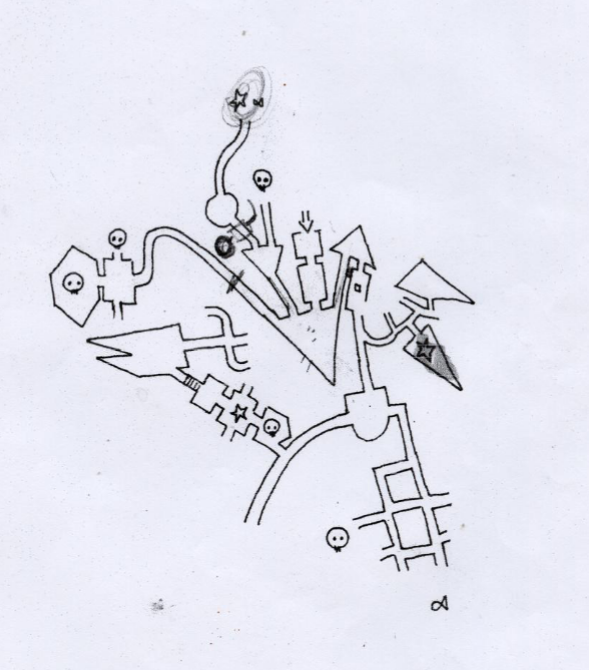
This map proved to be quite frustrating to players when they discovered it was incorrect. To my surprise, instead of realizing the map was wrong, they decided they were in the wrong place! Eventually they figured it out, though. The point was to aid players in drawing their own maps, not to have them use the given one.
Here is the most up-to-date player map, drawn by Idraluna and posted with his permission:
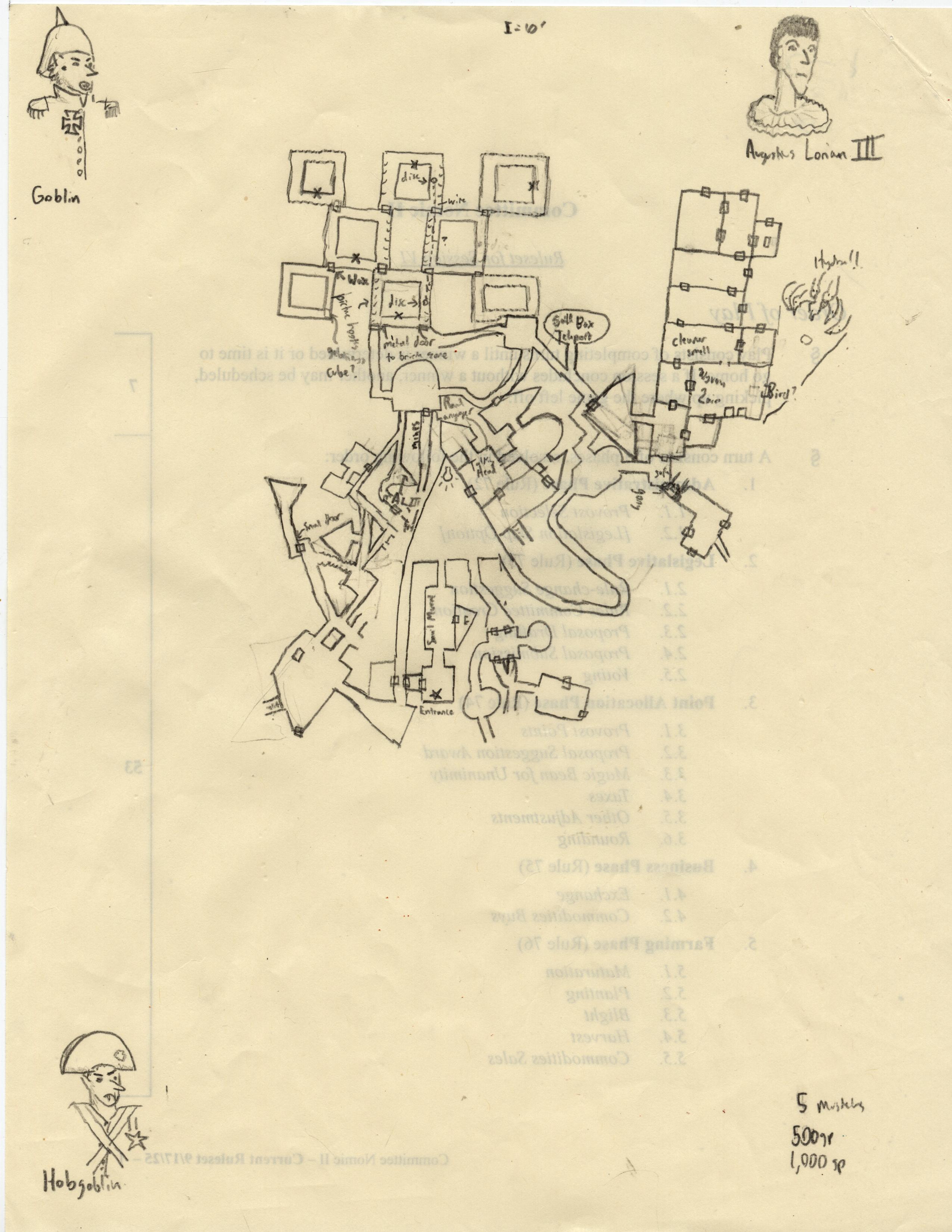
You can compare this with the referee map and see that it is incredibly accurate. I have had zero trouble with players mapping Alpha.
My referee map doesn’t have any markings, but it is draw to scale, so I eyeball the distances and relay them. When a room is difficult to describe, I will draw it out on a piece of scratch paper and show it to the players for them to copy down. I keep an eye on their maps, and if they draw something which doesn’t fit what the characters are seeing, I correct it.
I don’t correct errors on the player map if the characters aren’t there to see it, and if a player makes assumptions (say, connecting a hallway on the map without having actually gone down it) they are on their own.
Keying
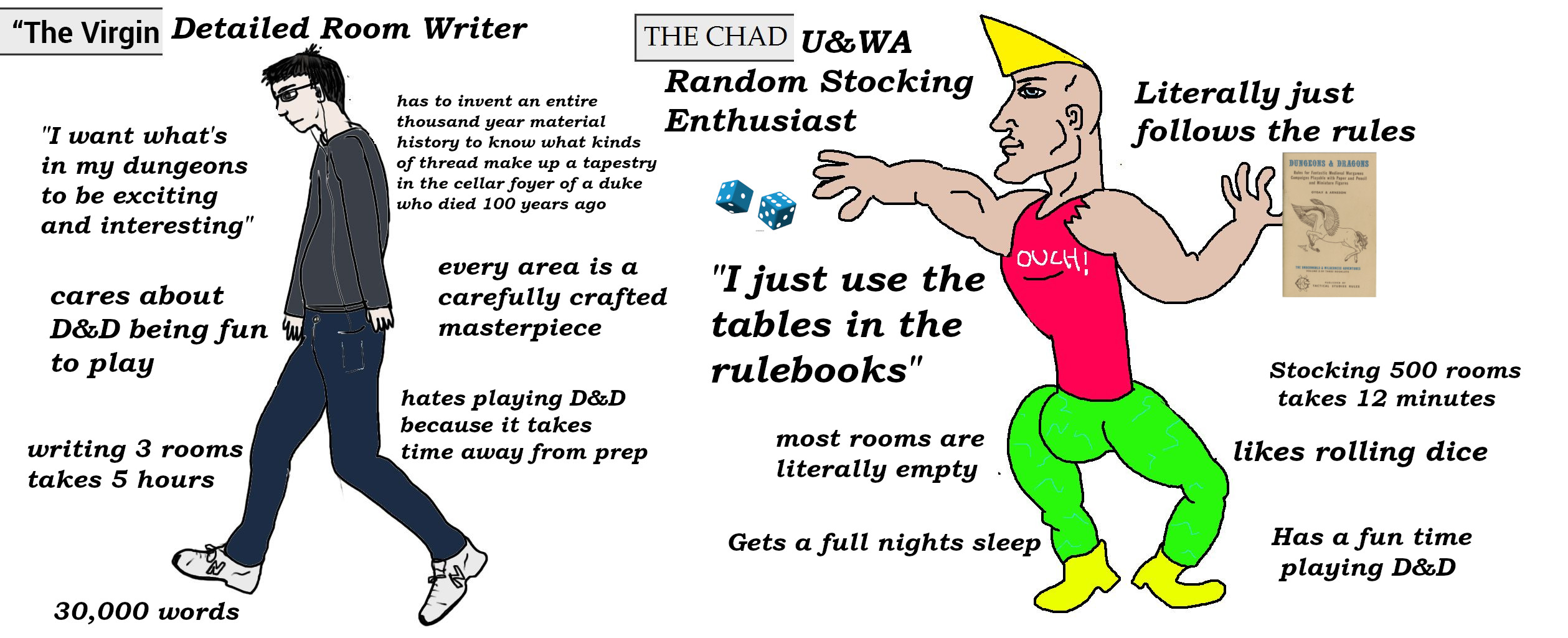
This meme demonstrates the duality within my soul
Initial keying was done mainly with the U&WA tables, with a few areas grandfathered in from the earlier keyed version of the map. I really like the random distribution, because frequently the dice will place content in places I never expected. For treasure especially, the U&WA tables are great for insisting that something is there, definitely in that place. Once I have a baseline distribution, I can go in and add more detail/embellishments.
In general I take fairly sparse notes, but add concrete detail in specific areas. Redux Alpha has a lot of writing associated with it, but most of this writing is Dr. Ultima’s essays and pamphlets.
Select Wandering Monsters
My wandering monster table has undergone several modifications. When a monster type has been cleared from the level I cross it off the list. Alpha uses a simple two-tiered table with monsters inhabiting Alpha and those from elsewhere.
Ruff-fish
The Ruff-fish are a plain rip-off of a vignette in Yevgenia Belorusets’ Modern Animal, where a priest has been preaching to a group of fish, and they respond with the curious inverted collective-individual dialogue.
They are a chorus, and so to produce the chorus I have the players all read aloud from the script together. I’ve had a lot of fun with these encounters. It’s pretty much strictly non-combat, but it forces players to be immersed in what’s happening before them.
The problem comes when players ask the Ruff-fish questions. I haven’t been able to come up with many satisfying ways for dialog with these creatures, so for the most part they say their piece and move on.
Dr. Alfonso Ultima, PhD
Dr. Ultima’s writings have been a really fun part of Redux. Started with a pamphlet, and he has also written numerous essays which get left around. The man himself has been fairly elusive; the players are still puzzling over what his deal is. He was the subject of a Records Request.
Select Keyed Areas
A - Lightbulb headed monstrosity (ON)
The LBHMs were inspired by the “protagonist” character from MAD GOD. They have lightbulbs for heads and lots of HD. When their pull-cord is pulled, the light is on, and the LBHM sits immobile.
This was a really great feature for the early sessions. It was something of a mystery, it lit up the central room for ease of description, and, it’s largely harmless unless disturbed in an obvious way. Eventually the PCs’ curiosity got the better of them, and they killed it, which is sort of sad.
?? - Goblins
My goblins have uniforms and equipment reminiscent of WWI Germans. The concept is something like outposts of units, so they have been building out various defenses. Including booby traps (usually poison gas behind doors or paintings), obstacles like barbed wire and land mines.
Goblin rifles are really dangerous at long range, but closing the distance seems to work well, as they aren’t wearing armor. So far bullets have been stopped by shields in NRACS, but I might want to change that soon.
AB - Treasure of the Snail Knight
Search for the actual treasure is still ongoing. In typical Referee fashion I assumed it would be much easier to find than it actually was. There is a looted treasure room, which contained a huge and heavy brass snail shell. Much interest was had during the session where the party slowly dragged it out and hoist it up the shaft into the air.
?? - Magic Booth
A simple teleported added well after the initial keying. Having a cool-shaped empty room was really handy for this purpose.
The Living Dungeon
Huge portions of what’s “true” about the dungeon have few or no written notes.
Perhaps the biggest one of these is that Alpha starts with stairways to a room, then a rough 40′ shaft downwards into the center of the level. There are no notes of this room or shaft because I know it’s there. This fact about the world shows up in player notes and expedition logs, but not my referee map or notes. The space in which play occurs–call it an imaginary world if you like–does not exist except in the actual interactions at the table. It’s not written down anywhere fully, it’s not in my head, not really. It emerges through social play.
Monday, March 9, 2026
Level Zeta III
The gift of creative energy has been bestowed upon me, and so here is a deeper part of my underworld: Redux Zeta III (0,0).
No, this is not a disentanglement from, but a progressive knotting into
- Gravity’s Rainbow, p. 1
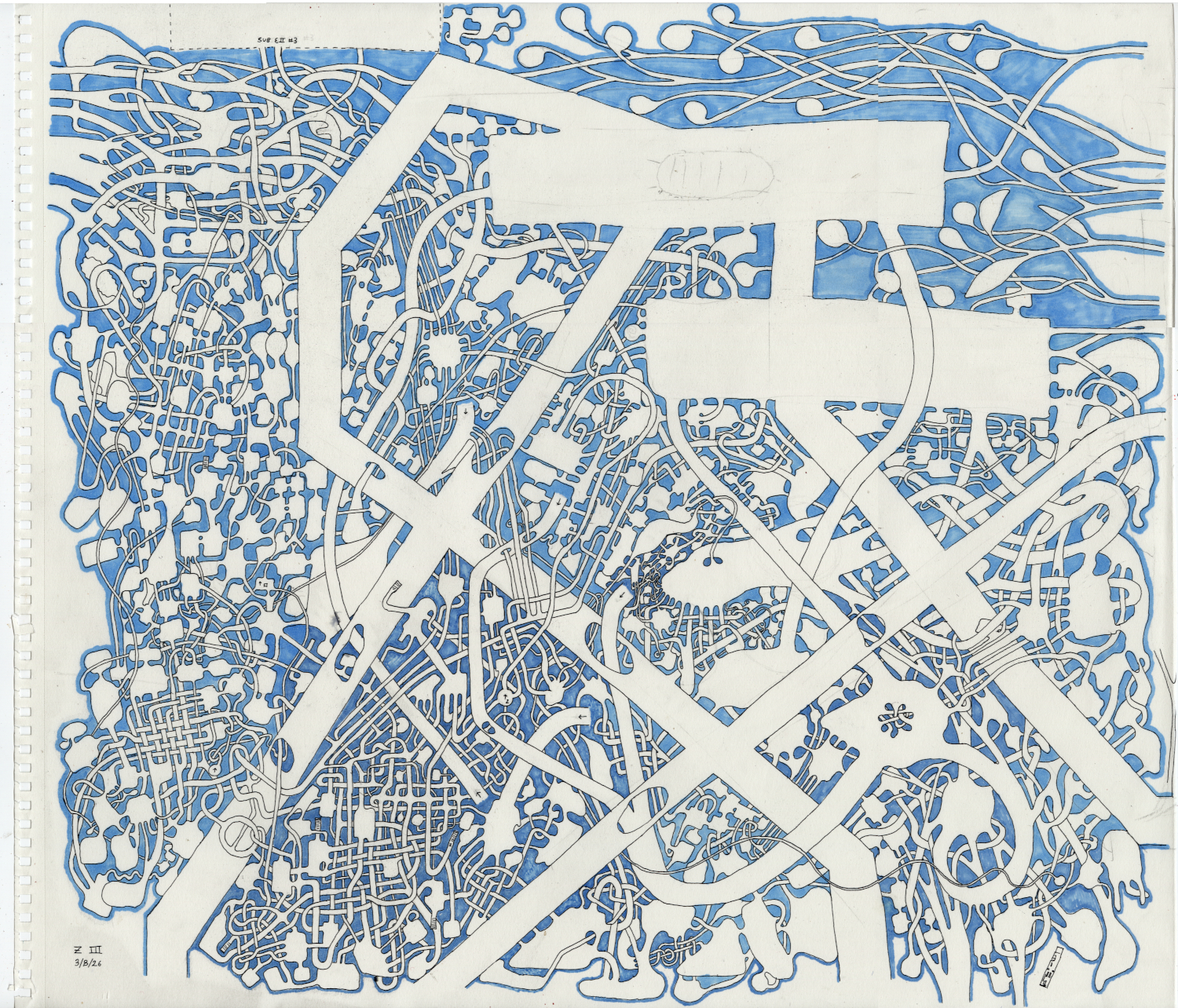
Zeta III is three levels beneath Epsilon and two levels beneath Delta-Zeta I. Its main connections are with Zeta I and Zeta II. 5 of the arms of Zeta I’s large star descend via slopes two levels to Zeta III: these are those curvy 30’ passageways. You can also see the two gargantuan rectangular rooms–Zeta III is the floor of those rooms.
The scale is the same as my other maps, though it’s not on graph paper. For reference the three parallel passageways in the upper left are each 20’ wide. The smallest corridors tangled in the center are about 2’ wide.
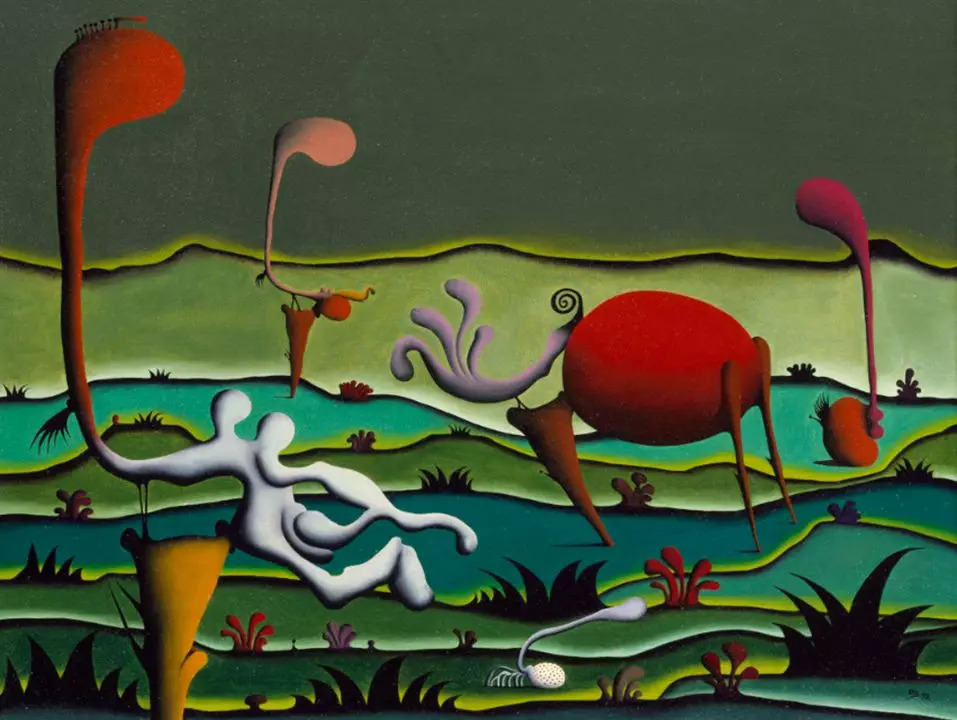
Unlike Delta-Zeta I, I have many concrete ideas about Zeta III’s denizens. In the colossal rectangular open spaces are huge roly-poly’s. The large 100’ hallways are the domain of the Ormyul. The many densely packed chambers on the left hand side of the map contain an extensive library. The larger 15’ passages are home to Snail Men. The balance will be made up with creatures similar to those found in this painting–surreal sorts of colored blob creatures.
I suspect a workable method of mapping Zeta III will be a node map with lines representing corridors and nodes representing rooms or intersections. In part because in many ways the way it’s drawn is already a node map, just with added embellishments.
I’ve been making maze drawings with overlapping passages since middle school. I’d always wanted to find a way to make them D&D maps, but the logic never quite made sense to me. Still stuck in my foolish notions about dungeons having to make some kind of sense I wasn’t in a place where I could make something satisfying. For some reason I’m there now. It’s strange how as we get older, we come into age for certain things.
I’m definitely not the first person to draw maps like this. The ones here are beyond astonishing and beautiful. I tried to mimic some of the elements from those, with “windows” cut out of the bigger spaces and lots of parallel passages. I couldn’t hold a candle to their precision, though, and moved into my own chaotic knotwork.
I found myself experimenting with a bunch of different styles here. The 100’ passages sort of break the map up into sections, and in each one it appears I’ve tried something a little different. I won’t say this was intentional–it just sort of happened. Some of the styles I like more than others. I’m especially intrigued to explore more flora-like structures, with leaves, vines, and flowers.
The blue shading adds a lot. I didn’t intentionally choose TSR module blue, I was just looking for a somewhat neutral color which would provide good contrast, which I suppose is why they chose it.
There’s lots I’m happy with in this map, though I sort of hate how the big 100’ passageways look. They don’t fit in with the rest, and I feel like they are awkwardly in the way. This was sort of intentional–I wanted them to be separate from the main tangle, blocky and sharp obstacles–but I feel like they just sort of look bad. I drew too early in the process, and too hastily I think.
It is possible that they will look less bad once I give them somewhere to go–you can see how the map extends off three edges; more maps of this type will need to be drawn up. Perhaps its just that they’re such a huge structure you need to zoom out farther for them to make sense.
I have plenty more paper.
—
I ran a session of The Realm of Yolmi using this map, detailed here: Escape From Special Operations Complex #903 Session Report