Monday, March 9, 2026
Level Zeta III
The gift of creative energy has been bestowed upon me, and so here is a deeper part of my underworld: Redux Zeta III.
No, this is not a disentanglement from, but a progressive knotting into
- Gravity’s Rainbow, p. 1
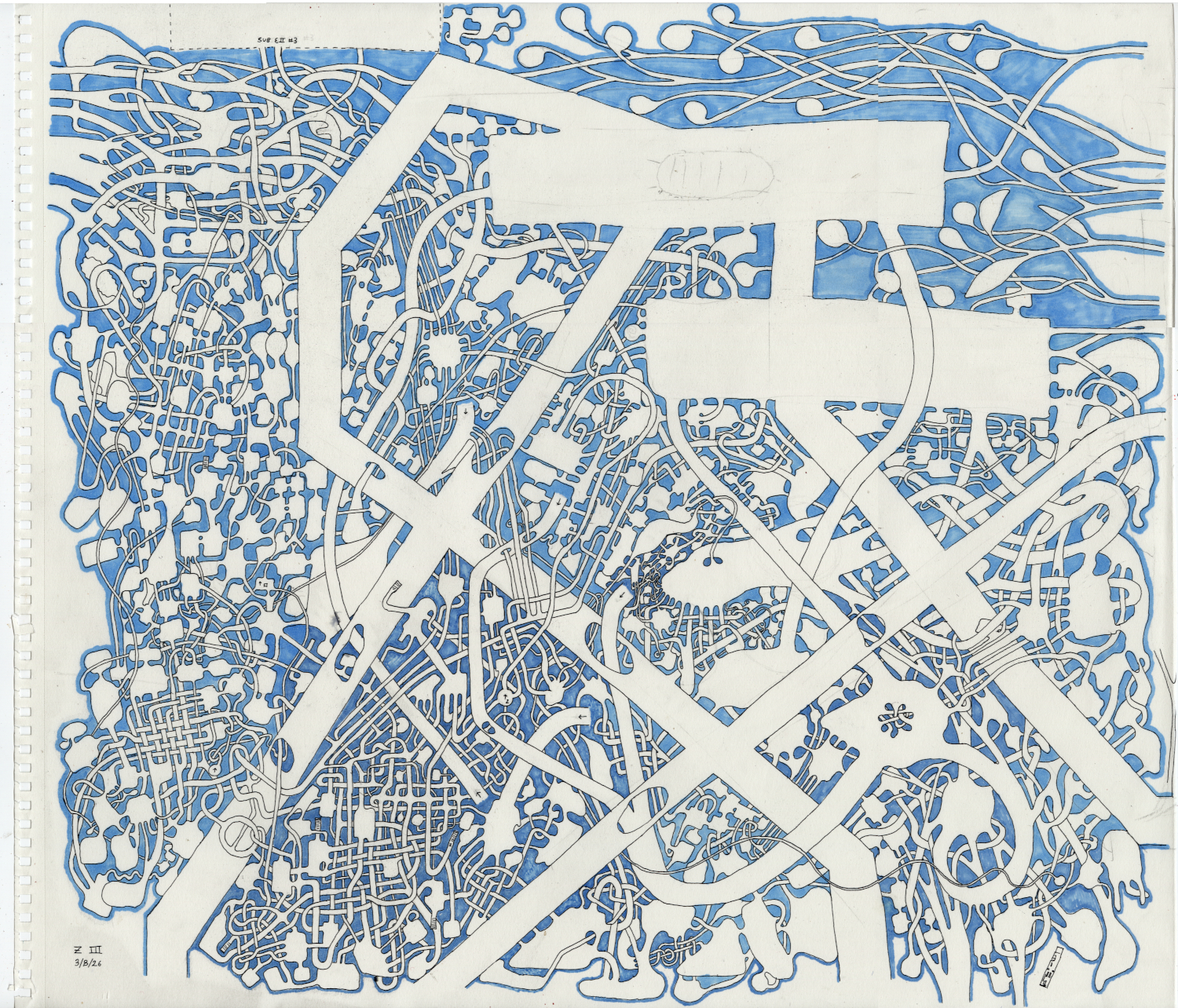
Zeta III is three levels beneath Epsilon and two levels beneath Delta-Zeta I. Its main connections are with Zeta I and Zeta II. 5 of the arms of Zeta I’s large star descend via slopes two levels to Zeta III: these are those curvy 30’ passageways. You can also see the two gargantuan rectangular rooms–Zeta III is the floor of those rooms.
The scale is the same as my other maps, though it’s not on graph paper. For reference the three parallel passageways in the upper left are each 20’ wide. The smallest corridors tangled in the center are about 2’ wide.
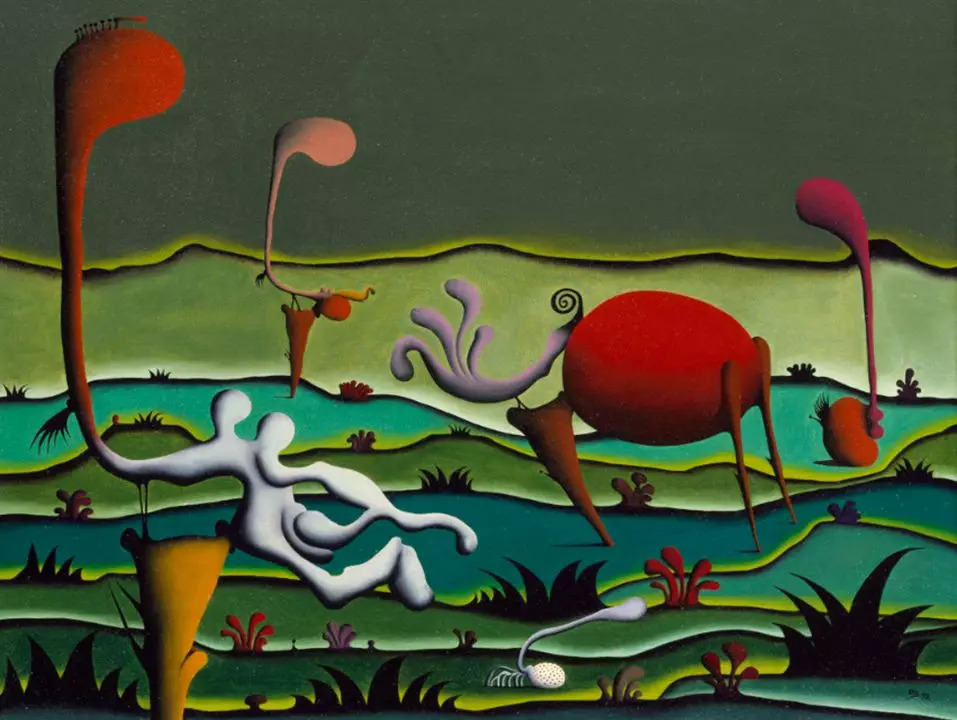
Unlike Delta-Zeta I, I have many concrete ideas about Zeta III’s denizens. In the colossal rectangular open spaces are huge roly-poly’s. The large 100’ hallways are the domain of the Ormyul. The many densely packed chambers on the left hand side of the map contain an extensive library. The larger 15’ passages are home to Snail Men. The balance will be made up with creatures similar to those found in this painting–surreal sorts of colored blob creatures.
I suspect a workable method of mapping Zeta III will be a node map with lines representing corridors and nodes representing rooms or intersections. In part because in many ways the way it’s drawn is already a node map, just with added embellishments.
I’ve been making maze drawings with overlapping passages since middle school. I’d always wanted to find a way to make them D&D maps, but the logic never quite made sense to me. Still stuck in my foolish notions about dungeons having to make some kind of sense I wasn’t in a place where I could make something satisfying. For some reason I’m there now. It’s strange how as we get older, we come into age for certain things.
I’m definitely not the first person to draw maps like this. The ones here are beyond astonishing and beautiful. I tried to mimic some of the elements from those, with “windows” cut out of the bigger spaces and lots of parallel passages. I couldn’t hold a candle to their precision, though, and moved into my own chaotic knotwork.
I found myself experimenting with a bunch of different styles here. The 100’ passages sort of break the map up into sections, and in each one it appears I’ve tried something a little different. I won’t say this was intentional–it just sort of happened. Some of the styles I like more than others. I’m especially intrigued to explore more flora-like structures, with leaves, vines, and flowers.
The blue shading adds a lot. I didn’t intentionally choose TSR module blue, I was just looking for a somewhat neutral color which would provide good contrast, which I suppose is why they chose it.
There’s lots I’m happy with in this map, though I sort of hate how the big 100’ passageways look. They don’t fit in with the rest, and I feel like they are awkwardly in the way. This was sort of intentional–I wanted them to be separate from the main tangle, blocky and sharp obstacles–but I feel like they just sort of look bad. I drew too early in the process, and too hastily I think.
It is possible that they will look less bad once I give them somewhere to go–you can see how the map extends off three edges; more maps of this type will need to be drawn up. Perhaps its just that they’re such a huge structure you need to zoom out farther for them to make sense.
I have plenty more paper.
Friday, February 20, 2026
Level Delta-Zeta I
Nearly 5 years ago I kicked off this blog with a post about Level EPSILON in Redux. Well, I am happy to announce that I have finally completed drawing level Delta-Zeta I, which sits directly beneath Epsilon:
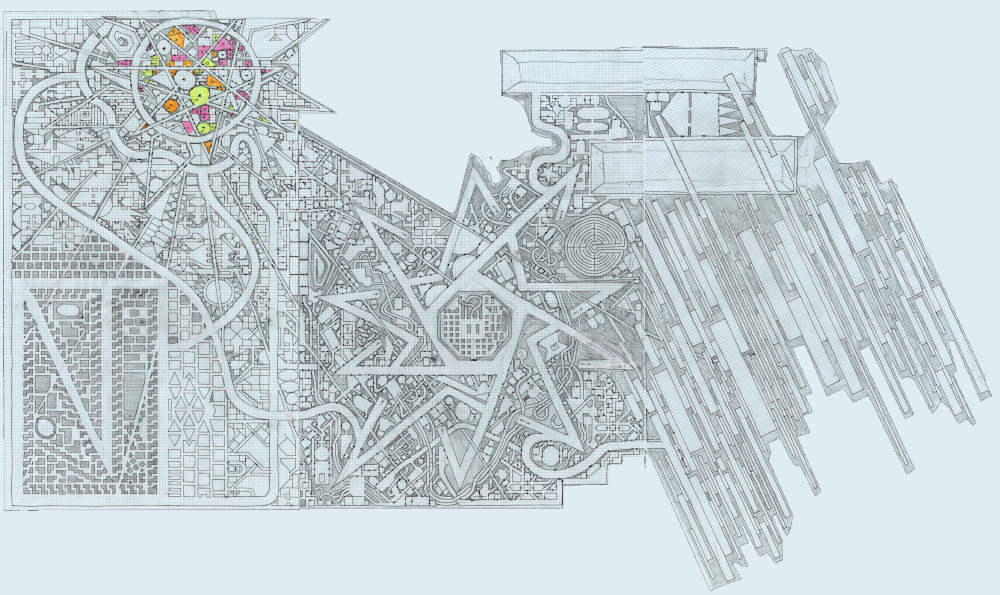
(in this map, as with Epsilon, North is to the left.)
The left third of this image is Level DELTA, right two-thirds are ZETA I. Underneath this map is ZETA II (still under construction) and ZETA III.
The Process
Level ZETA has been a long time coming. (It usually doesn’t take 5 years to finish level 2!) After drawing Epsilon in 2021, I immediately wrote up a schematic for Zeta, and got to work:
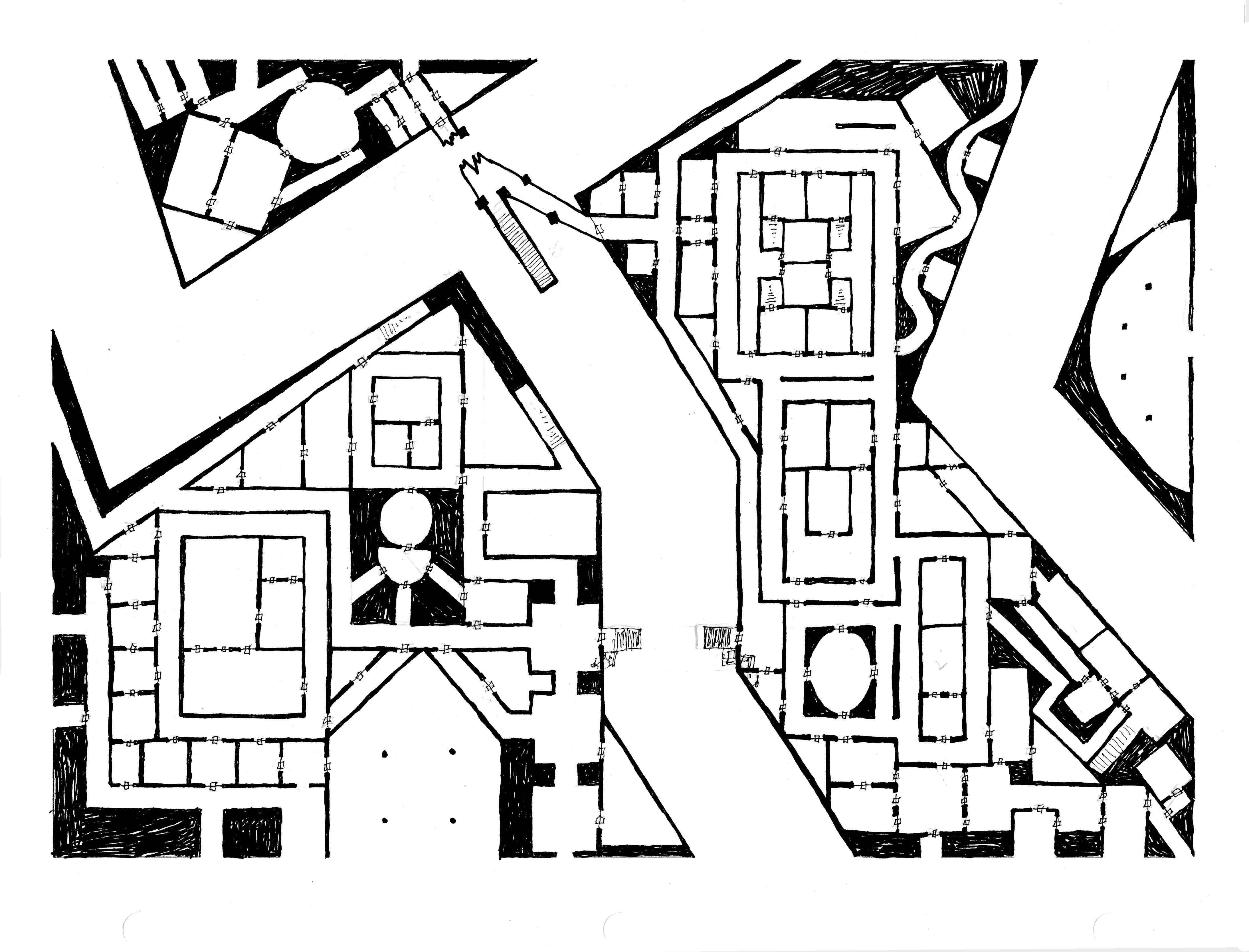
Quickly I lost steam–it just took too many sheets of 4-squares-per-inch inch graph paper to realistically have 50′ hallways. Over the years I kept returning, would get a little ways into it and then become overwhelmed.
I moved on to other maps at smaller scale–drawn on blank paper or index cards–which have become the main area of exploration for Redux. (One of these I slotted into the space beneath Epsilon and wrote about here: Defunct Dungeon Map.)
When the Redux campaign finally began in 2023 (with actual players!), I started them in my newer levels. Zeta has remained dormant as a Good Concept until now. Now it’s about ⅓ done.
Level Delta (the left side) I completed separately, but recently had the energy to expand connect a new Zeta portion to it. I did a very quick sketch in my notebook with the main features, and got to work.
I carefully sketched out the star first, trying several permutations, before copying it at scale on graph paper. This was entirely nerve-wracking. After this I filled in the space. I used a very fine ballpoint gel pen and a pencil on three 11” x 17” sheets of 10-squares-per-inch graph paper. I didn’t use a straightedge or a compass, everything is freehand with the graph paper as a guide.
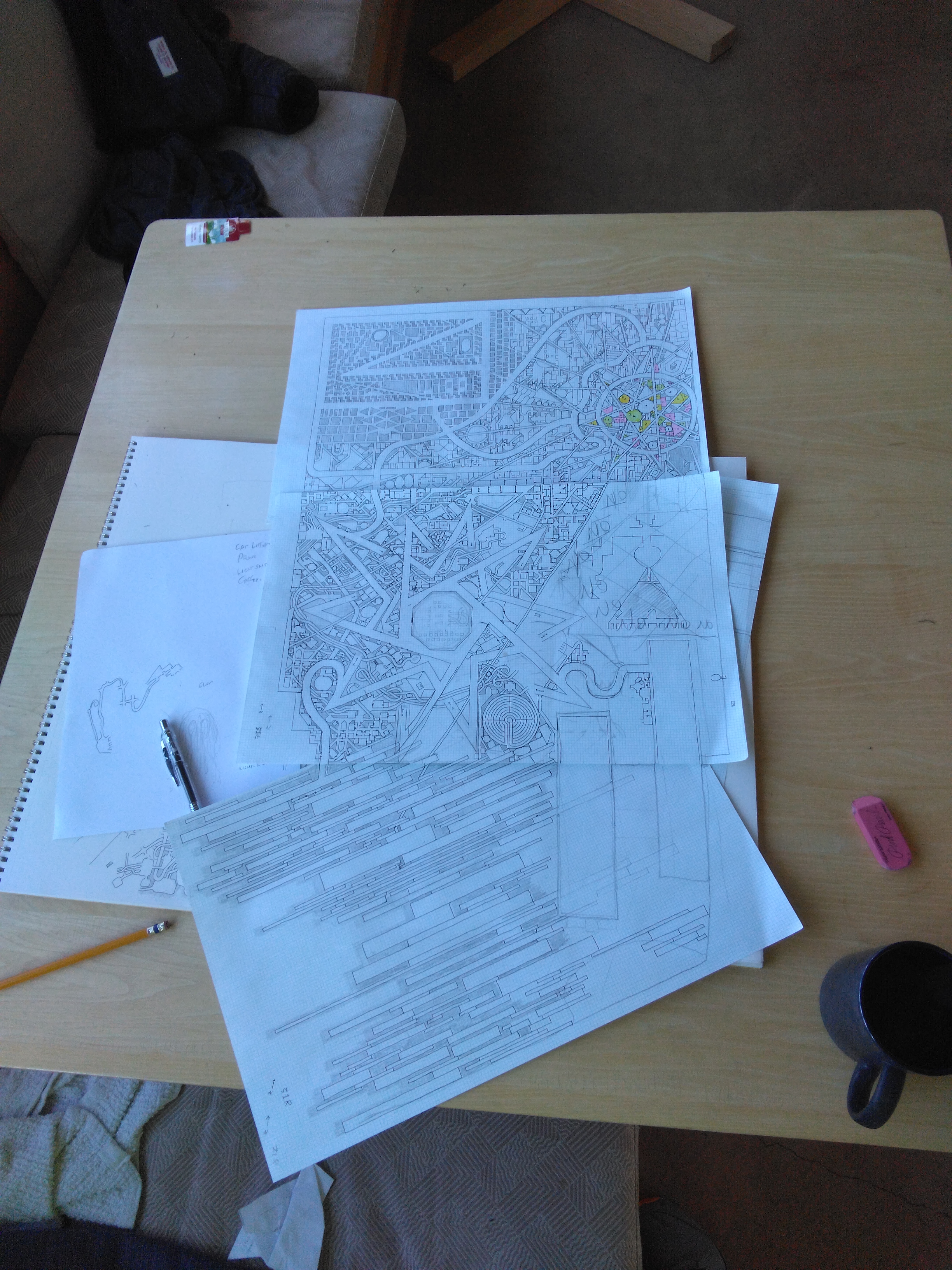
I did not count how many hours this took me to draw, and it’s complicated because I was simultaneously drawing portions of Zeta II and Zeta III, but quite a few. It’s been a fairly manic couple weeks. I find once I start working in earnest on levels like these it begins to dominate my thoughts. I see tangled passages when I close my eyes–glimpses of the fantastic. When I get home from work I immediately start drawing and wont stop for hours, don’t even notice when people ask me things.
Notes about the Layout
Many of the passages are knotted together–these are not upward- or downward-sloping passages, but are all level ground. Call it non-euclidean if you’d like. I imagine these sections will be hideous to map out, but that’s my players’ problem, not mine. I like how a topology can be so clearly readable when looking at it flat on the page, but be so bewildering once you try to make sense of it as a 3 dimensional space.
I do my best to make my dungeons fairly easy to navigate once you know where you’re going. Those big 30′ passages can take a party to any section of the map it wants to go if they’re willing to take the long way around, and then if they choose get into the weeds of things they can.
For this project I intentionally included a ton of stairs, elevators, and slopes. Likewise, I paid special attention to the stairways coming down from Epsilon, giving those locations plenty of navigation options. It’s fairly trivial to go from the up-stairs down a level or two.
The 10-pointed star turned out fairly well; half of its slopes go down 1 level to Zeta II, and the other half go down to Zeta III. The octagonal interior reminds me of Dark Souls, for some reason. Stars are neat features because they force a kind of outpouring and an inward tendency–I feel like the big one is sufficiently grand and overwhelming.
There aren’t very many choke points in this map, but there are a lot of shortcuts and longcuts. It’s possible to travel through this map by sort of choosing a direction and going towards it, but there will be resistance in the form of monsters/traps and doors. Lots of doors.
The long staggered parallel passageways to the south were surprisingly easy to draw, and I find them different and visually appealing. They remind me a little of crystalline rock structures, growing. In my D&D campaign before Redux, all the maps of which were lost in the mail, I had some really beautiful organic maps. Recently my maps have been fairly blocky and chunky (mostly because I’m using graph paper.) This isn’t a bad thing at all, but it’s nice to have found a structure which is both blocky and gives the impression of growth.
The big rectangles at the top are immense open spaces–about 100′-200′ down. They make me very uneasy, but they are necessary I think. It might be possible to run BITS in them.
The lower left corner of the Delta map came to me in a dream. I saw it in a flash, and then worked to make it real. I’m glad I did, turned out great.
Not everything worked. My linework in some places is less clean than I’d like it to be. Also I drew to the very edges of the graph paper to get the connections precise. This worked, but was sort of a pain to deal with. Some areas feel better than others, and there are a couple of places at least which I feel downright awful about. I made a few mistakes with the pen, and when I went to correct these with whiteout I whited out the correction instead of the error. I was blessed to only have to do this 3 times, though.
For me, the concept of the underworld includes immensity and unknowability: complete indifference to visiting inhabitants. I want viewers of this map to have to sit with the notion of these vast empty subterranean spaces. I want it to be a kind of struggle. The underworld is awe-inspiring and bewildering and strange, not because it is large, but because it is unyielding to interpretation. I paid attention to navigability when drawing this map, but haven’t worried too much about mapability. In part this is because I’m blessed with players who enjoy mapping, but also I’m beginning to question whether it’s important for my dungeon maps to be game-friendly at all. I’ve decided to begin focusing on things which I find to be beautiful and meaningful, and trusting the people I play games with to find them beautiful as well. This has been freeing.
It’s possible the best game with which to explore this map won’t be OD&D, perhaps it will be something like Conventional Dungeon Paradigm, or something else entirely. Regardless, only a tiny percentage of the spaces depicted on this map will ever see the light of a PCs torch. The exciting part is that any one of them could, and many will.
Notes about Contents
It takes a very long time for me to develop dungeon contents which are satisfying. Check back in like, uh, 4 years.
Saturday, February 14, 2026
Dungeon Map Notions I’ve Moved Away From
I have discarded two notions about what dungeon maps are or ought to be, and would like to share them here. I’m speaking only for myself, and only about the kinds of dungeon maps I most often interact with: massive, sprawling underworlds. This blog post has been written hastily and badly so I apologize.
First Notion: We Absolutely Must Know Who Built the Dungeon, Why, and What it was Used For
I first started D&D with 3.5e as a teenager, and following the instructions that those books laid out was fairly frustrating. Drawing maps has always been fun to me, but the advice in those books had me constantly trying to squeeze my interesting game-spaces into some form of setting-logic, a discipline which demanded far more knowledge of people and architecture than I had, and also one which wouldn’t have made playing D&D any better.
I thought that in order for a dungeon to be “good” it had to be “realistic”. To be meaningful, it had to have direct reasons for all of its attributes. Each room must have had a purpose and a history effected by the people who built it. This really stifled my creativity. I kept drawing maps which I thought were interesting, but then discovered on analysis that they were unrealistic. Nobody would ever build a thing like this. I would say to myself, sadly, What things could go in all of these rooms, which make sense? Nothing! Nothing at all!
AD&D was a little better in that the Dungeon Master’s Guide provided a lot of options. I spent a long time reading AD&D’s “Room types” table, and tried to match each room in my dungeons to one of these. Still, I was stuck trying to invent coherent things for my rooms which fit into the boxes of NPC activity. I thought that’s what a dungeon was supposed to be.
Philotomy’s “mythic underworld” opened my mind to an entirely new approach to dungeons. Dungeons as a sort of living entity one its own; a Thing which exists, a place, yes, but not in the sense of a house or a building, where there are distinct design choices. Instead the underworld is the expansion of the fairy-tale castle: it is immense. The “reasons” for things being the way they are can be attributed to a bizarre kind of mythic logic. Confusing, unclear, or “random” dungeon elements can be folded into the mythic underworld mystique.
Still, though I had lingering in the back of my head that a dungeon must have some reason or explanation for its existence. I was still stuck in a “reasons” mode of thinking, although the Mythic Underworld concept offered a “reasoning” which could include the kinds of maps I like.
After reading The Underworld and Wilderness Adventures more and more carefully, I have come to a new understanding of dungeon maps, one which pushes past even the Mythic Underworld: the Underworld is drawn by me, the referee.
I mean this more than in the sense that a dungeon is a game-space designed for player interaction. While this is vaguely true, player action is not the reason the underworld exists. It exists because putting pen on paper to draw a map creates a Space, and the space will flow outwards across the page if you let it. It will sprawl in all directions, unfolding and repeating, looping back upon itself and leaping out into the void. It will go off the edge of the paper, and tunnel downwards. Abstract and mesmerizing, the dungeon goes on and on.
The drawing is an activity all itself, is what I’m saying. It is constructed through my interaction with the paper, through my instincts about rhythm and shape. Who built the underworld? Well, me! Because I’m the referee and the rules told me to, and once I started drawing I found I couldn’t stop.
Second Notion: The Dungeon is Primarily a Visualized Imaginary Place, and the Dungeon Map Merely Represents That Place
The second notion was harder to set aside. The notion was this: the dungeon is an imaginary place, and we can draw maps and write keys to help us understand the place. But the map is not the dungeon, the key is not the dungeon, both of these are instructions for how to build the imagined space in our heads which we can then play within.
At the table, supposedly, the “true” place gets accessed through the words of the referee and the imagination of the players. Players take notes and make maps only to help them keep track of where they are.
The problem with this notion is that it does not match any at-the-table experience I’ve had involving dungeons. When players ask the referee what’s beyond a door, the referee looks at the map and describes what they see. The players–immediately–begin to mark their own map. They then stare at and add onto this drawing for the whole rest of the game. There is no intermediary imagined three-dimensional space; the dungeon exists on paper.
Literally, right there. The dungeon we’re talking about is marks on a page. The rules we use sort of treats navigating those marks as if it were a physical space–opening doors and so on–but the real, actually game we’re playing takes place on paper. It’s very tangible and literal. I have a drawing and I’m trying to get you to make a mostly similar drawing. If you use miniatures, it’s the same thing but with little pieces moving around. They’re not representational: they’re the thing.
This isn’t bad. Pen and paper games are fun. Moving pieces around is fun.
(I have had the idea of running a game entirely in a mind palace–no maps for any of the participants, no written notes of any kind, just spoken words and the imaginary. I think that some surprisingly complicated and beautiful spaces could be developed using this method. This would be a substantial departure from most RPG setups I’ve seen, though.)