Wednesday, February 25, 2026
Against Diegesis
My cousin Pedantarius doesn’t have their own blog, but they wrote an essay and wanted me to share it here. I have obliged, mainly out of respect for my aunt. Please know that the opinions expressed by my dear cousin are not necessarily my own. - Scribble
Against Diegesis
By Pedantarius Wobble
Diegesis is a lie perpetuated by theater kids and simulationists in a desperate attempt to justify their crummy rules and paltry performances as corresponding to an imaginary world outside of them.
Here’s the truth: there is no shared imaginary world. The objects we engage with in games are mere collections of words, numbers, and drawings. Rules are literally a set of instructions for following procedures to manipulate these, either by writing or speech. The Game exists entirely on paper (or digitally), in what is said out loud, and the activity of altering these.
“But Pedantarius!” I hear you cry, “Isn’t it fun to pretend, for a little while at least, that we really are on a fantastic adventure in an amazing place? Wouldn’t it be interesting to imagine what it would be like to live in a world of magic and unknowable terrors, and furthermore, to make tactical decisions proceeding from these imaginings? Surely one cannot deny the importance of the imaginary in fantasy games.”
This objection seems reasonable on the surface, but falls apart under scrutiny. When we imagine something we invent an object. Due to its very nature as invention, an imagined object is not subject to the laws which govern the material world–indeed, an imagined object is subject only to the mind of the imaginer.
If we wanted to apply arbitrary rules to an imagined object (say, of an imagined person, that they are capable of jumping) we can, but the rules would not be directly affecting the object. Instead, the imaginer has to decide that the rules should govern how the imaginer imagines the object–the link between rules and imagined object is sustained only through wilful effort of the imaginer.
If you wanted to make anything like “tactical decisions” in an imagined world, you must first decide upon what tactically-rich rules to apply to the imagined object, and then wilfully connect the two. But, don’t you see that making tactical decisions in such a setup is merely interacting with the rules and not the object itself? The imagined object needn’t be there at all, in fact. It is only window-dressing for what you’re really doing.
This problem is compounded if you have multiple people supposedly imagining in tandem. The only possible way for this myriad of imagined objects to correspond is with a big set of rules and social conventions holding them together. In such a situation, you are really dealing with these rules and conventions, not the imagined objects at all.
The imaginary is added after the fact-–it is a personal interpretation, a reaction to the rules situation which actually exists at the table.
“Ah, Pedantarius!” you bluster, “You have too narrow an understanding of rules! My rules sprout upwards from the imaginary according to common-sense notions about the ways in which worlds work. The ‘top down’ rules you describe are non-diegetic, which are fine in themselves, but not what we are talking about.”
To this I say that it is simply untrue that these so-called diagetic rules are rooted in an imaginary world at all. Like what you call non-diagetic rules, they are decided upon socially and applied to a game situation. There is no distinction between them, other than aesthetically.
Consider two scenarios, in a hypothetical roleplaying game in which a player controlling a unit wishes to leap over a chasm.
A. There are no written rules for jumping a chasm. The GM decides to rule such an action succeeds according to several factors: the width of the chasm, the relatively unencumbered status of the unit, the desire to reward the player for taking an action, and an interest in what the player will do once beyond the chasm.
B. There are written rules. The GM pulls out the rulebook, finds the rule, and follows a procedure which is very abstract and is not very immersive.
I say that these are substantively indistinguishable from one another. The “rules for jumping the chasm” are in both cases brought in to the game situation and applied. In both, the rules were chosen because of the existing rules-situation. The only real difference is that in the case of A it is possible the rule was invented on the spot. In both cases the imaginary (character jumping over the chasm) only exists after the rules have been decided upon and applied.
Rule mutability, even extremely freeform mutability, is no argument for the existence of diegetic rules. This is evident.
Again I hear your complaints, “Surely you acknowledge that in your example a chasm described as ‘imposing, gaping, unimaginably vast’ should be more difficult to leap across than one described as ‘narrow and deep, scouring the bottom of the earth’? The fiction carries with it connotations and associations, which can be more or less easily transformed into outcomes.”
To this I say that I agree fully–it’s just that those words and phrases fit within an interpretive and social context. The game meta-rules for interpreting those words are not distinguishable from the game meta-rules for reading text like “Characters carrying less than 20# of equipment can leap chasms up to 15’ wide if they roll higher than 10 on a twenty-sided die.”
To claim that the artifacts of description, and the connotations carried by these, is a separable layer of rules, a “diegetic” layer, simply fails to acknowledge the real rules governing play: the social-interpretive rules. All games are sets of rules in action, and, while some of these are nested sets, all are determined exclusively by two components: text and player interpretation. The imaginary world doesn’t exist in any sense.
We should not focus on fiction. We should not delude ourselves into thinking that imaginary worlds speak back to us. What we should focus on is rules and procedures which are interesting and beautiful in themselves. Focus on the friends who play with you, and their creativity. Pay attention to what we are actually doing at the table, the rules you are actually following.
- Pedantarius Wobble
Friday, February 20, 2026
Level Delta-Zeta I
Nearly 5 years ago I kicked off this blog with a post about Level EPSILON in Redux. Well, I am happy to announce that I have finally completed drawing level Delta-Zeta I, which sits directly beneath Epsilon:
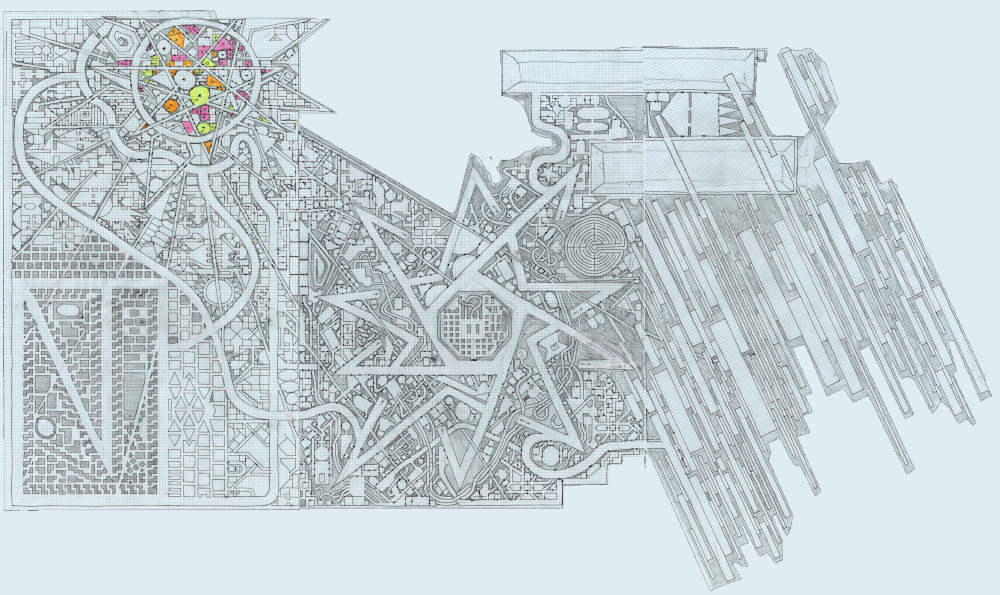
(in this map, as with Epsilon, North is to the left.)
The left third of this image is Level DELTA, right two-thirds are ZETA I. Underneath this map is ZETA II (still under construction) and ZETA III.
The Process
Level ZETA has been a long time coming. (It usually doesn’t take 5 years to finish level 2!) After drawing Epsilon in 2021, I immediately wrote up a schematic for Zeta, and got to work:
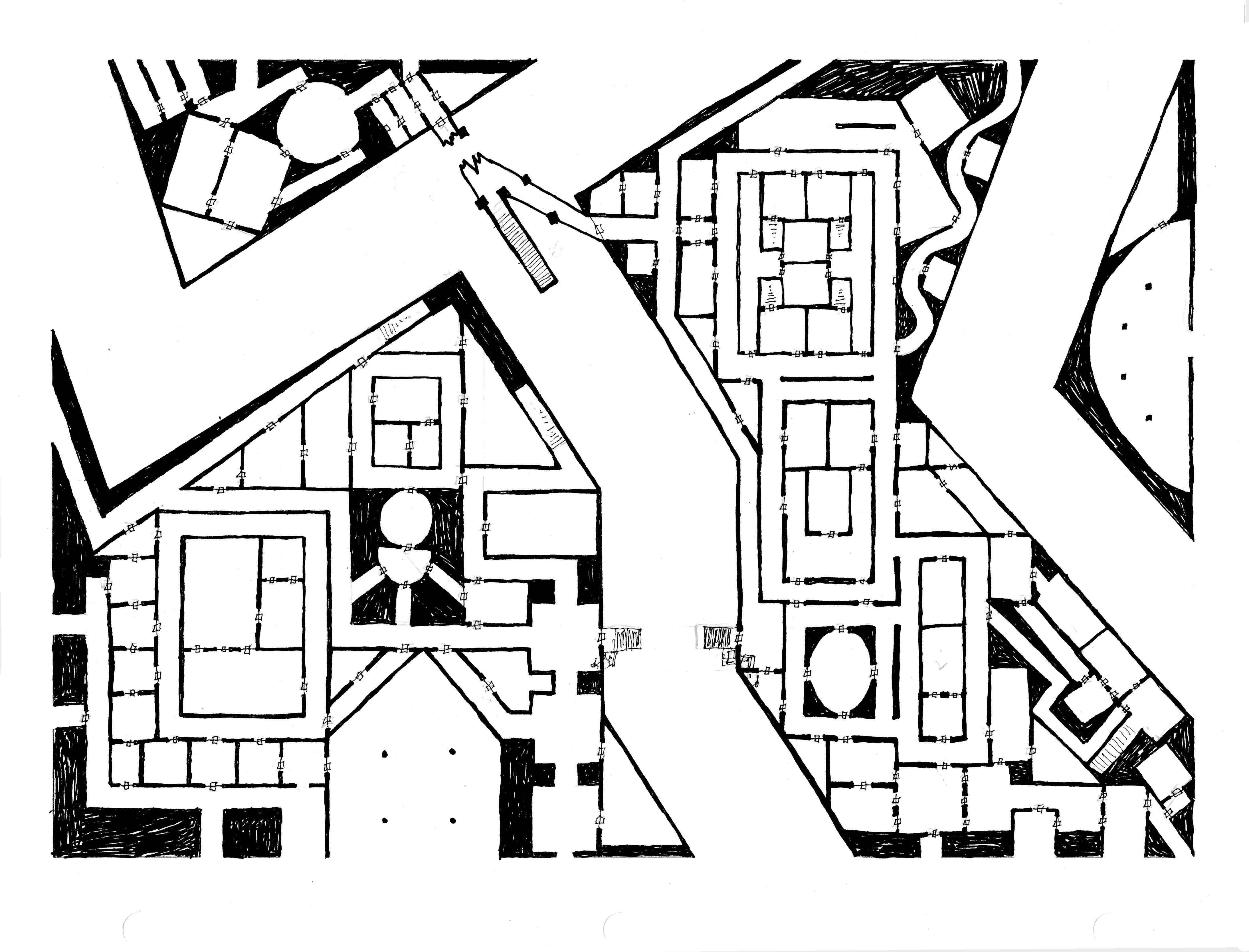
Quickly I lost steam–it just took too many sheets of 4-squares-per-inch inch graph paper to realistically have 50′ hallways. Over the years I kept returning, would get a little ways into it and then become overwhelmed.
I moved on to other maps at smaller scale–drawn on blank paper or index cards–which have become the main area of exploration for Redux. (One of these I slotted into the space beneath Epsilon and wrote about here: Defunct Dungeon Map.)
When the Redux campaign finally began in 2023 (with actual players!), I started them in my newer levels. Zeta has remained dormant as a Good Concept until now. Now it’s about ⅓ done.
Level Delta (the left side) I completed separately, but recently had the energy to expand connect a new Zeta portion to it. I did a very quick sketch in my notebook with the main features, and got to work.
I carefully sketched out the star first, trying several permutations, before copying it at scale on graph paper. This was entirely nerve-wracking. After this I filled in the space. I used a very fine ballpoint gel pen and a pencil on three 11” x 17” sheets of 10-squares-per-inch graph paper. I didn’t use a straightedge or a compass, everything is freehand with the graph paper as a guide.
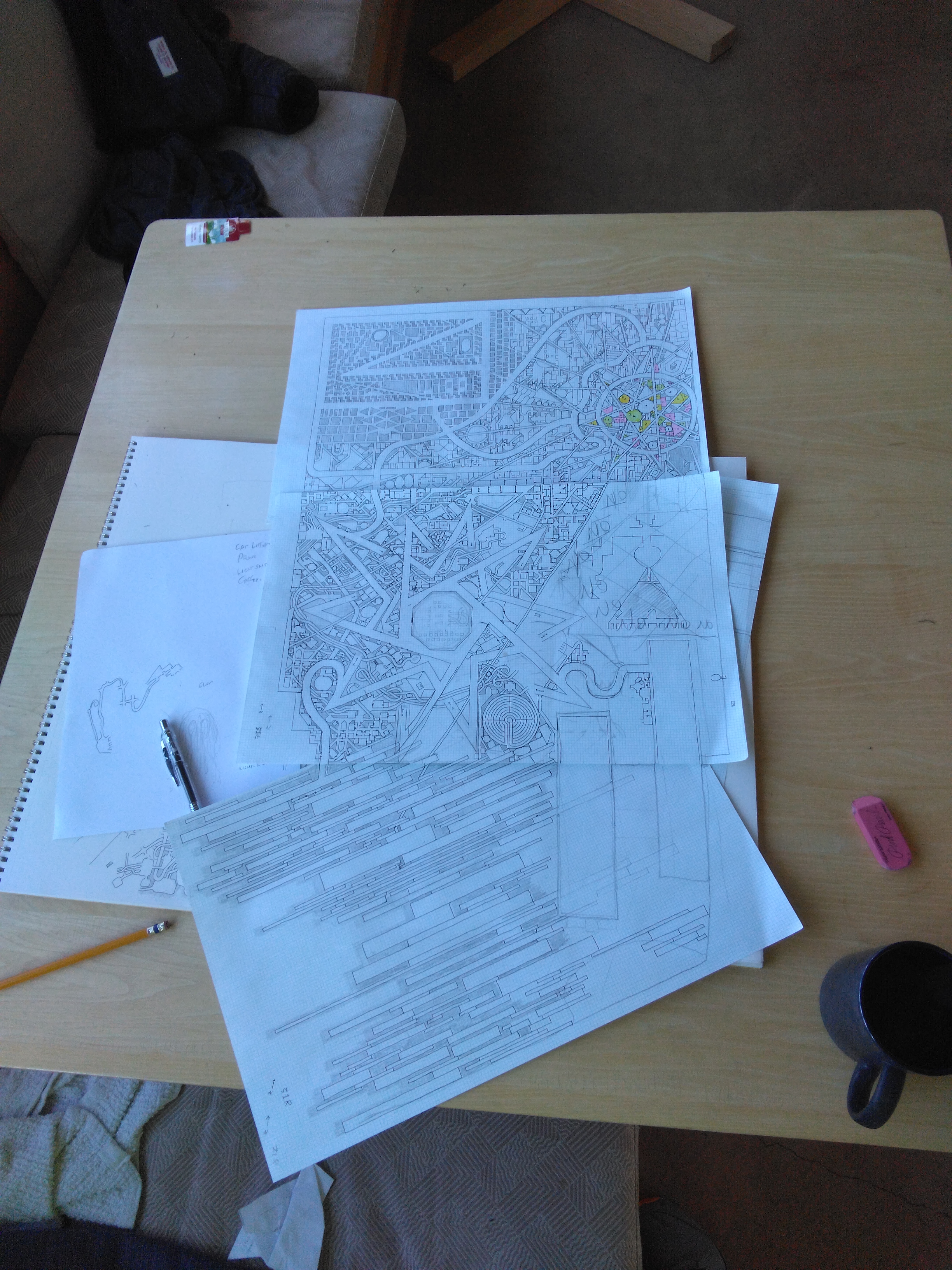
I did not count how many hours this took me to draw, and it’s complicated because I was simultaneously drawing portions of Zeta II and Zeta III, but quite a few. It’s been a fairly manic couple weeks. I find once I start working in earnest on levels like these it begins to dominate my thoughts. I see tangled passages when I close my eyes–glimpses of the fantastic. When I get home from work I immediately start drawing and wont stop for hours, don’t even notice when people ask me things.
Notes about the Layout
Many of the passages are knotted together–these are not upward- or downward-sloping passages, but are all level ground. Call it non-euclidean if you’d like. I imagine these sections will be hideous to map out, but that’s my players’ problem, not mine. I like how a topology can be so clearly readable when looking at it flat on the page, but be so bewildering once you try to make sense of it as a 3 dimensional space.
I do my best to make my dungeons fairly easy to navigate once you know where you’re going. Those big 30′ passages can take a party to any section of the map it wants to go if they’re willing to take the long way around, and then if they choose get into the weeds of things they can.
For this project I intentionally included a ton of stairs, elevators, and slopes. Likewise, I paid special attention to the stairways coming down from Epsilon, giving those locations plenty of navigation options. It’s fairly trivial to go from the up-stairs down a level or two.
The 10-pointed star turned out fairly well; half of its slopes go down 1 level to Zeta II, and the other half go down to Zeta III. The octagonal interior reminds me of Dark Souls, for some reason. Stars are neat features because they force a kind of outpouring and an inward tendency–I feel like the big one is sufficiently grand and overwhelming.
There aren’t very many choke points in this map, but there are a lot of shortcuts and longcuts. It’s possible to travel through this map by sort of choosing a direction and going towards it, but there will be resistance in the form of monsters/traps and doors. Lots of doors.
The long staggered parallel passageways to the south were surprisingly easy to draw, and I find them different and visually appealing. They remind me a little of crystalline rock structures, growing. In my D&D campaign before Redux, all the maps of which were lost in the mail, I had some really beautiful organic maps. Recently my maps have been fairly blocky and chunky (mostly because I’m using graph paper.) This isn’t a bad thing at all, but it’s nice to have found a structure which is both blocky and gives the impression of growth.
The big rectangles at the top are immense open spaces–about 100′-200′ down. They make me very uneasy, but they are necessary I think. It might be possible to run BITS in them.
The lower left corner of the Delta map came to me in a dream. I saw it in a flash, and then worked to make it real. I’m glad I did, turned out great.
Not everything worked. My linework in some places is less clean than I’d like it to be. Also I drew to the very edges of the graph paper to get the connections precise. This worked, but was sort of a pain to deal with. Some areas feel better than others, and there are a couple of places at least which I feel downright awful about. I made a few mistakes with the pen, and when I went to correct these with whiteout I whited out the correction instead of the error. I was blessed to only have to do this 3 times, though.
For me, the concept of the underworld includes immensity and unknowability: complete indifference to visiting inhabitants. I want viewers of this map to have to sit with the notion of these vast empty subterranean spaces. I want it to be a kind of struggle. The underworld is awe-inspiring and bewildering and strange, not because it is large, but because it is unyielding to interpretation. I paid attention to navigability when drawing this map, but haven’t worried too much about mapability. In part this is because I’m blessed with players who enjoy mapping, but also I’m beginning to question whether it’s important for my dungeon maps to be game-friendly at all. I’ve decided to begin focusing on things which I find to be beautiful and meaningful, and trusting the people I play games with to find them beautiful as well. This has been freeing.
It’s possible the best game with which to explore this map won’t be OD&D, perhaps it will be something like Conventional Dungeon Paradigm, or something else entirely. Regardless, only a tiny percentage of the spaces depicted on this map will ever see the light of a PCs torch. The exciting part is that any one of them could, and many will.
Notes about Contents
It takes a very long time for me to develop dungeon contents which are satisfying. Check back in like, uh, 4 years.
Wednesday, February 18, 2026
Faith and Games
When I sit down to play a game with someone, I am partaking in a kind of faith.
Let’s start with tic-tac-toe. When we play I agree to certain rules about how the gamestate can be altered. this is the ruleset of the game. Before the game begins our approach to the ruleset is one of agreement or disagreement. We say, either explicitly or implicitly, “Yes, I agree to play Tic Tac Toe with you, according to these rules.”
When actually playing the game, the relationship we have is no longer simple agreement, it is belief. When someone plays an illegal move (for example, placing an ‘X’ somewhere outside the grid) the first objection is “Hey, you can’t do that! That’s not a possible move!” My objection is one of possibility or impossibility, not agreement or disagreement. I do not (at least, not at first) accuse my fellow player of breaking our agreement to play this game. I instead contend that the illegal action is simply impossible. I have faith that the rules define what is possible. When this reality is challenged, my response is outright denial: you can’t do that–that sort of action simply doesn’t exist within this game.
To play a game of any kind is to have faith that the rules define what is and is not possible, and so long as I believe this to be true–so long as you and I and everyone act as though it is so, it is. The most important first step for playing a game is having faith that it is possible to play it.
Doubt arises when the rules appear contradictory, or when different players understand the rules to be different things.
In one of the early sessions of Verdun: A Dagger at the Heart of France (V:DaTHoFA) Idraluna and I discovered an apparent contradiction in the rules. The rules for Zones of Control in that game state:
The ZOC extends generally into the six hexes immediately adjacent to the unit. A ZOC does not, however, extend out of tunnels or forts, into city, town, fortress, partial forest, or forest hexes, or across trench or prohibited hexsides. (p. 2)
Clear enough. However, the rules for Fortresses state something contradictory:
Units in a fortress hex are quadrupled in defense against assault, but may not themselves make an assault attack. Units with a zone of control continue to exert it while in a fortress. (p. 6)
When I occupied one of Idraluna’s forts, this became a real question: does my 4-1-9 infantry exert its zone of control or doesn’t it? This caused some doubt about the rules–we were uncomfortable with the idea that two contradictory things could be true at once.
The doubt was so unpalatable to us that we paused play, had a discussion, and settled upon a decision which ignored the ZOC rules in favor of the fortress ones. We came to a new agreement as players (”We will play Verdun according to the ruleset, except that units in fortresses exert zones of control, despite what the rules say.”) This agreement made, we continued playing and had a good time.
The practice of coming to an agreement about interpretations of rules is common and good, but it demonstrates, I think, that we valued the comfortable notion that our game was playable more than we valued the rules as written. This is what it means to play games, after all. We had faith that the game would work without contradictions and continued under this belief until skepticism made it impossible. After we agreed on an interpretation, I think we both had a stronger faith that Verdun was playable in its new form.
Were we playing the same game after this? What was it that made us so uncomfortable about contradiction?
I should clarify that by “faith” I do not mean “high trust” in the RPG sense. Faith is as important in zero-trust games as it is in high-trust ones. What I mean is not faith in other players, but faith that the game itself is working, or will work.
I wrote a fairly unfun game a while ago called Revolution which in part was an attempt to explore these questions. I wanted to know what would happen if the players refused to play according to the ruleset. In this example, what would happen if a non-Sovereign player refuses to hand over their token. What happens in that moment, to the game, to play itself? Isn’t it possible to be still kind of playing a game even while ignoring the rules, so long as you believe you’re playing it? How much does the agreed-upon ruleset really define play?
Maybe you could say that, when you break free from a ruleset like that, you are simply bringing in new socially-defined meta-rules and interpreting the written ruleset as hypodiegetic. But what force do even these have, unless there is belief that moves made in the “Bully the player with the Sovereign role into changing the rules to make the game more fun” are valid? What’s the crossover-point between those towo?
I wonder whether there isn’t a continuum of dispositions to rulesets. I wonder if we couldn’t playtest rulesets which are progressively less coherent to see where the line is between “playable” and “not playable” is, in the true sense. When does it happen that we’re not playing a game anymore?
Mishmash is a game which does seem like fun and I do want to play about this question.
One final example:
I am working slowly on a wargame called Assault on Castle Slazzo. There is an artifact which operates according to the following rules-text:
Ø - APPLIANCE FOR THE DISILLUSION OF THE ANTITHETICAL
The APPLIANCE might better be described as a ridiculous concept or idea rather than any sort of physical manifestation. The militiaman who first sights the APPLIANCE carries it. The APPLIANCE concerns p and ~p. The militiaman carrying it can, once, for any unambiguous verifiable statement about the game state p, reveal that its logical negation ~p is also true. The strain of such a revealing invariably kills the carrier, thus removing the APPLIANCE from play.
In AOCS it is likely that there will be many statements about the gamestate which are both true and not true at the same time. Surprisingly, this was entirely playable in playtesting.
I’ve written previously that Nomic is a social game masquerading as a logic game. But now I’m starting to wonder if all games are sort of masquerading as themselves. All pen and paper games are notebook kayfabe.
…
This post was inspired by discussion around this one: https://kattkirsch.b … r-replaying-modules/
Rule Mutability in Nomic and Dungeons & Dragons
In most games, play alters the gamestate only. Nomic and Dungeons & Dragons are unusual (though not unique) in that they require participants to constantly assess, critique, and modify the fabric of the games themselves.
The rules of Nomic and D&D are distinctively mutable: through the course of ordinary play, participants alter the ruleset. The emergent complexity produced by this rule mutability is crucial to the success of both games.
There are major differences, however. In D&D, mutability is expressed through the complete authority of the referee to present scenarios and resolve situations, either according to the logic of the fantasy world or their best judgement for playability. In Nomic, mutability is enforced through a strict set of rules-amending procedures effected by player vote, procedures to which all players are rigorously subject.
I wanted to share some thoughts and analyses about these two favorite games of mine. I don’t really have a coherent or paradigm-shattering argument—just musings and descriptions mostly. Much of what I say here about D&D is of course applicable to other wargames and RPGs, especially OSR and FKR-leaning playstyles. Likewise, Nomic has its peers in Diplomacy, real-world governance, drinking games, and the like.
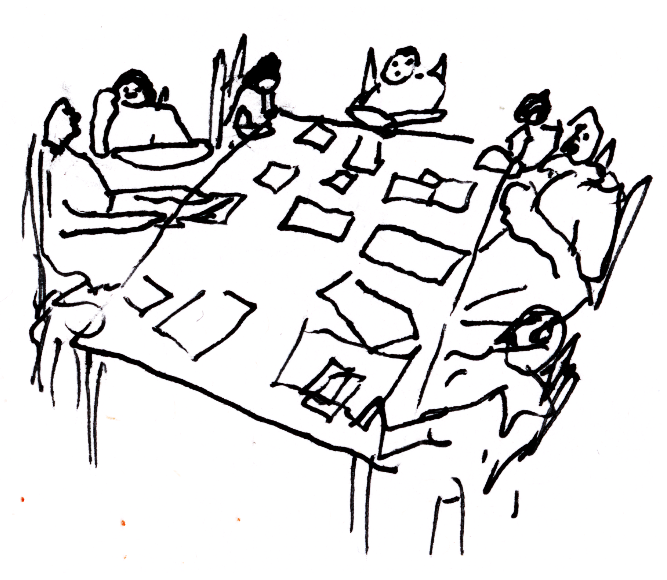
(Image is of a game of Nomic in progress on 7/9/2025)
It does seem to me these two share a kind of kinship–I do not know of any other pen and paper games so enthusiastically mutable as these two. (Write to me if you know any, I’ll be really intrigued!)
Nomic is also more obscure and often misunderstood, at least in my circles. I wish it were more widely known. Many of Nomic’s lessons are useful for thinking about the structure of game rules in general, even (or especially!) those which have no rule mutability whatsoever.
Which D&D?
By Dungeons and Dragons I mainly mean what I play: the three original booklets sans supplements. For me the 3LBBs amount almost to something like sacred texts, not because their authors were divinely inspired or virtuous (God no!), but because they carry a mysterious impenetrability, what Marcia B. calls “…the way in which it does not survive being read.” Accidental genius, I think. Lightning in a bottle stuff.
What is Nomic?
Nomic is “A Game of Self-Amendment” invented by Peter Suber in 1982 while working on his book on legal philosophy The Paradox of Self-Amendment: A Study in Logic, Law, Omnipotence, and Change. The book was published in 1990, and is available in full on Suber’s website, with the Initial Ruleset for Nomic making up Appendix 3.
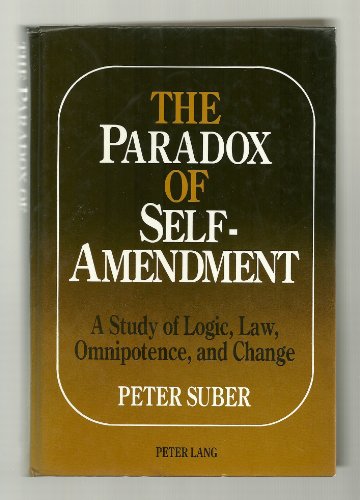
(Suber’s Paradox of Self Amendment could win an award for Ugliest Cover Imaginable, but I am fond of it.)
Nomic is designed more to be a teaching tool than amusement. It is intended to demonstrate Suber’s philosophical position on the nature of legal authority. The main question, if I understand it, is: Can a legal document grant amending authority to revoke its own amending authority?
According to formal logic the answer is supposedly paradoxical. (Quite possible that I’m misreading and/or dangerously oversimplifying Suber’s arguments here. I did my best, but Paradox of Self Amendment is a dense book.) It’s the same problem as Can an omnipotent God create a rock He can’t lift? A god who couldn’t create such a rock isn’t omnipotent, but a god who could wouldn’t be able to lift a rock, and thus also isn’t omnipotent. Does a legal document, then, really have the power to revoke its own authority?
In the real world of politics and laws these kinds of amendments plainly exist and are used all the time without difficulty, paradox or no paradox. Suber’s claim is that Law has its own reasoning system for dealing with logical inconsistencies: political will.
Nomic, then, is a test chamber for philosophical problems of legal reflexivity. It is purpose-built to raise difficult questions about the nature of rules themselves.
The Initial Ruleset for Nomic consists of 29 rules governing play, numbered 101-116 and 201-213. There is no imagined setting in Nomic, no role-playing, no referee or GM. The rules are written concisely and logically, with few explanatory remarks. Sometimes a concept or mechanism is split up into two or three rules, which can make it difficult to read at first, but makes the ruleset more modular for amending.
Rules are divided into two classes: Mutable Rules can be added, amended, or repealed by unanimous (later majority) vote. Immutable Rules cannot be amended, but can be transmuted into Mutable Rules by unanimous vote. Thus some rules are harder to alter than others (requiring more political will.) Generally the more important and fundamental rules are initially Immutable, while the substantive process rules are Mutable. It also seems like some of the more dangerous, exploitable rules (ex. Judgement, Win by Paradox) are mutable.
The main gameplay loop in Nomic is described with the following rules:
201. Players shall alternate in clockwise order, taking one whole turn apiece. Turns may not be skipped or passed, and parts of turns may not be omitted. All players begin with zero points.
…
202. One turn consists of two parts in this order: (1) proposing one rule-change and having it voted on, and (2) throwing one die once and adding the number of points on its face to one’s score.
Rule 203 sets the vote requirement for a proposed rule-change to be adopted, (unanimous, except after the second complete circuit of turns). Rule 103 defines a rule-change, (either the amendment, enaction, or repeal of a Mutable rule or the transmutation of an Immutable one.) 208 defines the winner as the first player to achieve 100 points.
Many of the other rules describe how to organize and interpret rules against one another. Rule 212, for instance, describes the process of Judgement, whereby disagreements about the interpretations of the rules are settled by one player acting as Judge. The Judge is supplied with somewhat binding parameters, and can be overruled by the other players.
The malleability of the Nomic rules is enforced. Since parts of turns can’t be skipped, players must propose rule-changes. The way points are allocated further means that a player cannot gain points unless their proposed rule-change is adopted–you lose 10 points each time one of your proposals is voted down. (Technically the net point loss per turn for your proposal failing is randomly between 9 and 4.)
It is, conversely, rarely the optimal choice points-wise to vote for another player’s proposal under the initial ruleset. Voting for someone else’s proposal gives them points and gives you nothing. The players are in a lose-lose situation until they work cooperatively to change the rules. Like Diplomacy, simple rules must be brought alive by the complicated nature of inter-personal relation. In order to make any progress at all players must work together against the situation presented by the Initial Ruleset.
Much of the gameplay of Nomic is trying to come up with neat rule ideas, trying to convince fellow players to vote for them, and watching these plans unravel. It’s delightful, devilish fun. A social game masquerading as a logic game.
Like D&D, the Nomic Initial Ruleset is clunky, sometimes dense, and occasionally frustrating. It seems to demand fixing. Elaine Scarry in her book On Beauty and Being Just said of beautiful things that they “…seem to incite, even to require, the act of replication.” I wonder if it isn’t true that well-made pen and paper game rulesets incite or even require one to play with it. As in D&D, whatever fixes get implemented usually break several more things, so it is a constantly churning patchwork rollercoaster.
I highly encourage any person interested at all in games of any kind to read the Initial Ruleset. It is a work of art. Since faith without works is dead, I also encourage you to actually play Nomic. It may surprise you.
Rule Mutability in D&D
Dungeons and Dragons states the attitude its participants should adopt to the rules text in the introduction and the afterword. The first paragraph of the Introduction begins:
These rules are as complete as possible within the limitations imposed by the space of three booklets. That is, they cover the major aspects of fantasy campaigns but still remain flexible. As with any other set of miniatures rules they are guidelines to follow in designing your own fantastic-medieval campaign. They provide the framework around which you will build a game of simplicity or tremendous complexity – your time and imagination are the only limiting factors…. New details can be added and old “laws” altered so as to provide continually new and different situations. (M&M, p. 4)
The rules position themselves as incomplete; a guideline-framework, pieces of a game which must be assembled. There are variations on the kind of game which can be built–simple, or complex–and the fundamental motive power for this kind of building is “…your time and imagination…”
The rules explicitly allow for enacting new rules (adding new details) and for amending existing ones (altering old “laws”) A purpose for the mutable approach is also made explicit: “…to provide continually new and different situations”
The Afterword restates these points:
There are unquestionably areas which have been glossed over. While we deeply regret the necessity, space requires that we put in the essentials only, and the trimmings will oftimes have to be added by the referee and his players. We have attempted to furnish an ample framework, and building should be both easy and fun. In this light, we urge you to refrain from writing for rule interpretations or the like unless you are absolutely at a loss, for everything herein is fantastic, and the best way is to decide how you would like it to be, and then make it just that way!…(U&WA, p. 36)
Here is added that the assembly of the game from essentials is part of the experience–easy and fun. The fantastic is to be the main driving force of the game, which pushes further into mutability. The recommended method for settling disputes is not writing for clarifications, but the far more freeing, fanciful, and uncharacteristically friendly “..the best way is to decide how you would like it to be, and then make it just that way!” The afterword thus cautions players against taking a non-mutable approach to the rules.
What Counts as Mutability?
Aren’t all games mutable, if you want them to be? You can always change or ignore the rules of any games you play. Moreover, it’s common to forget rules, and, once the mistake is discovered, to find a group consensus for how to proceed. Usually, though, these rule-change shenanigans operate outside the rules-as-written. The rules do not themselves account for these kinds of alterations. My definition for rule mutability is that the rules as written tell you to do it.
Rule mutability is not something which happens to Nomic and D&D, it is an essential component of playing those games.
Writing Down Rule-changes
Both Nomic and D&D have a rule instructing players to write down rule-changes. In Nomic, we have the following:
106. All proposed rule-changes shall be written down before they are voted on. If they are adopted, they shall guide play in the form in which they were voted on.
In D&D, the second paragraph of the Introduction, directed to non-referee players, reads:
.…If your referee has made changes in the rules and/or tables, simply note them in pencil (for who knows when some flux of the cosmos will make things shift once again!), and keep the rules nearby as you play. A quick check of some rule or table may save your in-game “life”. (M&M, p. 4)
In Nomic, players write down a rule-change before it is in effect, as a necessary component of the process of making a rule change. Proposed rule-changes can’t be voted on until they are written down, and the writing itself is essential for guiding play. Thus, in Nomic, writing down a rule is a crucial step beforehand.
In D&D, players write rules post facto. The referee has already altered the rules, and players are directed to mark down those changes. Writing is done in pencil in case those rules change again. The writing is for convenience, and perhaps for strategy, but in no way necessary for the rule to be in effect.
Written down rule-changes, in D&D are only an aid–not definite, but occasionally helpful. This reflects the whole of D&D’s approach to rule themselves, as a framework or guidelines.
Rule 0 vs. Immutable Rule 101
“Rule 0” isn’t present in the D&D rules text, but as I understand the sentiment is something very close to the idea that the “make it how you decide you want it” principle supersedes all the other text in the game. Namely: the Referee can ignore any or all of the rules text in order to play the game desired. In D&D, the principle of mutability is closely tied up with the authority of the rules in general. Under Rule 0, the same power which effects rule mutability decides which rules are in effect, and when.
I bring the term “Rule 0” up here to contrast it with Nomic’s first rule, which conveys exactly the opposite sentiment:
101. All players must always abide by all the rules then in effect, in the form in which they are then in effect. The rules in the Initial Set are in effect whenever a game begins. The Initial Set consists of Rules 101-116 (immutable) and 201-213 (mutable).
Nomic, the game about rule mutability itself, sets as its most fundamental concept the idea that playing a game means following all the rules currently in effect. No player or rule supersedes Rule 101, in the Initial Set, and it is the hardest rule to amend or repeal.
Nomic is thus D&D inside-out. If D&D is a skeleton of guidelines which must be fleshed-out by creative and industrious participants, Nomic is an exoskeleton: the players are the fleshy parts trapped inside the skeleton, and if they wish to escape the old structure must be molted. In D&D, participants play with the rules; in Nomic, participants are playing against the rules.
One troubling aspect of Rule 101 is that it can be repealed. What happens, the Initial Ruleset asks, if players are no longer obligated to abide by the rules of the game?
There is no such contingency in D&D. It’s not clear that a Referee could abdicate their authority so thoroughly to the point that the paradigm (Referee runs the game by deciding what the rules are and how to interpret them) is dissolved. Saying anything coherent about this will require getting deep into the weeds about how cultures of play affect the interpretation of rules texts, though, so I won’t go further here.
Reasons for Changing the Rules
As I’ve said before, in Nomic mutability is enforced: you cannot play without trying to make changes. In D&D, mutability is always available; a set of tools waiting for you to pick up. The differences between these are reflected in the kinds of rules-mutability which are most frequently engaged in. In this section I’m just going to describe a few different types of mutability, and how they show up in each game.
Playability Mutability
Changing the rules to make play easier, more interesting or run more smoothly, or according to some other game design principle like simulation.
Examples abound in D&D; combat interpretations, house rules adding meaning to ability scores, tuning monster stats up or down for balance reasons, developing mechanics to account for players trying new things.
Nomic is full of these as well–one of the first rules added in new Nomic games I’ve been in are clear voting procedures and other clarifications.
Diegetic Rule Mutability
Diegetic rule mutability occurs when a rule is made in order to have the rules correspond more fully to an imagined world. D&D exercises this kind of mutability and Nomic generally does not, because D&D has a setting and Nomic doesn’t. In fact, most of the action of D&D takes place within this setting. The rules, then, engage in a dialogue with that fantasy world, both creating it and operating within it. The Introduction and Afterword repeatedly express the desirability of new situations, sparked by player (non-referee) initiative. These new situations are undoubtedly situations in the imaginary world.
There is no fantasy in Nomic, no verisimilitude to defend. The malleability of Nomic’s rules is not a means to achieve a better, quicker, or more full experience: malleability is the experience Nomic offers. The dialectic in Nomic is not between Player and Gamestate, like in other games, not between Ruleset and Fantastical, like in D&D, but between Ruleset and Player.
Both games, in common phrasing, can “Be whatever you want”, but both have definite restrictions. D&D by enforcing a fantasy world in which the action happens; Nomic by doing the opposite.
Gonzo Rule Mutability
Gonzo rule mutability is changing the rules into something bizarre or extreme just to see what will happen. The Wikipedia page for Nomic lists a really tremendous quote describing one playstyle being “…the equivalent of throwing logical hand grenades.” I would say Nomic has the edge on this one, because in Nomic “new and interesting situations” are only ever rules-defined. It is fun in Nomic to require that every player compliment another player before taking a turn, or sing songs, or to set up mind-bending official hierarchies with overlapping powers.
In D&D the referee may very well come up with very strange, wild, or interesting scenarios, but these are often in-setting creations. If a monster or situation is outside of the norm expected by the rules enough, it will spur new mechanics to be developed for dealing with it.
Judgement and the God Complex
Nomic does actually have an authority role, a participant who makes binding decisions about the scope and interpretation of the rules: the Judge. Both D&D and Nomic have The OSR “Rulings, Not Rules” mantra.
The Judge is an interesting role in Nomic, because they have wide authority for rules-interpretation, but can be overruled by a unanimous vote from all other players.
Likewise, mutability might seem to be entirely in the hands of the Referee, but they are not in control of what situations will be brought about: the referee is beholden to the fantasy world and the gamestate describing it. Players will continue to produce new situations which need adjudication. As players interact with the world through the rules, they can and do push back on rules interpretations. Players frequently bring up points or clarifying questions which push the referee to enact rule-changes which fit the play at the table. In D&D rule mutability is a collaborative effort, although it is an asymmetrical one.
Unfolding Games and Patagaming
Both games start simply and expand. There is a sense that anything is possible, that a whole cosmos of playability is within reach, if only you tinker here and there. Both games are likewise chaotic, which is to say, they both frequently feature awful game mechanics; but in both this is besides the point: the point is how players react to these mechanical situations.
Process is more important than product. These are experiential games–the fundamental excitement is that the players do not even know what kinds of things will be possible.
Two terms come to mind to describe this:
One is unfolding game, a term from this Extra Credits Youtube video: The Waiting Game - W … mes Become Cult Hits. An unfolding game is one where new mechanics or systems are revealed over time, usually recontextualizing the older mechanics.
The other term is patagaming, which I pull from this ODD74.proboards.com thread. Patagaming describes a way of playing where a game draws other games into it: D&D is a dungeon mapping game and a combat simulation game and a castle maintenance game and an overland travel game. Each of these games are fairly separable from one another: the striking position D&D takes, a position which sets it apart from other games, is that it brings these together.
The practice of patagaming or unfolding involves bringing more and more different kinds of games into the mix. Need a way to resolve jousts? Use the jousting minigame from Chainmail. Have some flying creatures? Here’s an aerial combat system. Need to get information about the dungeon? Here’s fantasy roleplay. In Nomic, players pull from all kinds of mechanics and laws in order to accomplish their goals, resulting in a mish-mash of different kinds of rules operating all together.
Rule Mutability is important for patagaming or unfolding, since as it allows these games to mimic other games, it allows the grounding in which play occurs to shift.
Community and Continuity
Finally, both Nomic and D&D tend to develop a community of players. I think this is largely because the story of a rule-mutable game requires investment. A rule-mutable game is a community project. There’s probably more that can be said on this, especially on how the two games deal with onboarding new players. That might be another blog post, though.
Monday, February 16, 2026
Thoughts on a Blog Post
This post is a response to Markus M’s Human Centric Game Design, which aims to provide a groundwork for making non-electronic RPGs with “human centered” design rather than something like “computer centered” design. I have some objections to the notions presented in this manifesto, which I’ll lay out here. I’ll address each of it’s 5 points.
1. Minimise Arithmetic
Computers are much faster (and mor accurate) than humans at performing mathematical operations. Why not leave it to the machines and spend our time on something else?
Objectionable here is the idea that we should cede arithmetic to the computers because they supposedly can do it faster and more accurately. When approaching the idea of a human playing a game, why should I care one way or the other whether a computer could do it faster? Cars drive faster than people, and bikes are more efficient, but neither of these has much bearing on whether going for a pleasant walk in the park is a good idea. In fact, prioritizing cars for locomotion because they’re faster than walking directly leads to environments which are less human friendly.
Mathematics is one of the most beautiful human activities–the idea that it might be “not human centered” for a game to have people doing math is fairly ridiculous.
Of course, I understand that lots of number crunching can be frustrating in many sorts of games. It can be a slog to keep track of many modifiers. Arithmetic in one’s head isn’t easy for everyone (me included), and doing math on paper can slow down the dynamic moments in some games. But this doesn’t mean that games with lots of math in them aren’t human-centered; it just means that they cater to particular kinds of playing styles.
Now, you can say that you don’t like those kinds of play styles. You can say that it’s frustrating that the primary assumption for making moves in most RPGs is that you roll dice and add numbers. (I personally think it’s quite frustrating for lots of reasons!) But to claim that it isn’t human centered design to have a game with a lot of math ignores a big part of how people play games.
2. Minimise Exact Variable Tracking and Triggers
Again, computers do not forget unless you ask them to, of if they are feeling very bad. Conserve human memory and processing power for the things that really matter.
An extension of 1. above. I’ll reiterate that taking the time to precisely track the game your playing can be a very worthwhile activity. Stop to smell the roses, that sort of thing.
I’ll also point out that in the rules for Monopoly if a landlord forgets to ask for rent before the moving player’s turn is over, the player doesn’t have to pay! Human forgetfulness can be a really excellent piece of a game.
3. Lean Into Improvisation and Open-ended Problems
Computers cannot be creative. Humans can. Leave space for this. Design your games to make use of this. Humans can react to open-ended structures, and improvise solutions to problems. Humans can fill the blanks you leave them.
This is mostly true and I like it.
4. Embrace Malleability, Reject Rigidity
Humans can adapt in the moment. Not everything needs to be predefined, why not make use of this? You can change things whenever it makes sense. Make a ruling to bend a rule, change your plans to take player decisions into account.
Here’s where I fall off again. Human beings are very adaptable, this is true. Making new rules is fun, this is also true. But, like, the whole thing about a game is that it’s a bubble of rigid processes within a social situation. Rules govern behavior in games, that’s what they’re there for!
Again, there are lots of different ways to approach rules. Some are better for certain situations than others, or are better for some people or playstyles than others. But, often rigidity is what you need! Frequently rigid rules force players to come up with creative solutions to problems, such as those advocated by 3. above.
Nomic is one of the best games ever invented, and it would be very difficult for a computer to play. It is almost infinitely malleable, and yet its rules are some of the most rigid and unbendable anywhere.
5. Tactility is Fun
You know what’s great? Touching stuff! Whether it’s moving minis around, drawing a map, or just rolling dice. Do something with your hands!
This is true and I won’t argue with it except to point out that it’s also fun to imagine stuff, draw stuff, and say stuff.
I guess my thoughts about this post can be summed by saying that I feel like it takes a fairly narrow view of what games are, what they’re for, and what is possible in them. Painting these really nuanced and interesting topics with such a broad brush misses a great deal. I don’t think the post is especially bad or anything, it’s not harmful to The Discourse or whatever. I just disagree with much of it.


