Tuesday, September 29, 2026
Untitled Underworld Project
This post is a formal description/advertisement for a new collaborative Untitled Underworld Project. The project is currently active in Phase I, which will run through December 31st, 2026, and is open for joining.
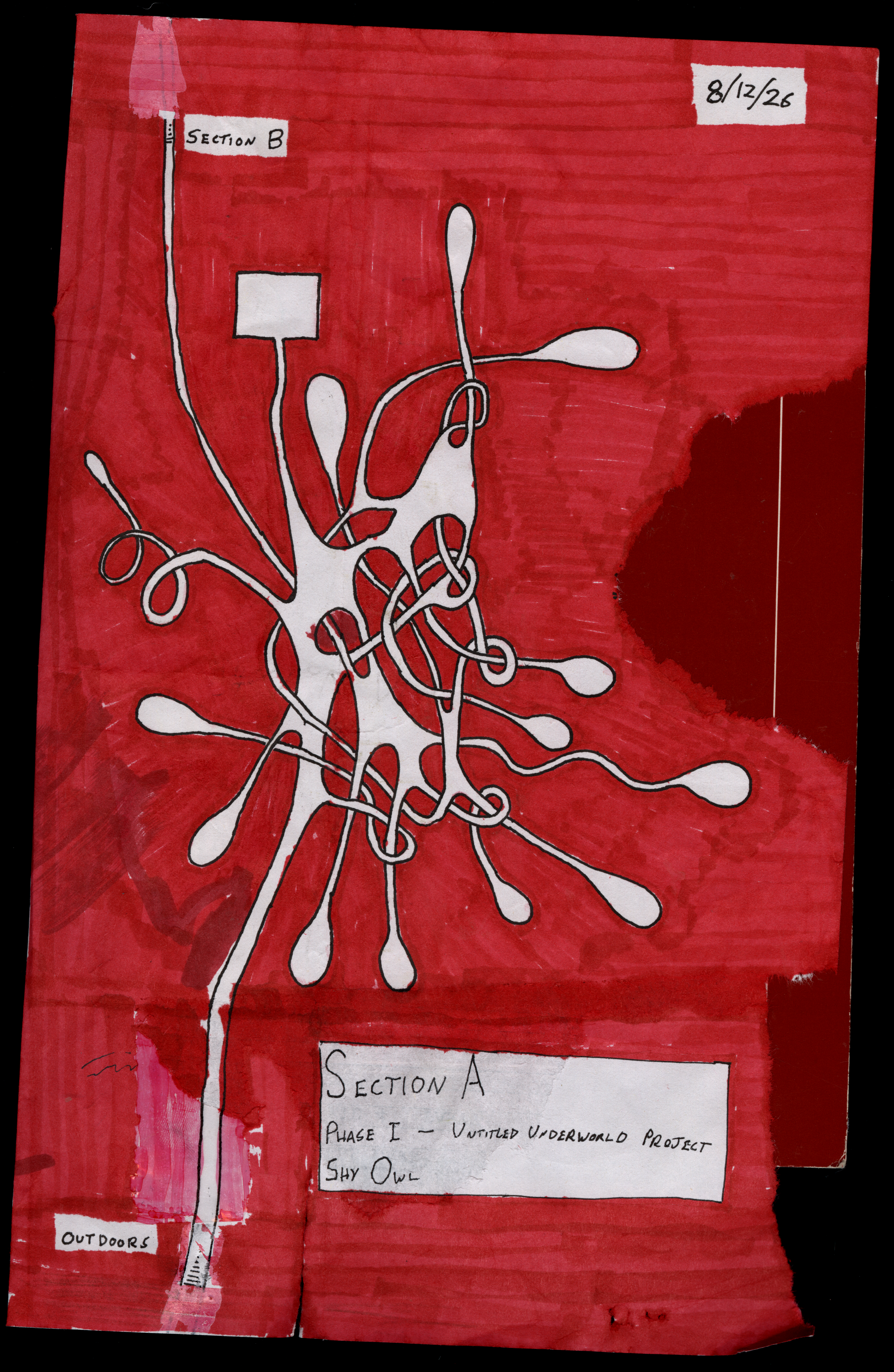
Shy Owl’s map of Section A, for the first phase.
The basic premise of UUP is that it’s a succession fort, but for pen-and-paper underworlds. Each participant in UUP is caretaker of a dungeon section for a period of months, and while it is in their care the participant has full creative control over that section: mapping, keying, running game sessions, writing fiction, composing laws, developing rules systems, re-stocking, simulating, editing, revising, censoring, updating, retrofitting, preserving, letting go stale, whatever.
At the end of the phase, the section gets handed to someone else, who will themselves have full creative control. The idea is that it’s a growing and living corpus of dungeon-making, a collage of creative styles and aims: a living document. (to use a tired but useful phrase)
UPP is inspired by the authority Microscope gives its players over objects in events and periods (near total control) and the iterative-patchwork qualities of Jerry Gretzinger’s Map.
Phases are 3 months. It’s a long and gently paced project. My projected lifespan for the project is maybe 5 years or so; lots of time.
Being a caretaker for one phase shouldn’t commit someone to caretakership for any other phase, and also it’s not necessarily incumbent on participants to “produce” a great deal. It will be good for regions of the underworld to be dormant or slow-altering.
Untitled Underworld Project is open for new participants! Reach out to me if you’d like to claim a section. I suppose my capacity for managing is about 20-30 or so.
Friday, September 25, 2026
Dungeon Maps That Ask Questions
Sauce
What makes a good dungeon layout? Well, obviously one that has sauce, one which makes you want to sit down and play with it right now, because whoa wow what a cool-seeming place to imagine being in lets see what it’s actually like.
Sauce is a useful concept, though as I’ve phrased it just now might seem dangerously close to “A good dungeon layout is one that is good.” Maybe true, but perhaps tautological. Set it aside, then.
Meaningful Choices
Some say that a good dungeon is one which maximizes choices, particularly meaningful choices, in order to allow players to make moves that don’t feel arbitrary. The motive is to enable informed consent, if not tactical positioning. Avoid quantum ogres and all that.
Nobody wants to play a game that’s boring, and an easy target for “Hey this game is boring and I don’t like it!” is moves which feel pointless. So you try to increase the opportunity for cool moves by piling Interesting Consequences on to all the points of decision.
Example: “Aha! The left passage smells like baked beans, and so the party will be rewarded for their left-hand choice with a fight to the death with the Bean Baron.” (The party which goes right is still rewarded for their choice, not with the Bean Baron, but with a set of Mysterious Footprints, belonging to a foolish and Odorless Curmudgeon who despises beans and barons alike.) The choice (bean smell or not bean smell) leads to consequences (Bean Baron fight or Odorless Curmudgeon roleplay).
I don’t really want to poo-poo this kind of thinking too hard, but, for me, in my experience, it doesn’t really match what I find compelling about dungeons or what I’ve found effective at the table. For one, it presupposes the idea that some outcomes are palpably more meaningful than others. The referee is supposed intuit which is which and then make decisions about decisions at varying levels of granularity in accordance with the ideal play-practice for their table. The result (whenever I’ve tried it, at least) is messy and too-crowded, like I’m trying to play my game on behalf of the players, like I’m chewing their food for them. Gross. Well, set that aside, too.
Questions
For the sauce-averse, and for the meaningful choice-averse another framing might be questions. Hypothesis: A good dungeon is one that asks questions.
Where is the entrance to the dungeon? What kinds of things live there? What treasures are inside? What will happen to my character if I drink from the fountain? Where does that door lead? Does it connect back to the passageway we were just in? Is there a secret room here? How deep can we go? How easy are twisty passages to map on graph paper? Can we find a better way to move this treasure to the exit? Why is it designed this way? Can we go even deeper? How will players respond to a hallway that rotates imperceptibly? Can I deduce where the edge of the referee’s graph paper is by going all the way to the east?
You get the idea. All of these questions encourage making game-moves towards answering them, and because of the way D&D is structured, making those moves is fairly immediate. These are actionable questions–you investigate them by playing the game. A good dungeon layout is one that encourages you to play D&D.
A series of empty rooms might not provide very many meaningful choices, but it sure does present a lot of questions. Questions about what’s in the rooms, why they’re empty, whether it’s worth it to investigate them all or better to move on to somewhere more interesting.
(The answers to these questions are, I think, less important. Sometimes a dungeon map will answer the questions it asks. Sometimes the referee will decide upon one later. Sometimes questions are never answered, looming gently in the background. The point is the process of trying, not necessarily the results.)
***
I don’t know how I feel about this framing, ultimately. I definitely don’t want a heuristic for “good dungeons” to be how many Interesting Questions it asks, and I don’t think it’s worth anyone’s time to make a literal list of dungeon-questions to have in mind while making one. Question-based dungeon design sounds abysmal tbh.
It’s just more an observation that, when a dungeon map is finished and I’m looking at it and I think “Hmm, this is good.”, oftentimes one of the things that makes it good is that it asks many questions, questions which demand sitting down with the thing and playing D&D with it. It has sauce.
Monday, September 14, 2026
Creatures — Living Hammer
Living hammers are not inherently malevolent. It’s just that they know only one solution to any problem, and they love doing their jobs.
6HD, AC 4, 6” mv., 2 dice damage.
Thursday, September 10, 2026
Amoeba D&D — Slime Mold
Awed by the genius of Warenunförmig’s Ocean D&D, I present the burgeoning and mucusy aggregation of a new game, also like Dungeons and Dragons, but different.
Behold Amoeba D&D (AD&D)!
In AD&D, players assume the role of microbes in some fantastic environment. XP is granted for consuming food (often bacteria), and the microbes can go on whatever adventures they wish. The world is quite large when you are very small.
The first class of this new D&D game (and all that exists so far) is the Slime Mold. I present a first draft here, untested and unrefined.

At levels 1-4, a Slime Mold can asexually reproduce, dividing itself into two equal amoeba with ½ experience points. These amoeba function independently, but may be under the control of the player.
At any time, if the sum of the xp of Slime Mold’s is between 15000 and 29999, the bodies can permanently form together to become a Grex, a slug which moves twice as fast.
The final stages of the Slime Mold, Sorocarp and Sporangium are stationary, as the mold builds a towering structure in order to disperse its spores. This is perhaps analogous to a castle in D&D.

Exhortation
All small things owe themselves to Ido, Lord of Microbes. Slime Molds can urge happenings by appealing to Ido. These are called Exhortations, because the slime mold exhorts the world to do something.
Predict Future
Solve Maze
Traverse Tremendous Distance
Resist Fire
Frighten Beetles
Operate Machinery
Farm Bacteria
Interpret Signs
