Friday, June 5, 2026
Worker Units in Starship Troopers
This post is a summary of one unusual mechanic in Avalon Hill’s Starship Troopers (1976), which addresses noncombatant deaths.
Starship Troopers presents seven scenarios, with each scenario adding increasingly complex mechanics. This can be a little frustrating–there’s no way to play the whole game at once–but if you think about it as seven closely-related games it’s not too bad. The scenarios carefully reproduce the battles described in the novel Starship Troopers.
In Scenario One, the terran marines overrun a humanoid colony. The humanoids are allies of the arachnids in this scenario, but later on in the story, after many sound defeats, they are forced into allying with the terrans. As a faction, the humanoids are squeezed between two overwhelming imperial powers, and struggle to find their own way of survival within them.
Here’s the information for Scenario One:
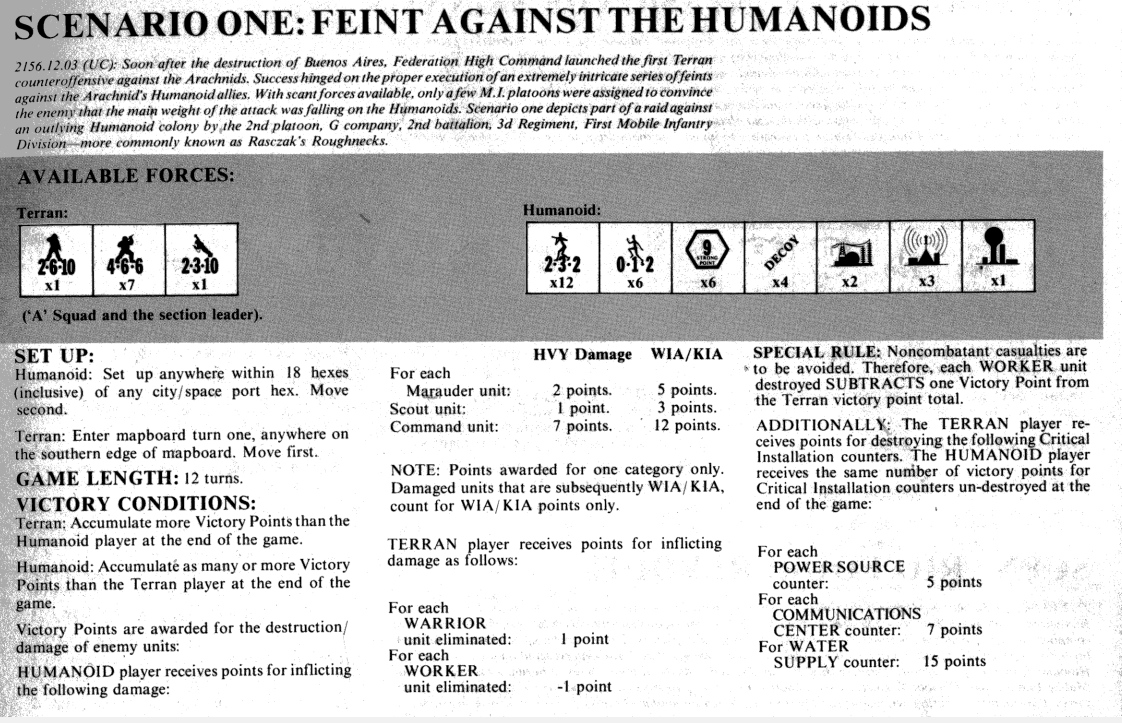
The alien player controls 12 Warrior and 6 Worker units, and has freedom to place Strong Points, Vital Installations, and Decoys. The terran player controls 9 marines and must navigate to and destroy Critical Installations within a set number of turns.
As you can see, most of the victory points for the terran player are in destroying infrastructure: Water, Power, Communications. Token VPs are granted for killing enemy Warriors (1 each), and negative VPs for killing enemy Workers (-1 each). As it states, “SPECIAL RULE: Noncombatant casualties are to be avoided.”
I have played this scenario as the humanoids, and the negative VP mechanic incentivized me to intentionally move worker units into Critical Installations in order to slow down and dissuade the terran player from destroying them. The rules encourage the alien player to use workers as shields to delay the inevitable: force the marines to suffer VP loss to win objectives.
It models a horrifying desperation on the part of the humanoid side. On the terran side, it simulates a callous “rules of engagement” style positioning: It’s a shame, but if we want to destroy the water supply it must be done! Rather than disincentivize the war crimes committed by the terrans in this scenario, the negative VP mechanic includes those crimes as part of an acceptable calculus. The cost of murdering civilians is diplomatic inconvenience, a PR problem.
The inconvenience is juxtaposed against the goal of the scenario, which is the wholesale destruction of infrastructure. How many more civilians are affected by the elimination of those power and water installations? How many further deaths and displacements do the terrans cause in this scenario for their operational feint, after they leave? The terrans lose no victory points for those noncombatant deaths. They play no part in the calculus.
I’m not sure if this was the intent as designed, but this little mechanic strengthens my understanding of the profound (American) evil that the terrans represent in Starship Troopers. The futility of the gesture towards humanity underscores its horrific context.
