Friday, March 13, 2026
Keying and Running Redux Alpha
In this post I share my notes for Redux level Alpha. It’s in response to what are reasonable questions about how my large and oddly shaped dungeon maps work in actual play. It’s also a record of my personal prep and playstyle. I don’t pretend to be presenting anything terribly novel here–there’s no shiny method or clever innovation in how I run things. This is just what the most well travelled corner of my underworld looks like after 30-odd sessions of 3LBB campaign play.
It is a companion piece to Redux Setup, which covers some physical aspects of how I run my game.
The Notes
Here is a pdf which contains my complete notes for Redux Alpha, redacted to exclude what hasn’t seen play action, or what might be spoilers. Only about 3 pages of notes are witheld:
In addition to these notes, here are documents authored by Alfonso Ultima, Phd. These were found kept in the folder until discovered, then handing to the players:
Ultima_Has-God-Spoken-to-You.pdf
Ultima_How-to-Make-Decisions.pdf
Ultima_Guilt-and-Forgiveness.pdf
For comparison with actual logs of sessions played, here is a pdf of all 9 Redux sessions up through March 1026 where action took place at least partially in Alpha:
The Map
Construction and Development
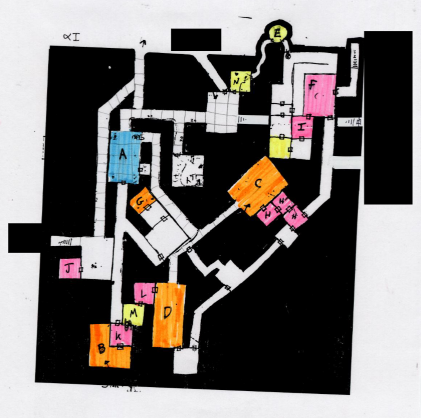
Alpha began life as a fairly straightforward map drawn on graph paper. It looked like this:
This map never saw play. By the time I got a group together, I had replaced with this, the current Alpha:
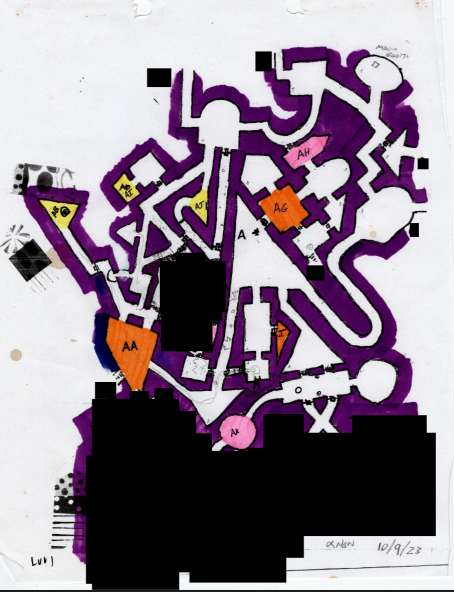
I drew the new map on an index card, then printed out a full-page version to key. The highlighting indicates results from the U&WA tables: pink for Monster, orange for Monster and Treasure, yellow for Treasure only.
When I drew Alpha I was very cognizant about playability. I wanted the level to be accessible and exciting. It’s not too big, and each of the paths one can take leads somewhere slightly different. The large triangular room makes a pretty good landmark for deciding to explore other areas.
The multiple loops mean that Alpha is pretty good for telegraphing unexplored space. It’s been useful for players to work their way completely around an area. This has also meant that chases are pretty fun–there are several ways to get back to safety, and players have been able to make intelligent decisions in order to avoid danger.
Alpha is connected to lots of other levels. There are two downwards stairways and an elevator (though nobody’s ventured down them), to the north and to the east are other levels. To the south, well, less said about the south the better.
The Alpha Mapping Game
I gave players this initial map of the area. You can see plainly that it is wrong in several places, but it gives hints about the general layout.
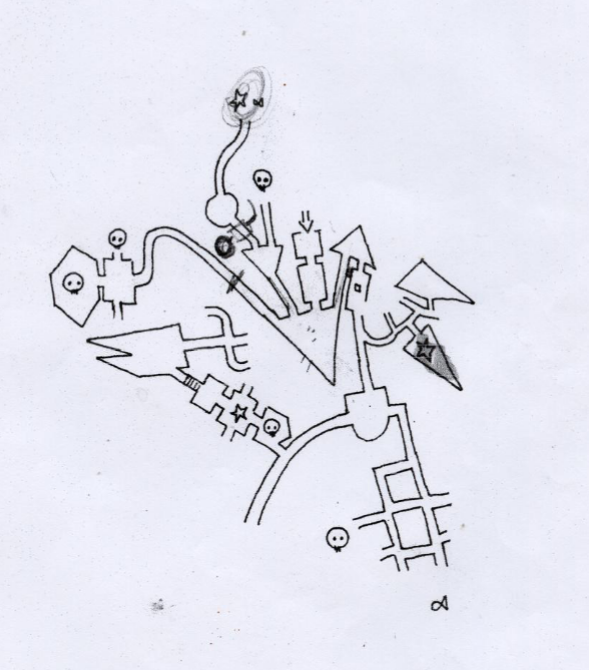
This map proved to be quite frustrating to players when they discovered it was incorrect. To my surprise, instead of realizing the map was wrong, they decided they were in the wrong place! Eventually they figured it out, though. The point was to aid players in drawing their own maps, not to have them use the given one.
Here is the most up-to-date player map, drawn by Idraluna and posted with his permission:
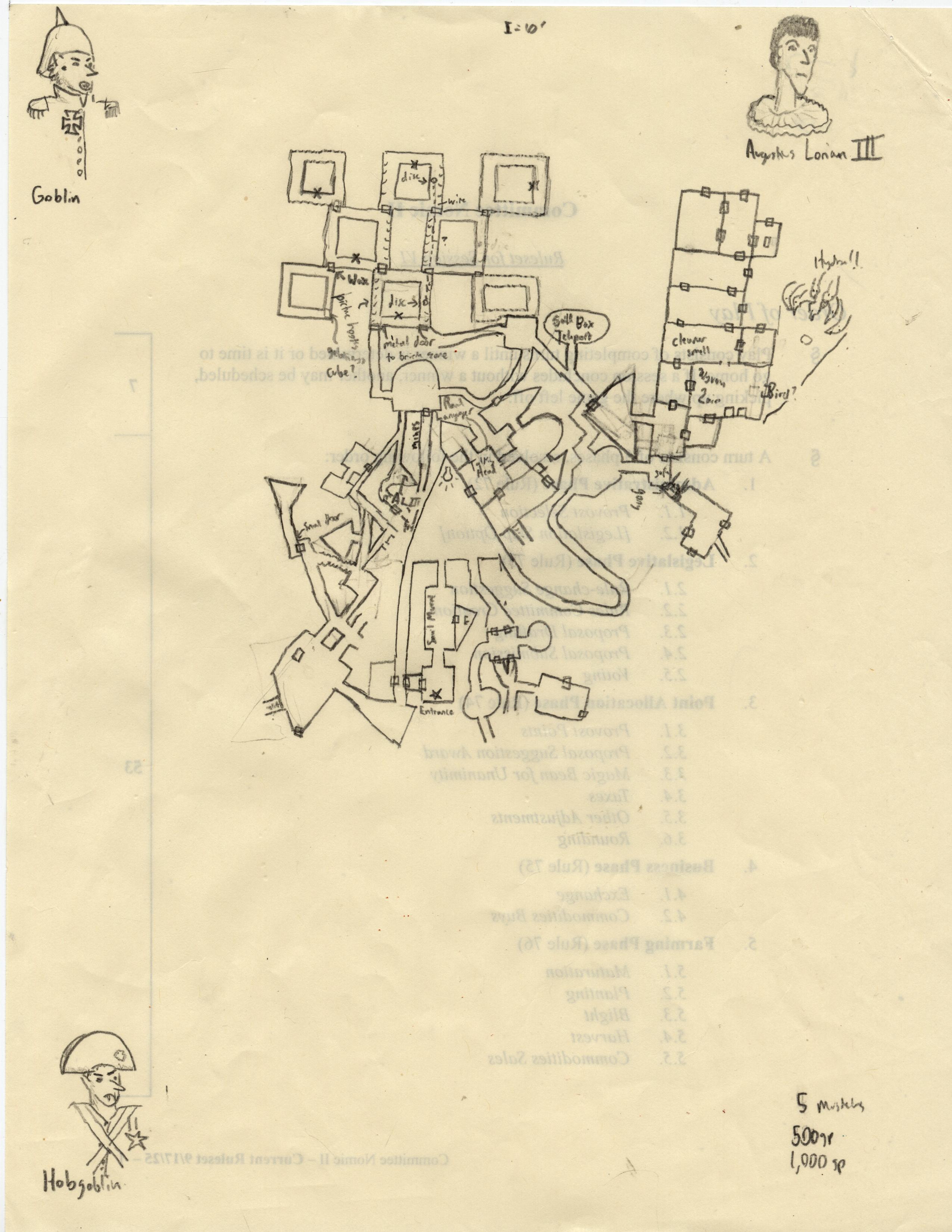
You can compare this with the referee map and see that it is incredibly accurate. I have had zero trouble with players mapping Alpha.
My referee map doesn’t have any markings, but it is draw to scale, so I eyeball the distances and relay them. When a room is difficult to describe, I will draw it out on a piece of scratch paper and show it to the players for them to copy down. I keep an eye on their maps, and if they draw something which doesn’t fit what the characters are seeing, I correct it.
I don’t correct errors on the player map if the characters aren’t there to see it, and if a player makes assumptions (say, connecting a hallway on the map without having actually gone down it) they are on their own.
Keying
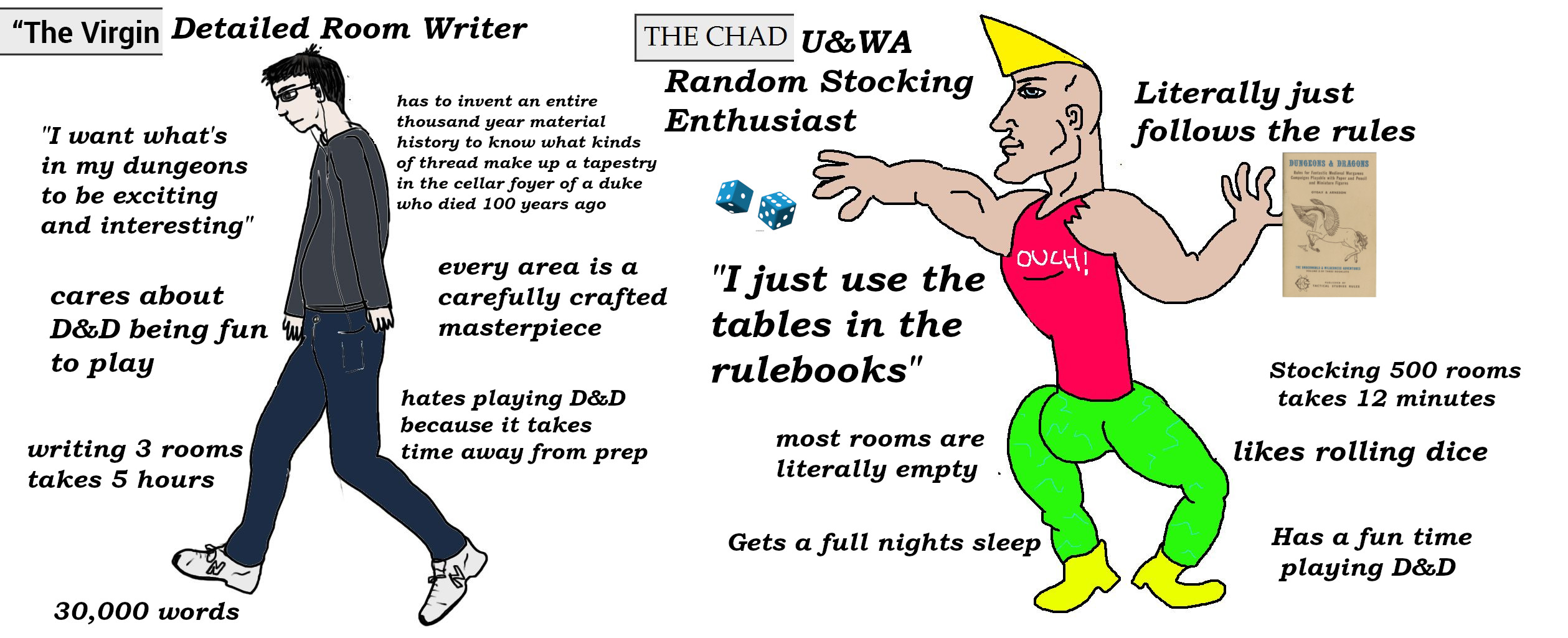
This meme demonstrates the duality within my soul
Initial keying was done mainly with the U&WA tables, with a few areas grandfathered in from the earlier keyed version of the map. I really like the random distribution, because frequently the dice will place content in places I never expected. For treasure especially, the U&WA tables are great for insisting that something is there, definitely in that place. Once I have a baseline distribution, I can go in and add more detail/embellishments.
In general I take fairly sparse notes, but add concrete detail in specific areas. Redux Alpha has a lot of writing associated with it, but most of this writing is Dr. Ultima’s essays and pamphlets.
Select Wandering Monsters
My wandering monster table has undergone several modifications. When a monster type has been cleared from the level I cross it off the list. Alpha uses a simple two-tiered table with monsters inhabiting Alpha and those from elsewhere.
Ruff-fish
The Ruff-fish are a plain rip-off of a vignette in Yevgenia Belorusets’ Modern Animal, where a priest has been preaching to a group of fish, and they respond with the curious inverted collective-individual dialogue.
They are a chorus, and so to produce the chorus I have the players all read aloud from the script together. I’ve had a lot of fun with these encounters. It’s pretty much strictly non-combat, but it forces players to be immersed in what’s happening before them.
The problem comes when players ask the Ruff-fish questions. I haven’t been able to come up with many satisfying ways for dialog with these creatures, so for the most part they say their piece and move on.
Dr. Alfonso Ultima, PhD
Dr. Ultima’s writings have been a really fun part of Redux. Started with a pamphlet, and he has also written numerous essays which get left around. The man himself has been fairly elusive; the players are still puzzling over what his deal is. He was the subject of a Records Request.
Select Keyed Areas
A - Lightbulb headed monstrosity (ON)
The LBHMs were inspired by the “protagonist” character from MAD GOD. They have lightbulbs for heads and lots of HD. When their pull-cord is pulled, the light is on, and the LBHM sits immobile.
This was a really great feature for the early sessions. It was something of a mystery, it lit up the central room for ease of description, and, it’s largely harmless unless disturbed in an obvious way. Eventually the PCs’ curiosity got the better of them, and they killed it, which is sort of sad.
?? - Goblins
My goblins have uniforms and equipment reminiscent of WWI Germans. The concept is something like outposts of units, so they have been building out various defenses. Including booby traps (usually poison gas behind doors or paintings), obstacles like barbed wire and land mines.
Goblin rifles are really dangerous at long range, but closing the distance seems to work well, as they aren’t wearing armor. So far bullets have been stopped by shields in NRACS, but I might want to change that soon.
AB - Treasure of the Snail Knight
Search for the actual treasure is still ongoing. In typical Referee fashion I assumed it would be much easier to find than it actually was. There is a looted treasure room, which contained a huge and heavy brass snail shell. Much interest was had during the session where the party slowly dragged it out and hoist it up the shaft into the air.
?? - Magic Booth
A simple teleported added well after the initial keying. Having a cool-shaped empty room was really handy for this purpose.
The Living Dungeon
Huge portions of what’s “true” about the dungeon have few or no written notes.
Perhaps the biggest one of these is that Alpha starts with stairways to a room, then a rough 40′ shaft downwards into the center of the level. There are no notes of this room or shaft because I know it’s there. This fact about the world shows up in player notes and expedition logs, but not my referee map or notes. The space in which play occurs–call it an imaginary world if you like–does not exist except in the actual interactions at the table. It’s not written down anywhere fully, it’s not in my head, not really. It emerges through social play.


