Thursday, March 5, 2026
Redux Setup
The Filing Cabinet: A Vertical History of Information is a book by Craig Robertson which describes in detail the technological and social history of the filing cabinet. The whole cabinet apparatus information retrieval system, Robertson argues, developed as a confluence of technological capabilities, economic incentives, prevailing styles, and modes of social enforcement. The filing cabinet is not a neutral “best” way of storing paper documents; it is only one of many different technologies which could achieve similar aims. The ubiquity of files is because the filing cabinet was chosen by the corporate west as its information retrieval mainstay–instantaneous access to compartmentalized data. This legacy lives on in the skeuomorphic files and folders of computer systems.
It’s a good idea to pay attention to how we physically deal with records. The material reality shapes our understanding and use of information. We should make informed organizational choices.
Emphatically, this does not mean that referees need to take “better” notes, or be “more organized” in accordance with some objective ideal. A one size fits all solution is worse than useless here. What I mean is: we should pay attention to the kinds of documenting structures we use, and be willing to explore new ones if the old ones are causing trouble. Conversely, we should work to actively maintain structures which work well.
So, here is my paper setup for my in-person Redux OD&D campaign. For context, the campaign runs once a week at a local gaming store in an open table format. I will go over all my physical components of play, and how I keep and maintain my notes.
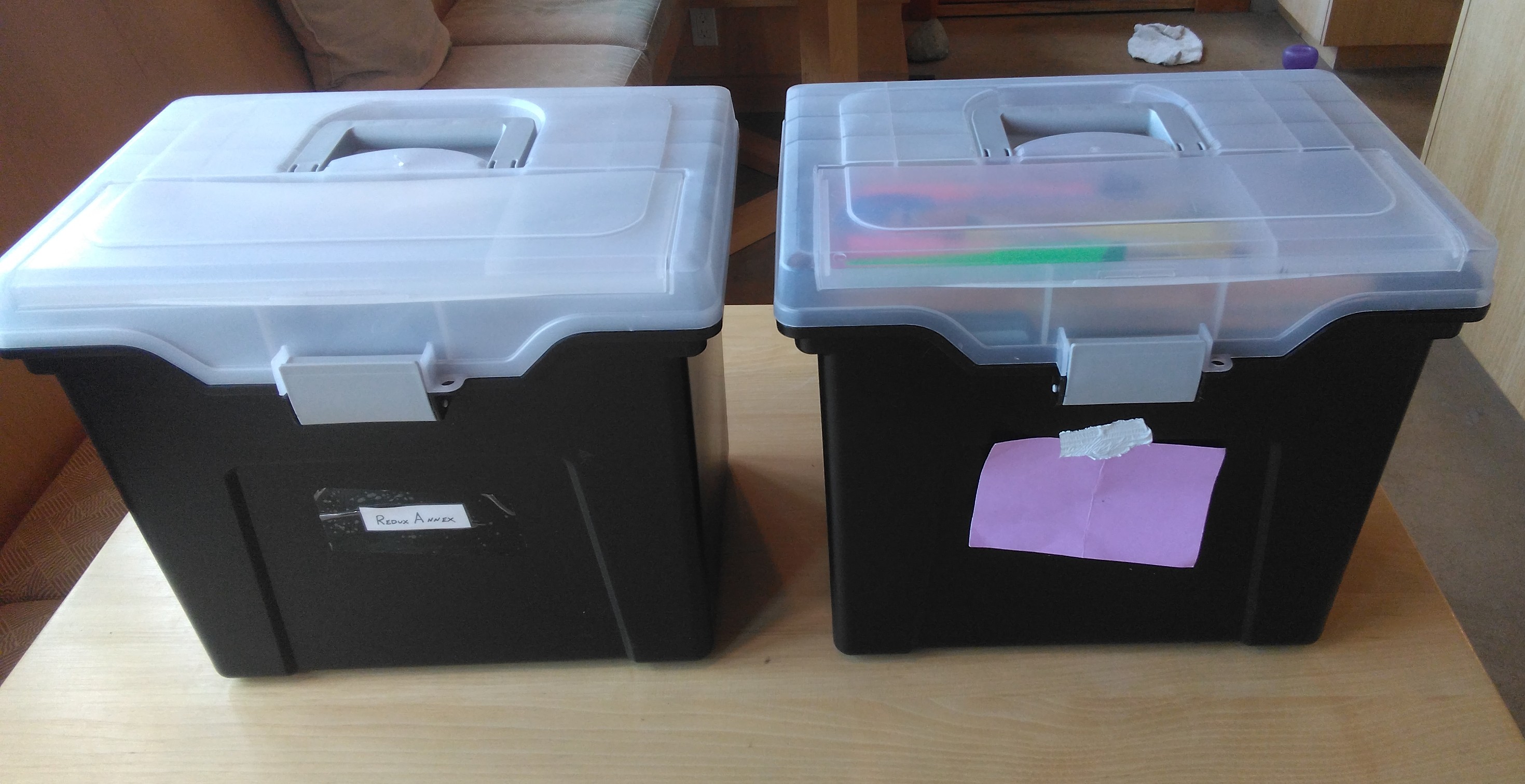
I don’t use a binder or a laptop at the table. The whole of Redux fits into these two document boxes. One contains entirely paper (this is the more important box), and the other contains dice, a rulebook, hole-punch, miniatures, pencils, pencil shavings, and paper clips.
Equipment
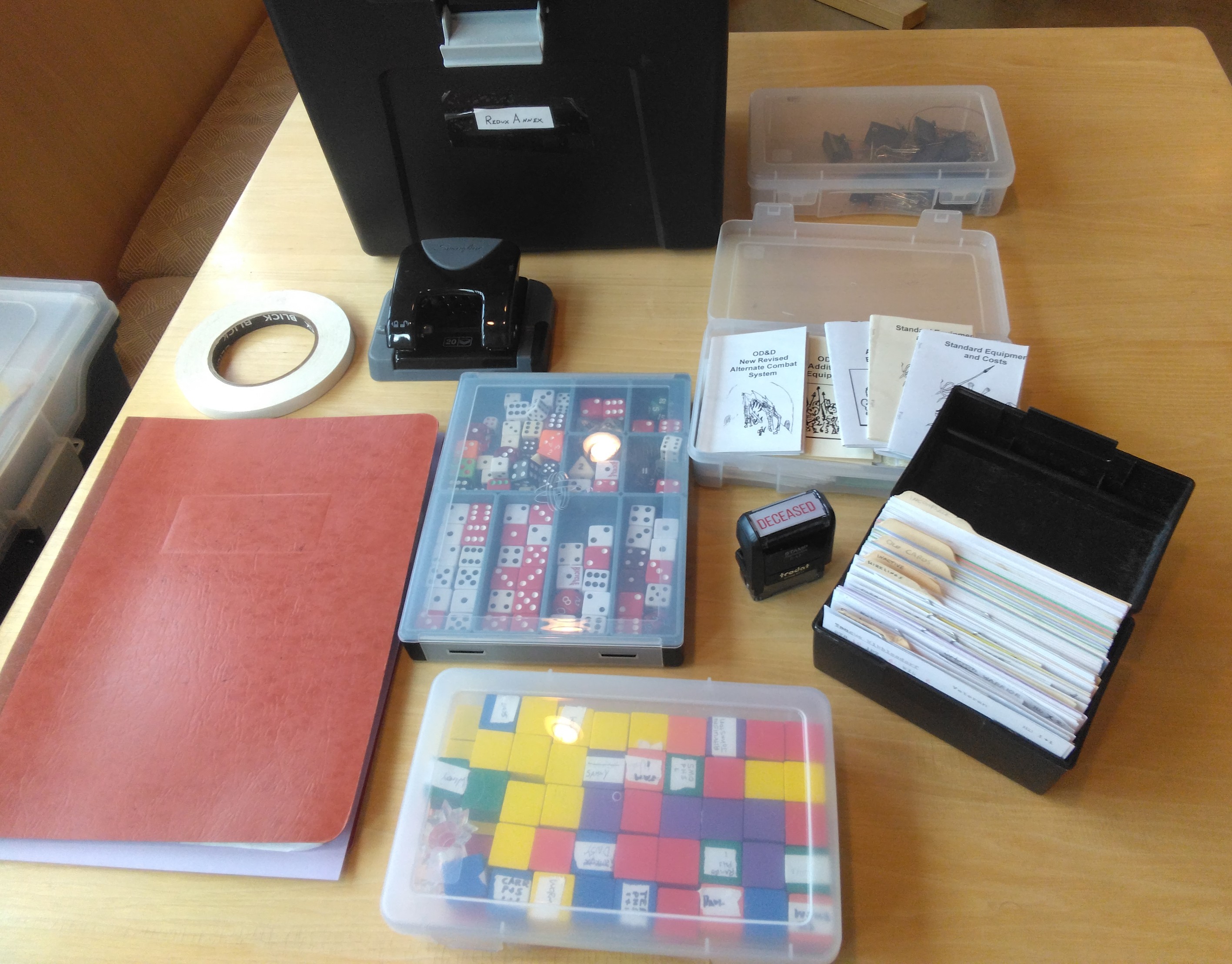
- My rulebook (left) is my printed out OD&D all bound together. I mostly just use it for quick reference.
- I printed little reference zines (upper right), which I distribute in the center of the table. Most rules-reference is done using these.
- Character sheets are index cards in an index card box. Ideally these should be organized in some fashion, but generally they are not.
- For miniatures I use little cubes with names written on them. Ideally, these are color-coded. Since there are so many characters, it has been a little fiddly and frustrating to make sure everyone has a cube with their name on it. The combat system NRACS works really well with these simple miniatures.
- NRACS uses lots of d6s so I have a bunch of these in two colors.
- I’m very glad to have a little box for pencils, but I definitely need to get more of them.
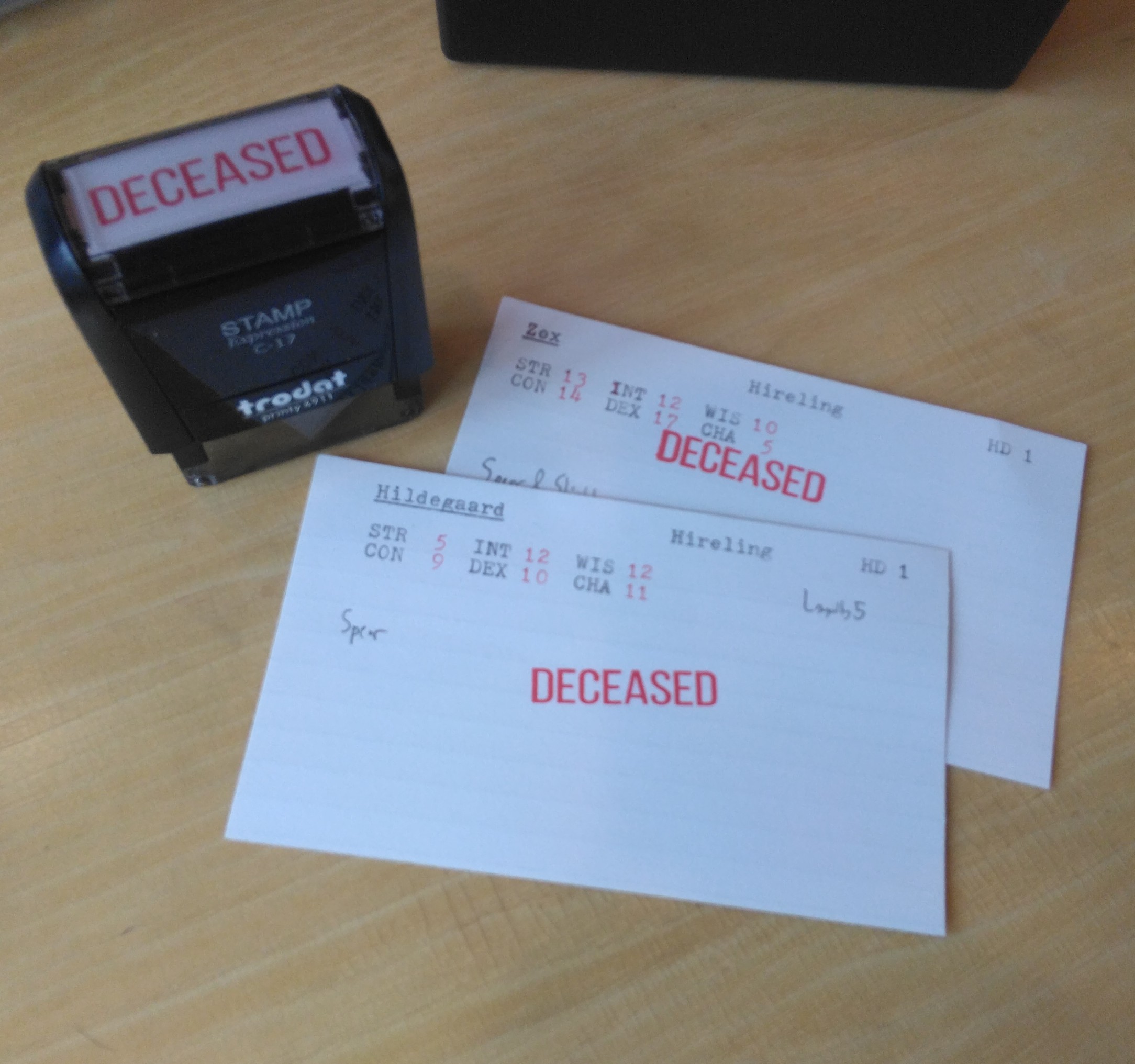
- The “deceased” stamp was a wonderful birthday gift from a dear friend of mine. It’s really satisfying to use–a little ritual for a legitimately sad thing. I generally have the controlling players use it on their characters, of course.
Documents
Each dungeon level or section is its own folder. I like these fastener folders.
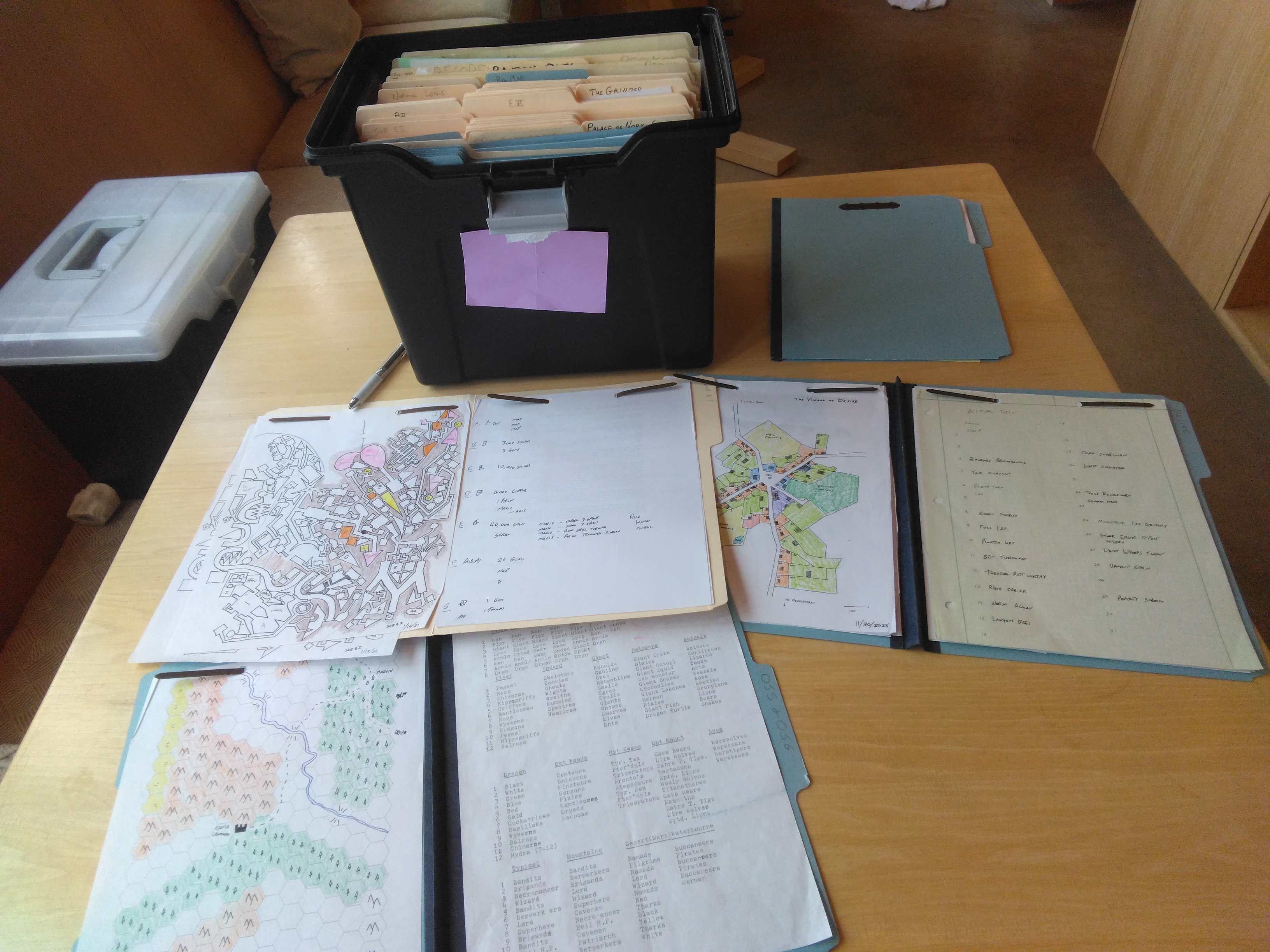
When laid open, to the left is the dungeon/wilderness map and to the right is first the Wandering encounter table, and then the key and other notes beneath it. Usually there are illustrations here, and also occasionally handouts.
I don’t use a Referee’s screen; instead I cover the map with a piece of paper (usually my notes for the session). In play, then, the folder lies flat with the map covered and the wandering monster table exposed. I mostly only need to take quick peeks.
Generally play outpaces my ability to write things down, so for the most part my notes are the barest essentials generated using UW&A. Occasionally there are some more detailed writeups or drawings. When I draw a new version of a map or write up a new key, I just insert it at the top of it’s half of the folder–this makes it so the older notes are “deeper”.
I’ve found that my drawings in particular are really useful, and that I will frequently want to show the drawings to my players–the fastener-folder setup make picking up the whole thing and clumsily flashing my scribbles for all to see doable and fun.
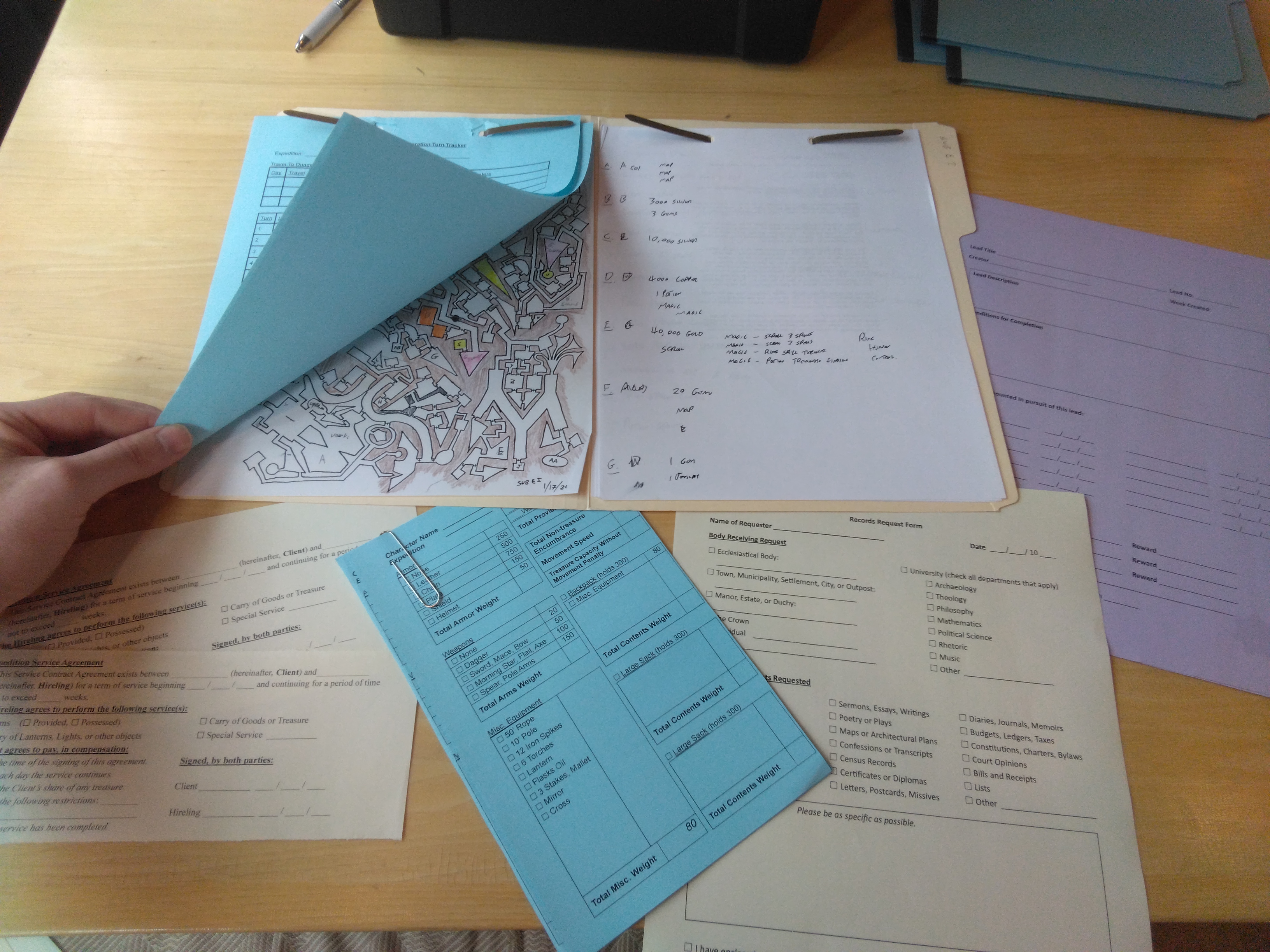
I use a lot of paper tracking documents: Writs of Free Arms, Clerical Assignments, Equipment Trackers, Hireling Contracts, Session Log Sheets, not to mention the ordinary player maps, other contracts, letters, handouts, and so on. In addition to dungeon/wilderness maps and keys, then, I keep simple folders for:
- blank paper (usually scratch paper from other projects)
- player notes (all together in one big stack)
- expedition logs by season (includes at-session notes alongside typed up and printed logs)
- Records Requests by season
- Active Leads
- Completed leads
Out of an abundance of optimism I have also been carrying around the Outdoor Survival board, in here, but I should really probably put that back where it belongs.
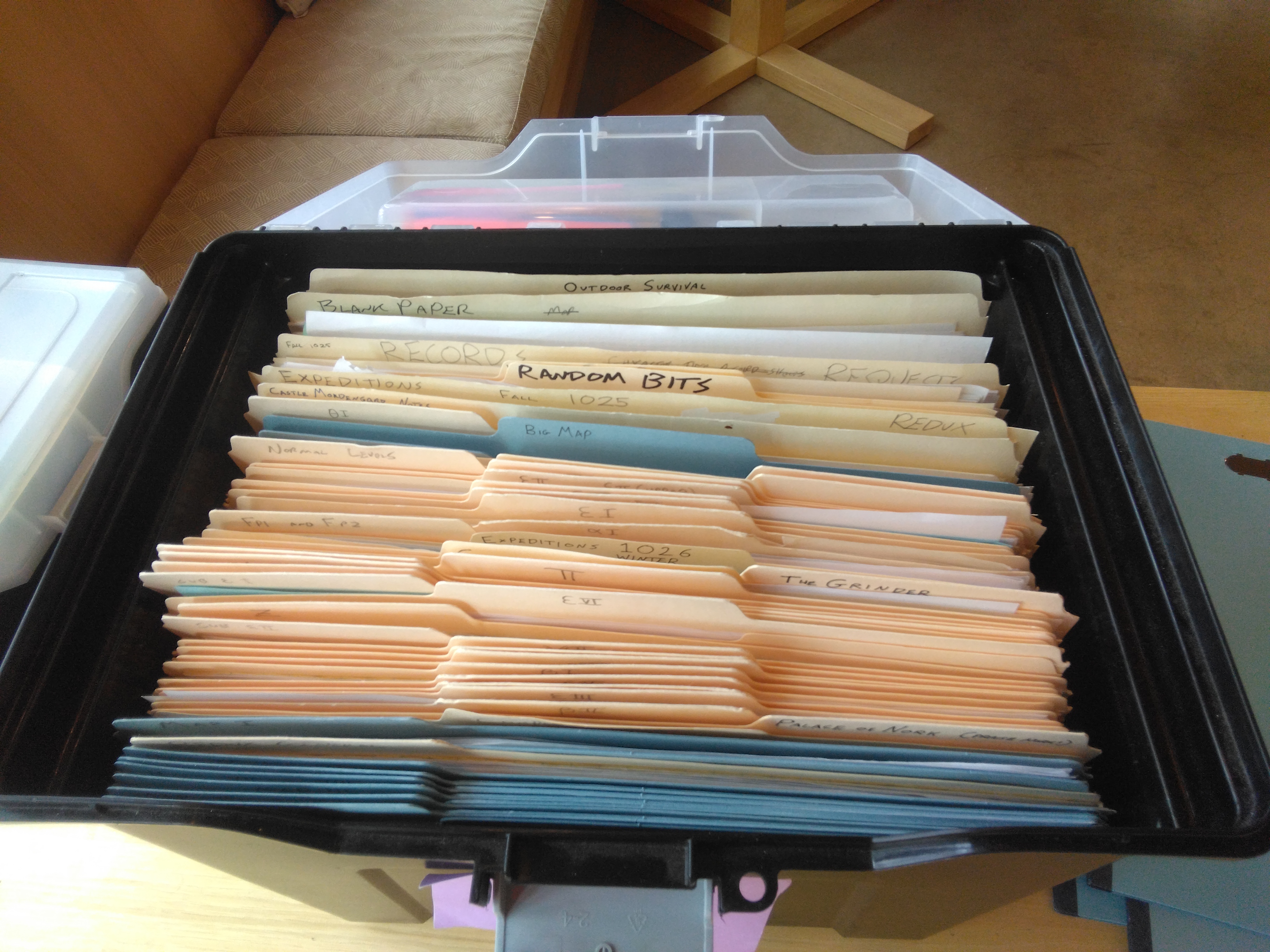
For the most part I hold on to player character cards and player-drawn maps. I don’t enforce this–people can take them home if they want to–but it has seemed to make sense for all the actionable pieces of the campaign to be together. This adds a further layer of custodial responsibility onto me the referee.
Tradeoffs
My system works well for quickly accessing the layout of a dungeon and the contents of a room. It is quite fast for navigation, and I like the elegance of just a flat folder at the table with no screen intervening. I feel very immersed in the world.
I like how my setup accumulates paper as it goes on–new maps get slotted in atop old ones, refreshed keys loom over earlier ones. It’s a chaotic overlapping mess in places, which is a good thing.
It is somewhat fiddly with all the pieces of paper and folders–not infrequently I misplace one and have to go digging for it. It has also happened at least once that I misplaced an entire folder, and so had to run a whole session without the relevant map on hand. (Thankfully I had posted an image of the map on my blog, and so was able to run things smoothly.)
Relying on multiple pre-printed forms means I have to maintain a stock of sheets, which adds complexity to prep.
The boxes are heavy and cumbersome to travel with. I am quite lucky in that I have access to a car and parking nearby to the game location. This setup would probably be unworkable if I were reliant upon public transportation to get to my games.
Monolithic sprawl and onerous bureaucracy is sort of the vibe I’m going for with Redux, so these tradeoffs make sense for the way I play. So far my notes have been effective at letting me run my game how I want to.
Preservation
When I moved after college I lost an entire campaign’s worth of maps and notes, which was a tremendous blow. For Redux, I’ve tried to be a little better about keeping backups.
I now scan pretty much every map I draw. Digital records are more fragile than paper ones, but they are easier to duplicate. I frequently print off copies of scanned maps and use those at the table. Occasionally I will hide copies of things in books to be discovered later.
Writing campaign logs and posting them on the internet is likewise a “second home” for the campaign. Online presence has its own dangers, though. What is online is scoured by AI and swept up into the vast panopticon police state of the 21st century. I don’t really want to expose my whole creative self to those winds. I also have a responsibility to my player’s privacy and their creative work–it would be unethical to post player-drawn maps or illustrations without their permission.
I won’t be able to preserve everything–RPGs are pretty ephemeral stuff–but I’m trying to avoid a total loss. As long as I won’t ever have to start all over from scratch again, I’ll have succeeded.
Links
I made this post after reading Idraluna’s What I want to read. I would like to link to other posts demonstrating the binder/note setup for games. Please send them my way!
Add comment
Fill out the form below to add your own comments


