Saturday, January 31, 2026
Records Requests — How its Going
Here’s how it works: any character, at any time, can submit a Records Request Form to an institution or individual in the world.
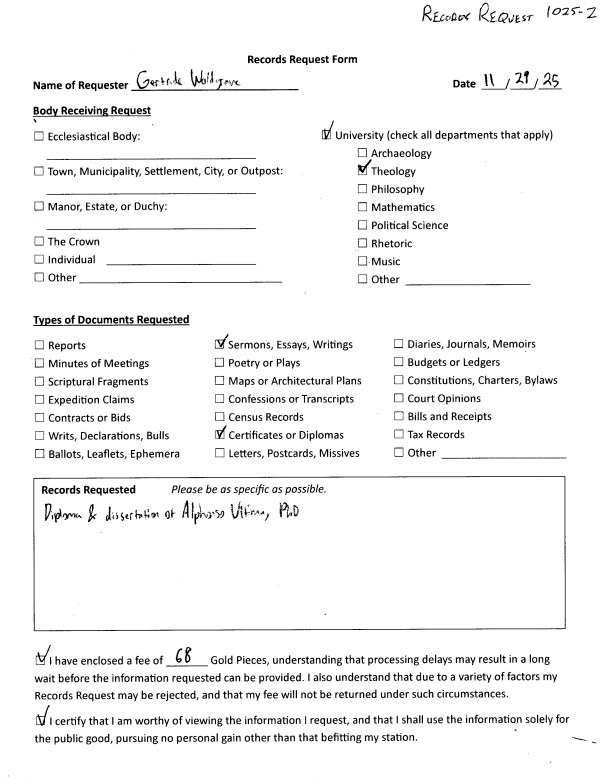
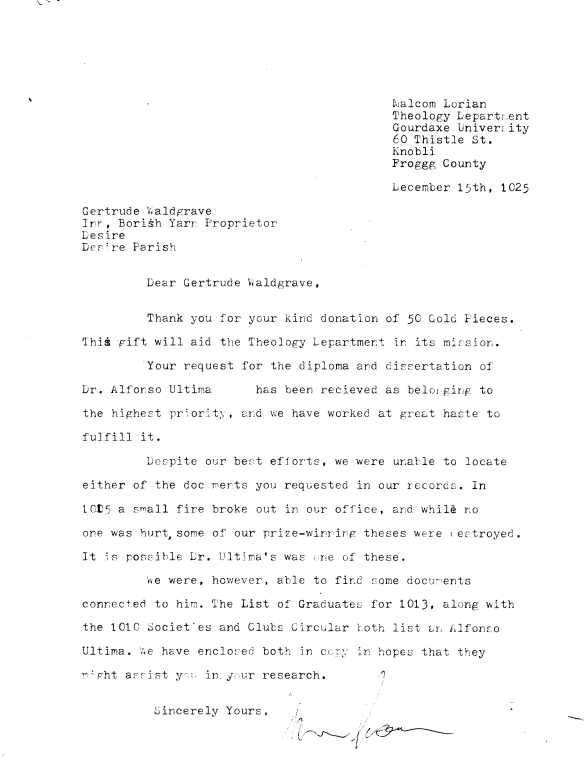
After several weeks the character gets the fulfilled request in the mail. Depending on the amount of gold paid for the fee and the nature of the request the documents received may be useful or not. I post the fulfilled records requests on the campaign website for anyone to view: https://www.reduxodnd.com/records/
The documents mostly answer questions obliquely; they are archival records for the most part, produced for reasons other than adventuring. They are artifacts of a society which exists outside of the adventurers, one full of people who do not know and will never care about player characters. Players have to ask carefully and read carefully to find information they want, and it might not be there at all.
Records Requests in the real world aren’t nearly so fun to fulfill, but here I get to pick out exactly which sorts of documents “exist” meeting the criteria laid out in the form. I can be snarky or evasive, abstruse or helpful to my hearts content. I can sprinkle hints and red herrings, and there’s lots of room to be utterly ridiculous.
I don’t like explaining my world’s lore very much. I’m much more interested in how players react to my world than I am in rambling on and on about it. (What horror stories have been told of DMs for whom a D&D session is a long droning History of Place!) One could break up the lore into multiple conversations with various NPCs, but that’s fairly boring to me as well. Just droning in funny voices instead.
Records Requests let me make a little piece of world information–often quite small–and toss it to players like a hot potato. The players get a tangible document that’s immediately actionable, and I don’t have to worry about it after that.
OD&D can be thought of as several different games working together. There is The Mapping Game (Underworld flavored and Wilderness flavored), The Talking Game, and The Fighting Simulation Game:– Records Requests constitute part of The Paperwork Game. In The Paperwork Game the world is explored through mock bureaucracy. Other components of the Paperwork Game include drawing up plans for your castle, logistics accounting, letters, declarations of war and such, as well as contracts, claims, lawsuits, and so on.
An obvious problem with this practice is managing the volume: can I keep up with producing all the records which are produced in a timely manner? Dungeons and Dragons already takes up a tremendous amount of my time, and writing these documents is quite slow, slower than drawing maps or stocking rooms. There is also greater pressure to get them “right”.
On the other hand, documents will stick around. After a while there’ll be a big corpus of them, each one continuing to make my world rich and navigable. I have been playing with Records Requests for 3 months, and there are about 30 pages of written material. This isn’t a bad start. The material I’ve written has in fact been really helpful in my own understanding of the world, it’s social systems and how it approaches problems.
I have been struggling with finding ways to “pick” documents or document types which 1) are fun to write, 2) are at least somewhat connected to the request, and 3) can be written in a reasonable amount of time. With any kind of game it takes a while to get a feel for things; maybe I’ll get a knack for it as the process continues. If there’s a request for a copy of a novel, for instance, I won’t feel all that obligated to write a whole novel, but I may settle on a review.
There is a sweet spot of verisimilitude I am aiming for with these documents–I’m not doing the full “tea-stained treasure map” document forgery, but I am composing them on a typewriter in a formal style.
You could, perhaps, set up a whole game that’s just records requests and the correspondence between them, but I will leave discussing The Imaginary Historian’s Society for another time.
Thursday, January 29, 2026
Mishmash: A Game About Rulestext
Came upon a post by Was It Likely? (https://wasitlikely. … 0-blows-kung-fu.html) and was fascinated by the example game rules-texts at the end of the essay. (I do not pretend to understand the full ramifications of the whole essay here, it is a lot, but I am narrowing in specifically on one point.)
One of the games which is presented has the following rules text:
Flying is bliss. the sky is beautiful, even falling to your death is beautiful . sometimes, rarely, you can survive such a fall and it’s like a fairytale. planes are acrobatic and spectacular and so fragile. the ocean is wild and hungry and lethal unless fortune saves you. on the earth everything takes energy, makes you tired. you can only get so much done in a day and a lot of it has to making sure you can eat and drink. stars fall from the sky every night. they strike the earth and burn the cities and towns so people travel in tents now. nobody is where you left them, but you’re always running into old friends. if you catch stars while they’re falling they retain their speed and lightness, and that’s what makes your plane work and your guns work. engines and bullets yearning to return to star-speed. huge war-blimps with buzzing flocks of star-snatcher warplanes.
I was amazed to see this kind of text be understood as rules-text, and I was inspired by this to further thoughts I have had about pushing the boundaries of rules-text. I came up with a concept for an experimental game which I am calling Mishmash.
The point of Mishmash is to strip a game down to its bare essentials: a group of people interpreting a piece of text as a ruleset instructing them to play a game.
Here is a link to advice for how to play Mishmash.
In Mishmash the rules text is the welding together of player-brought text fragments. The main difficulty in the game is figuring out how to understand the text as workable rules-text. Mishmash is not Nomic: the point is not to amend a ruleset together, or invent a game together. When play starts the ruleset is already made!
At the time of writing Mishmash has not been played, but I feel like there could be plenty of sticky points. It may be quite difficult. On the other hand, I really do think that quite a bit of game can be wrung out of some very non-game-looking text, if only the participants have open enough minds.
I can’t imagine a game of Mishmash would ever last more than one session. But, it is light prep, so hopefully it will be easy to start playing at least.
Thursday, January 22, 2026
How to Locate a Secret Room
Idraluna Archives’s writeup The Mapping Game is a wonderful description of an aspect of D&D which is sometimes under-investigated.
My two cents to throw out into the world is a few thoughts about how to place secret doors in places where mappers might infer them.
For this exercise, I’m assuming secret doors which are impossible to find unless characters actively take several turns searching the walls for them (except for elves, of course.) The idea is that, solely through the dungeon topology, players get a hunch.
They are arranged from easiest to hardest to locate. I’m not too worried about secret rooms being missed–all that means is there’s treasure left for next time. If it’s a really important secret door, you can put a bookcase, statue, or fireplace in front of it. (Or a big flashing sign reading “SECRET DOOR HERE”, which would be fairly nasty, especially if the secret door was actually 50′ to the right.)
Void Space
This method is works for high-density dungeons, and it’s the simplest. Consider the following hypothetical player-drawn map:
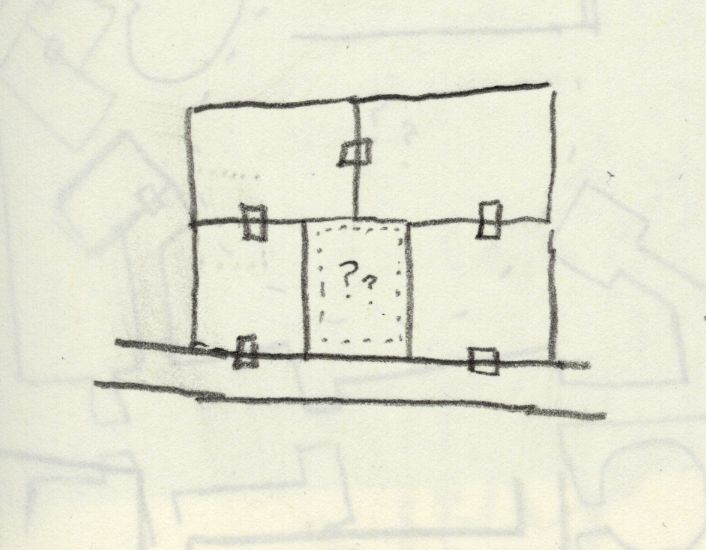
The rooms make a simple loop, but conveniently leave space for another rectangular room in the center. How could there not be a room there?
Pattern Interruption
Here you simply present a pattern and then supply its absence.
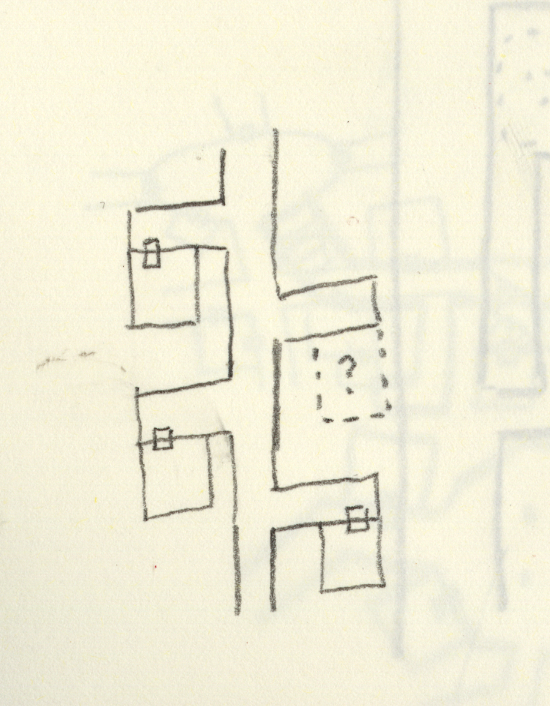
The pattern can be anything, but the key is to establish a trend and then buck it. Why would it suddenly change? Something fishy is going on…
Distance Discrepancies
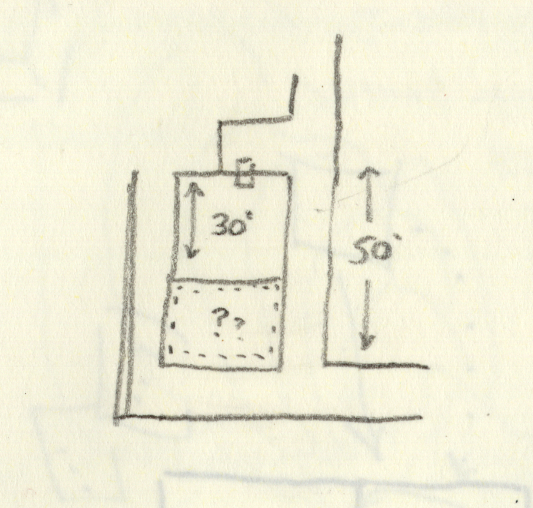
In the novel House of Leaves by Mark Z. Danielewski one guy discovered his house is several inches bigger on the inside than the outside. While we can’t expect player characters to measure dungeons with such precision, it is possible for distance discrepancies to be noticed. Hey, this room is smaller than I’d expect it to be!
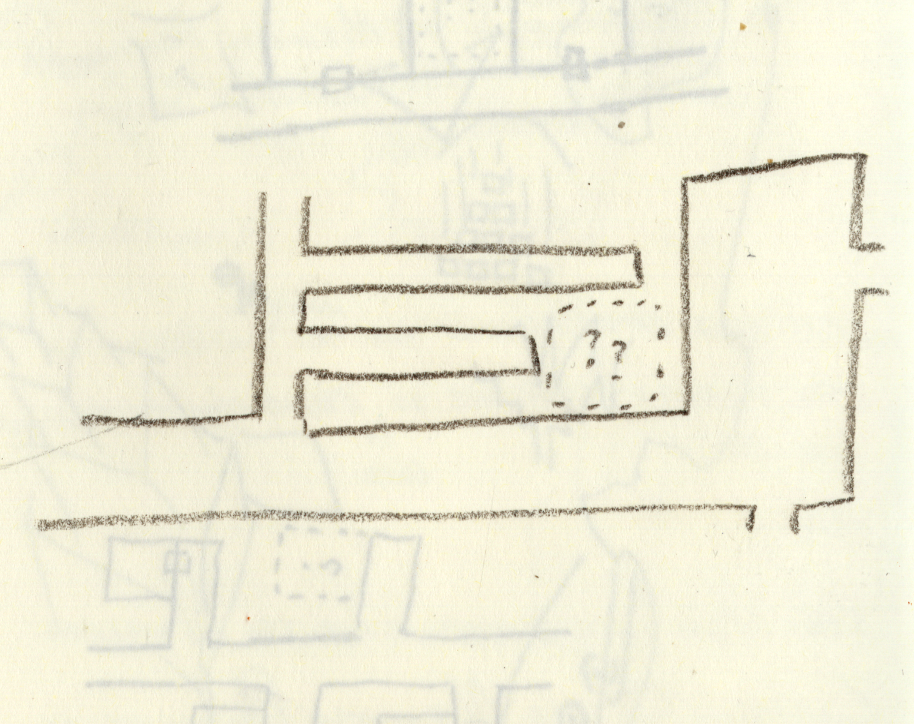
This can also be used with long parallel dead-end passages.
The Pincer Move
This method operates on a larger scale, where two apparent dead ends end up facing each other. Useful for telegraphing an entire secret area. Really the Pincer Move is a variation of Void Space.
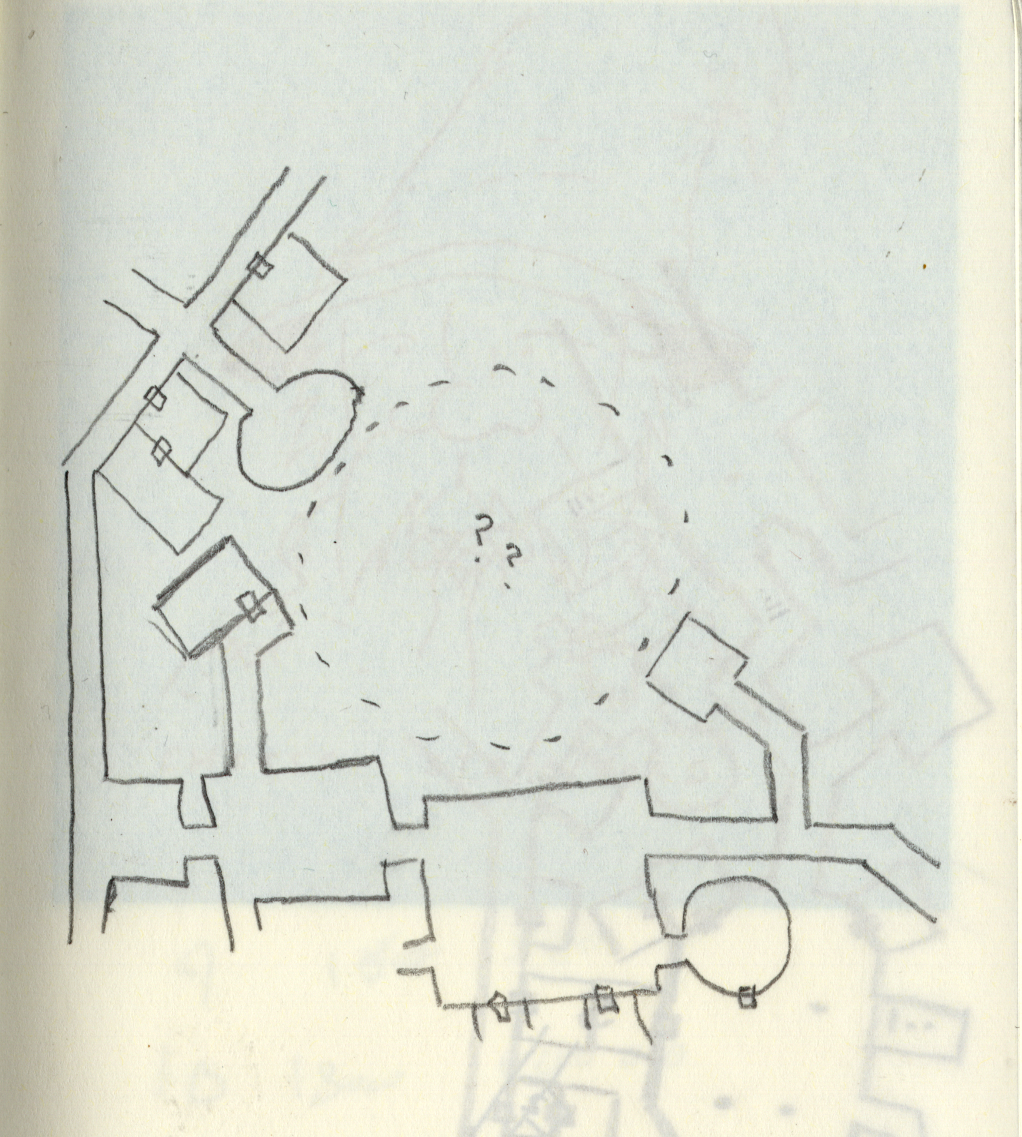
What on earth could be over there?
Shortcuts
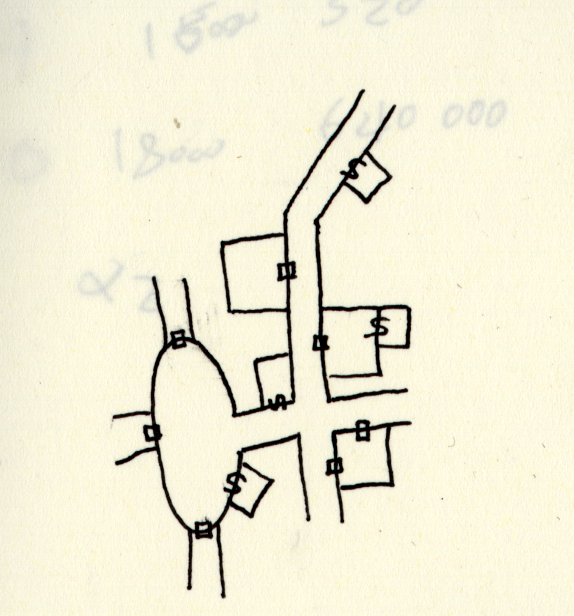
Dungeons wind their way around each other in a frustrating fashion. To facilitate getting form one place to another quickly, (after an area has been cleared) I add shortcuts. Here we have a round-about way, and the room in the center would be a perfect point of egress into the adjacent area. A secret door conveniently located there will probably be missed, but if a thouhgtful party is poking around for shortcuts, it might be an excellent discovery. Monsters will also use it, of course, which may also tip the party off. There’s gotta be an easier way to get through!
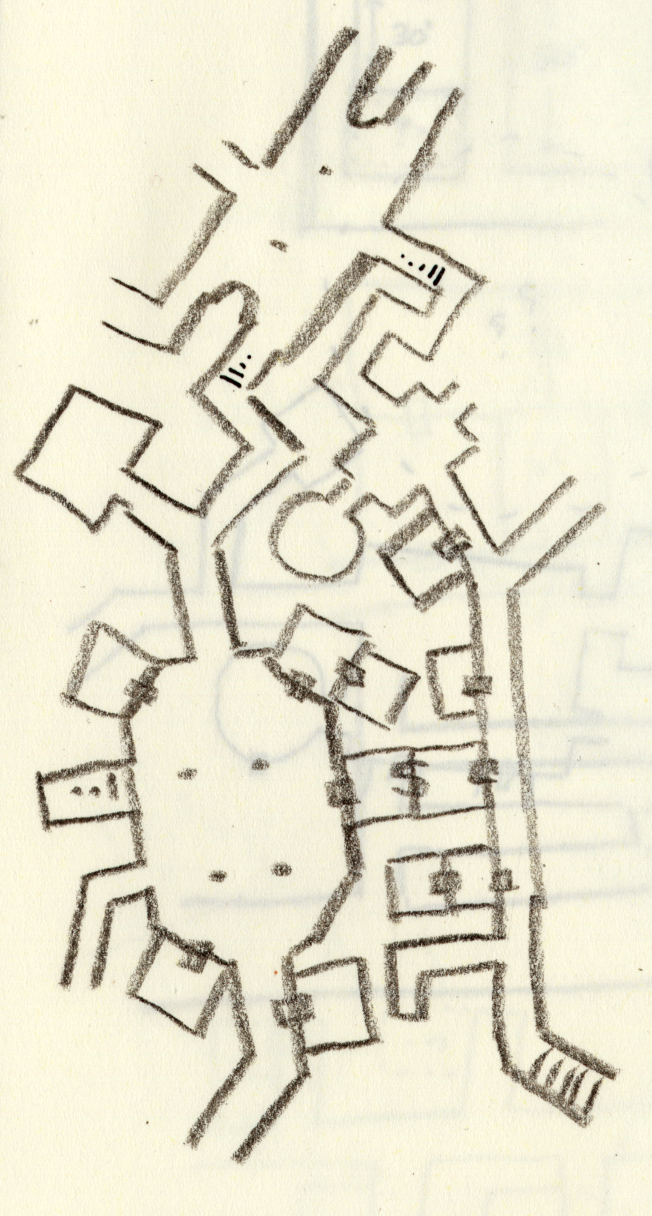
(Shortcuts can also be made solely with ordinary doors, as well. Since moving through passageways is less noisy and dangerous than rooms, hiding a shortcut behind several ordinary doors is viable.)
Random Location
These kinds of secret rooms are very difficult to locate using only the Mapping Game. Spells, hints, door mechanism clues, rumor, and old fashioned luck are needed to find secret doors like these.
Wednesday, January 14, 2026
The Endless Birthday Party of Kazzoo the Wise
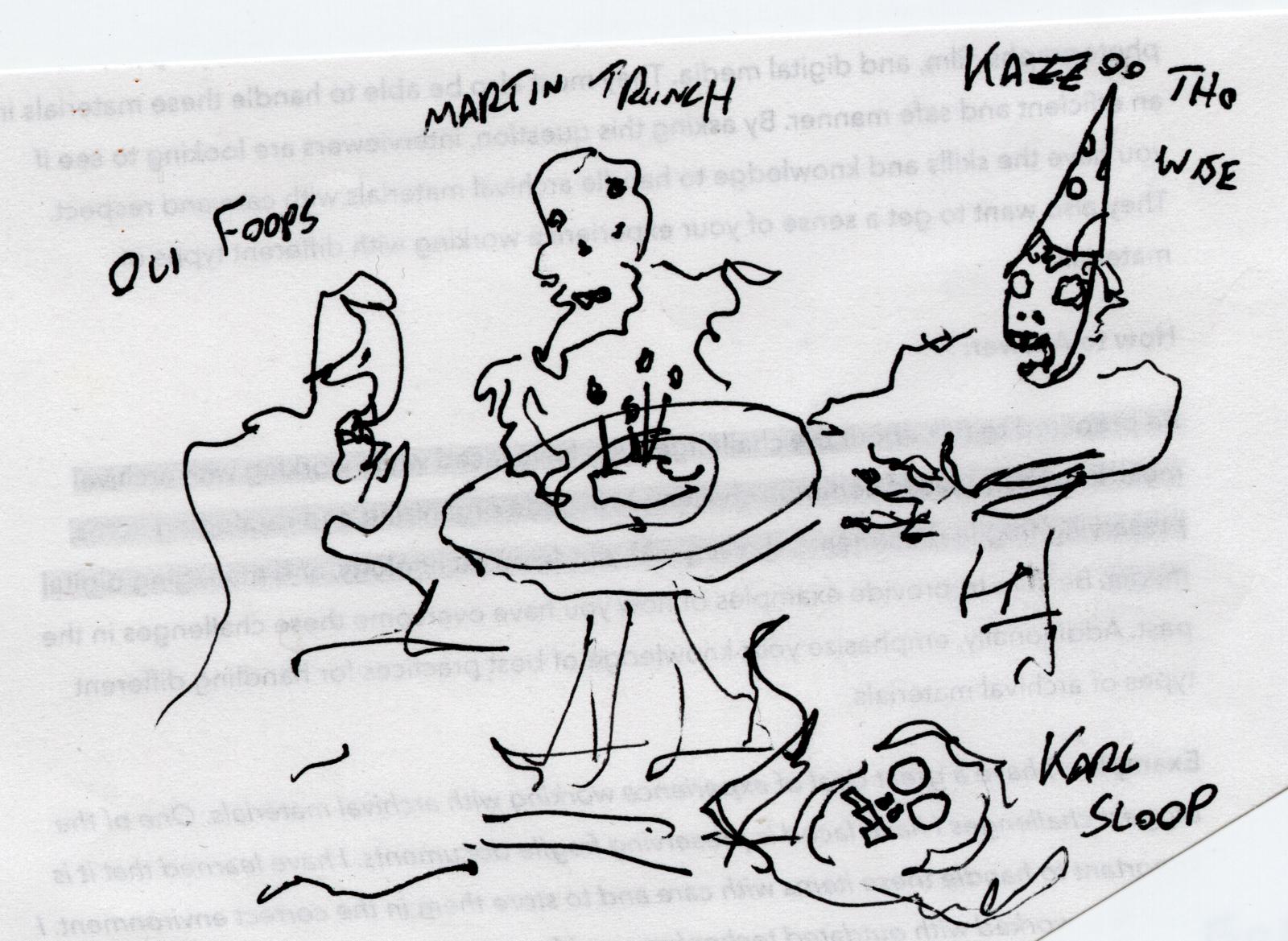
The Endless Birthday Party of Kazzoo the Wise is a grotesque monument to the insanity of absolute power. The corpses of great philosophers from disparate eras (Kazzoo the Wise, Martin Trench, Oli Foops, and Karl Sloop) have been exhumed from their resting places, brought to a cramped room, positioned stiffly around a table, and re-animated to engage in a philosophical dialogue steeped in the stench of immutable rot. The dialogue has been in progress for many centuries already, endless questioning and speculating in the dark, without interruption.
The interlocutors will not notice anyone who comes into the room, and will not talk with anyone but themselves. They are reanimated corpses–in no way alive, yet academically active. Attempts to attack or remove them will meet no resistance. The conversation will continue until all of them are reduced to dust.
Included here is a snippet of that conversation (perhaps the bit of conversation which the party of adventurers happen to walk in on right at that moment!) It should be assigned roles and read aloud at the table very slowly, in a zombified drone.
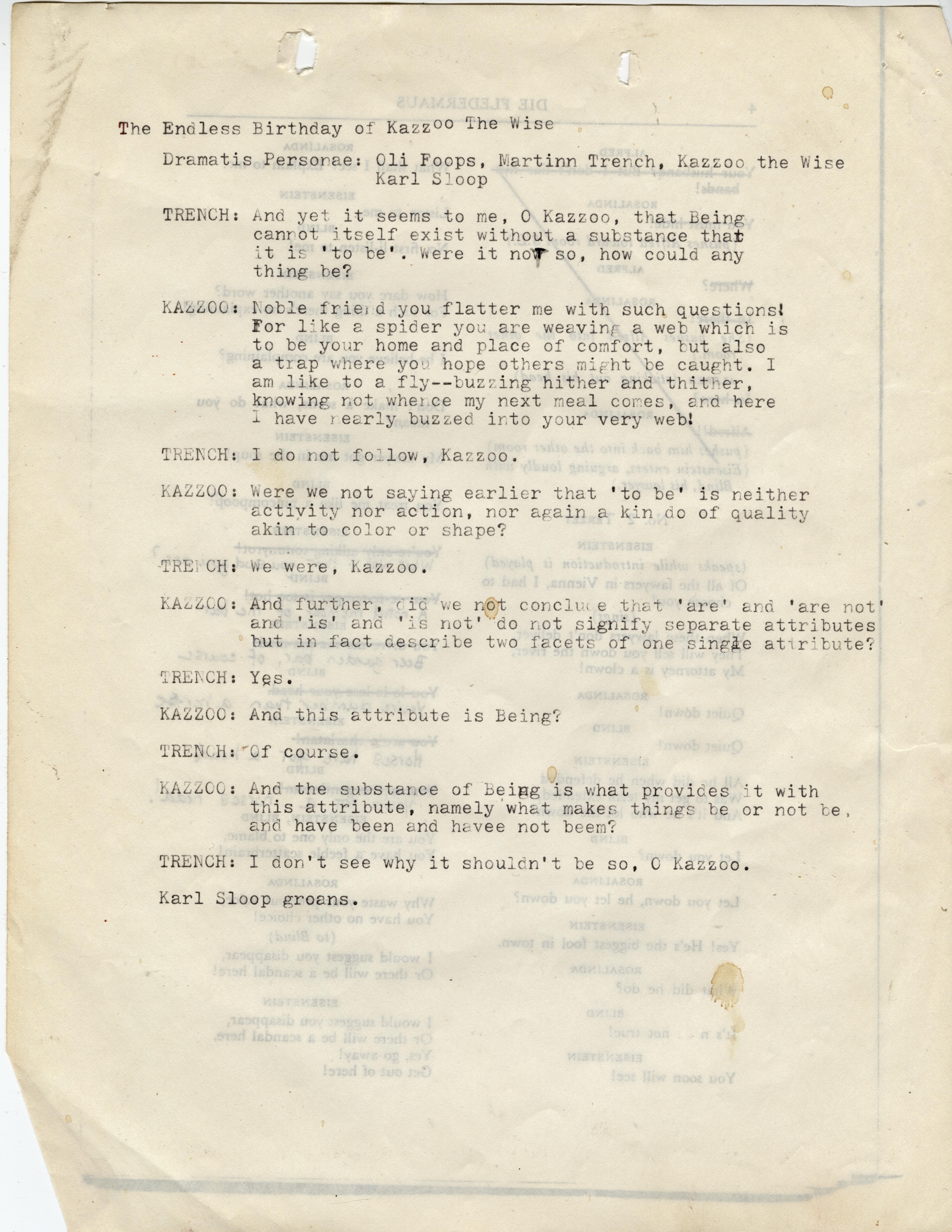
The conversation generally rotates every few months between Kazzoo-Trench and Kazzoo-Foops. Martin Trench of course mainly has questions about ontology, ecology, and epistemology. Oli Foops is concerned with aesthetics, politics, and his watered-down theology. (Oli is always asking about the Demiurge.) Kazzoo is characteristically circumspect, poking holes in others’ arguments without making many himself. Karl Sloop’s chair rotted out from under him one or two hundred years ago, so he remains on the floor, occasionally groaning. (One might joke that Karl Sloop’s philosophy was never much more than the occasional groan anyway.)
Why in God’s name Thackeracky the Terrible set up such a display is anyone’s guess. Perhaps it is simply because he could — surely not out of a real love of wisdom. Thackeracky is now long gone, and so the Endless Birthday of Kazzoo the Wise endures as a harmless, if unsettling, landmark.
Young philosophers have on occasion ventured to audit the dialogue for long periods, hoping to gain some wisdom in the exercise. A transcript of the partial dialogue was even published by Kendra Matchsticky as part of her Ph.D. Thesis, “Ways of Knowing: New Epistemologies from Old Voices.”
In general, though, the dialogue is obscure and abstruse, of no great interest even to those who know that it is taking place. Philosophers are mainly concerned with getting their own work published and regard it as irrelevant. Historians of philosophy consider the dialogue to be pure anachronism, unworthy of serious study.


