Thursday, March 5, 2026
Redux Setup
The Filing Cabinet: A Vertical History of Information is a book by Craig Robertson which describes in detail the technological and social history of the filing cabinet. The whole cabinet apparatus information retrieval system, Robertson argues, developed as a confluence of technological capabilities, economic incentives, prevailing styles, and modes of social enforcement. The filing cabinet is not a neutral “best” way of storing paper documents; it is only one of many different technologies which could achieve similar aims. The ubiquity of files is because the filing cabinet was chosen by the corporate west as its information retrieval mainstay–instantaneous access to compartmentalized data maintained by a gendered office division of labor. This legacy lives on in the skeuomorphic files and folders of computer systems.
It’s a good idea to pay attention to how we physically deal with records. The material reality shapes our understanding and use of information. We should make informed organizational choices.
Emphatically, this does not mean that referees need to take “better” notes, or be “more organized” in accordance with some objective ideal. A one size fits all solution is worse than useless here. What I mean is: we should pay attention to the kinds of documenting structures we use, and be willing to explore new ones if the old ones are causing trouble. Conversely, we should work to actively maintain structures which work well.
So, here is my paper setup for my in-person Redux OD&D campaign. For context, the campaign runs once a week at a local gaming store in an open table format. I will go over all my physical components of play, and how I keep and maintain my notes.
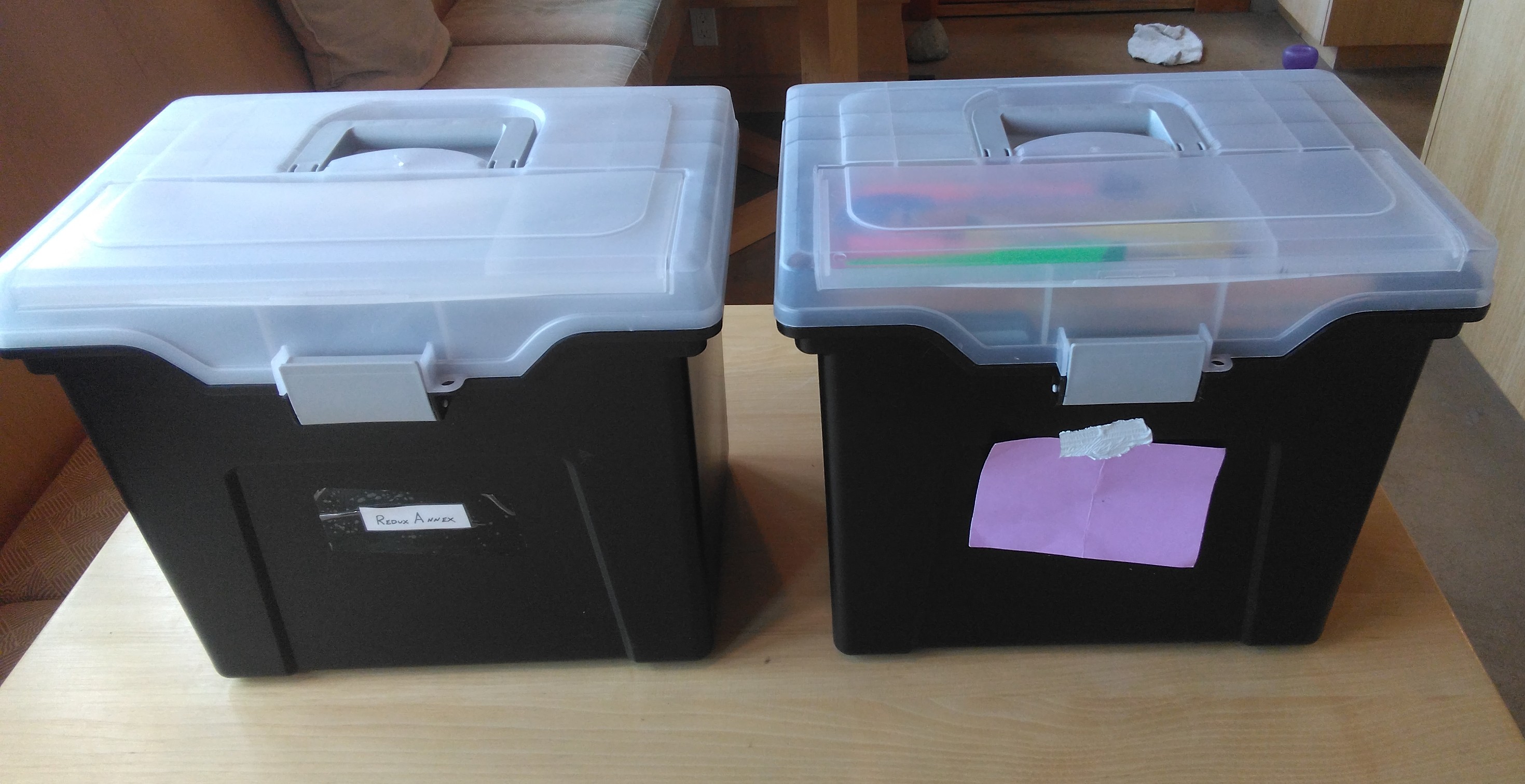
I don’t use a binder or a laptop at the table. The whole of Redux fits into these two document boxes. One contains entirely paper (this is the more important box), and the other contains dice, a rulebook, hole-punch, miniatures, pencils, pencil shavings, and paper clips.
Equipment
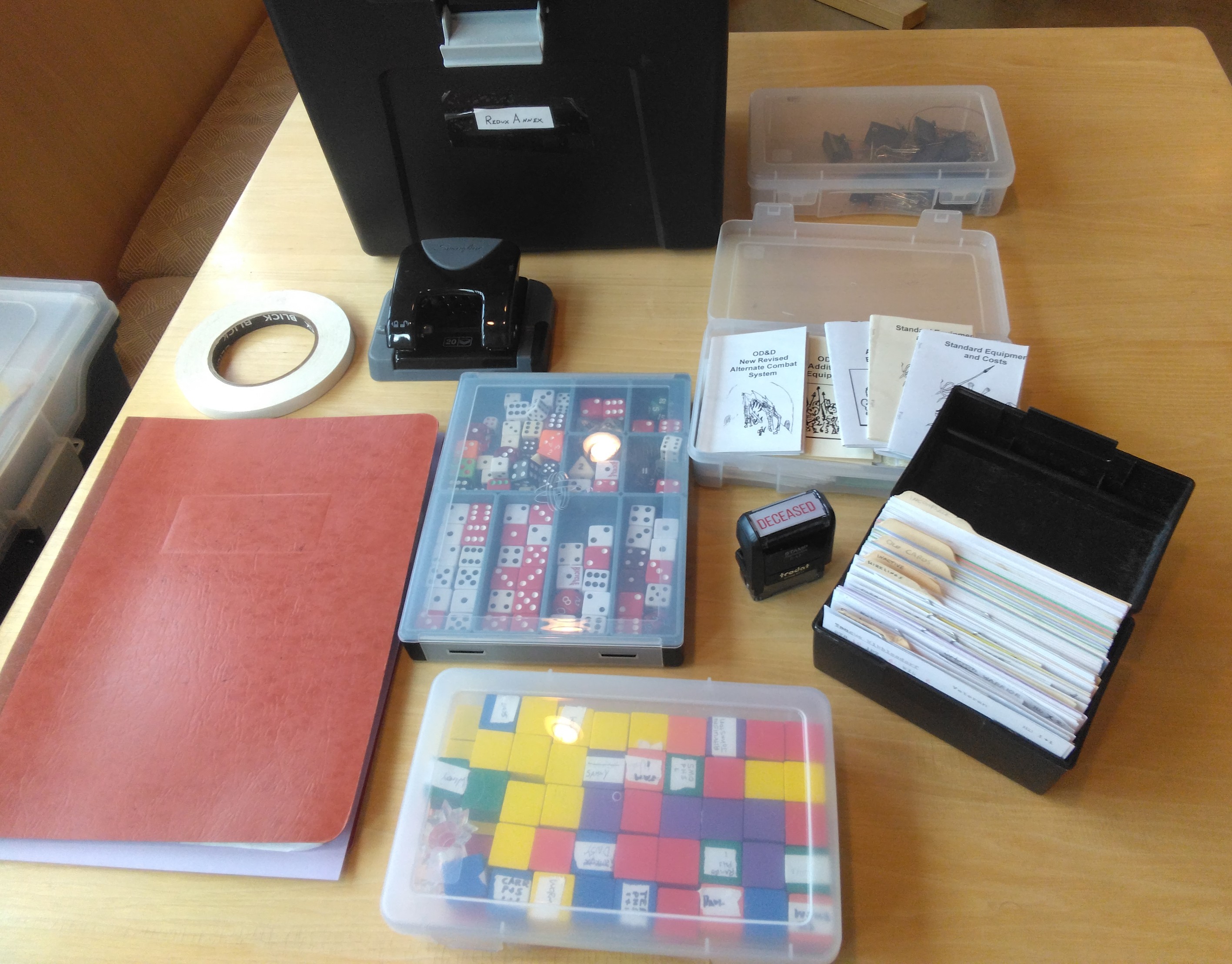
- My rulebook (left) is my printed out OD&D all bound together. I mostly just use it for quick reference.
- I printed little reference zines (upper right), which I distribute in the center of the table. Most rules-reference is done using these.
- Character sheets are index cards in an index card box. Ideally these should be organized in some fashion, but generally they are not.
- For miniatures I use little cubes with names written on them. Ideally, these are color-coded. Since there are so many characters, it has been a little fiddly and frustrating to make sure everyone has a cube with their name on it. The combat system NRACS works really well with these simple miniatures.
- NRACS uses lots of d6s so I have a bunch of these in two colors.
- I’m very glad to have a little box for pencils, but I definitely need to get more of them.
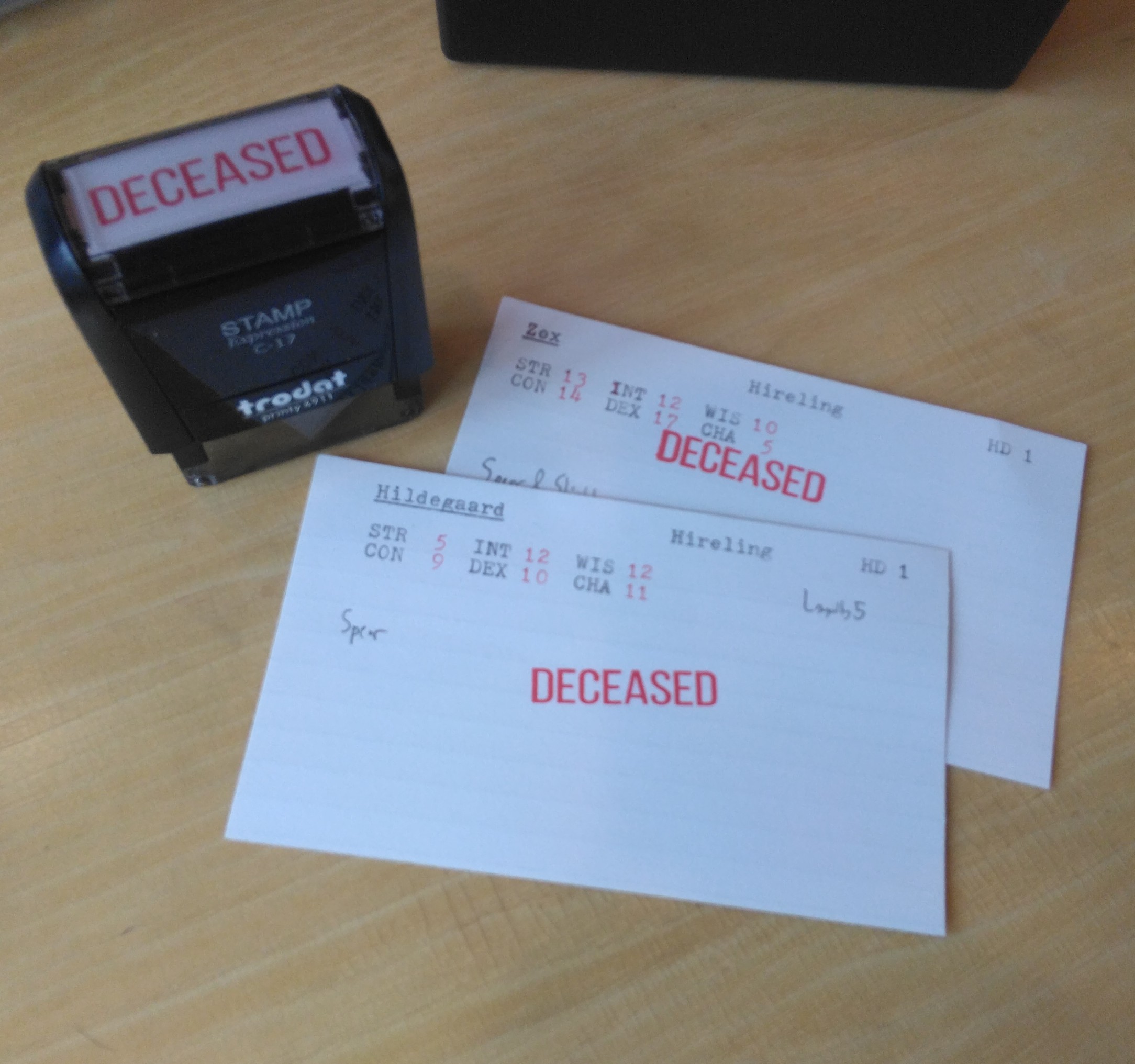
- The “deceased” stamp was a wonderful birthday gift from a dear friend of mine. It’s really satisfying to use–a little ritual for a legitimately sad thing. I generally have the controlling players use it on their characters, of course.
Documents
Each dungeon level or section is its own folder. I like these fastener folders.
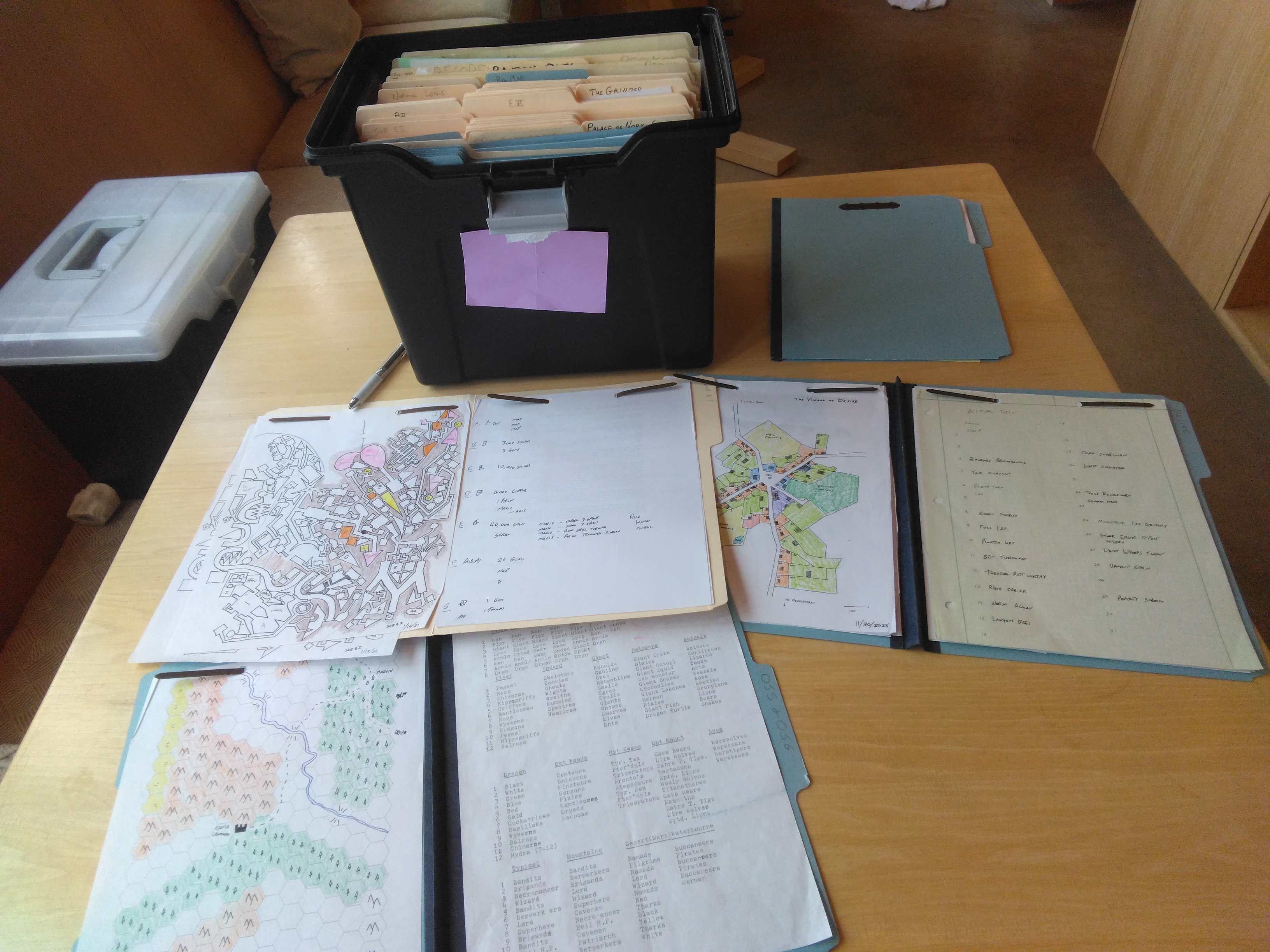
When laid open, to the left is the dungeon/wilderness map and to the right is first the Wandering encounter table, and then the key and other notes beneath it. Usually there are illustrations here, and also occasionally handouts.
I don’t use a Referee’s screen; instead I cover the map with a piece of paper (usually my notes for the session). In play, then, the folder lies flat with the map covered and the wandering monster table exposed. I mostly only need to take quick peeks.
Generally play outpaces my ability to write things down, so for the most part my notes are the barest essentials generated using UW&A. Occasionally there are some more detailed writeups or drawings. When I draw a new version of a map or write up a new key, I just insert it at the top of it’s half of the folder–this makes it so the older notes are “deeper”.
I’ve found that my drawings in particular are really useful, and that I will frequently want to show the drawings to my players–the fastener-folder setup make picking up the whole thing and clumsily flashing my scribbles for all to see doable and fun.
I shared some typical notes from these folders in my post Keying and Running Redux Alpha
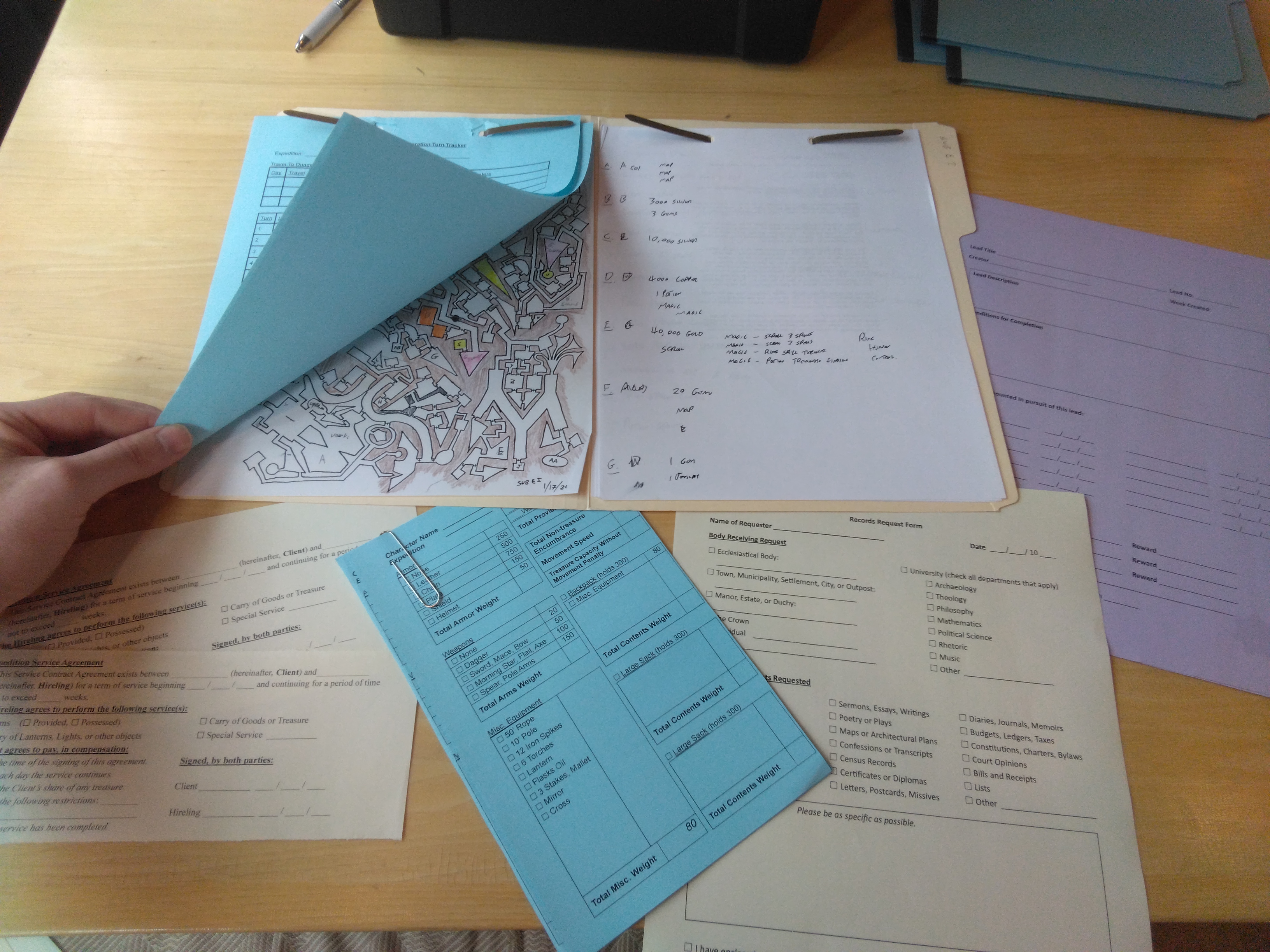
I use a lot of paper tracking documents: Writs of Free Arms, Clerical Assignments, Equipment Trackers, Hireling Contracts, Session Log Sheets, not to mention the ordinary player maps, other contracts, letters, handouts, and so on. In addition to dungeon/wilderness maps and keys, then, I keep simple folders for:
- blank paper (usually scratch paper from other projects)
- player notes (all together in one big stack)
- expedition logs by season (includes at-session notes alongside typed up and printed logs)
- Records Requests by season
- Active Leads
- Completed leads
Out of an abundance of optimism I have also been carrying around the Outdoor Survival board, in here, but I should really probably put that back where it belongs.
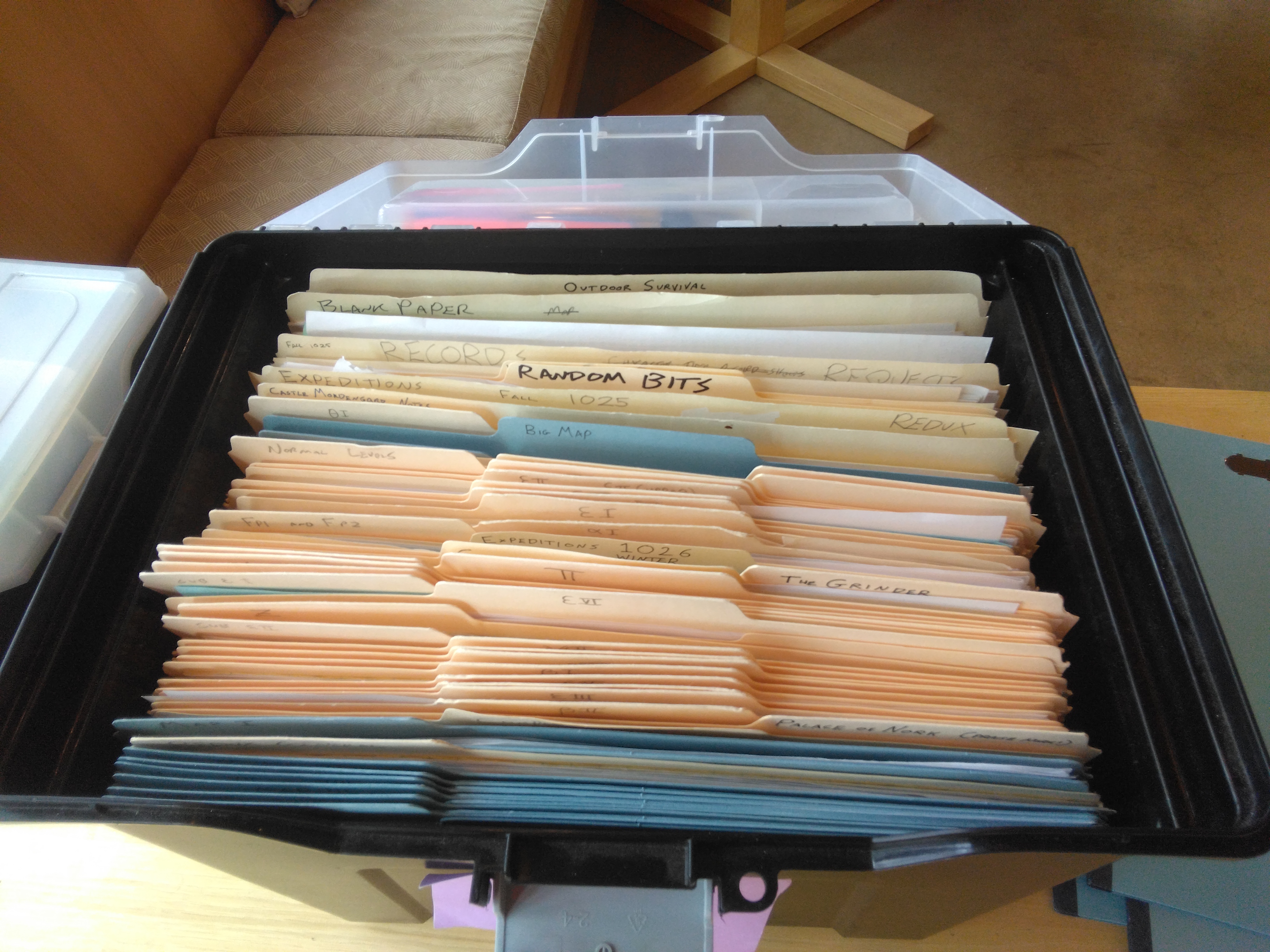
For the most part I hold on to player character cards and player-drawn maps. I don’t enforce this–people can take them home if they want to–but it has seemed to make sense for all the actionable pieces of the campaign to be together. This adds a further layer of custodial responsibility onto me the referee.
Tradeoffs
My system works well for quickly accessing the layout of a dungeon and the contents of a room. It is quite fast for navigation, and I like the elegance of just a flat folder at the table with no screen intervening. I feel very immersed in the world.
I like how my setup accumulates paper as it goes on–new maps get slotted in atop old ones, refreshed keys loom over earlier ones. It’s a chaotic overlapping mess in places, which is a good thing.
It is somewhat fiddly with all the pieces of paper and folders–not infrequently I misplace one and have to go digging for it. It has also happened at least once that I misplaced an entire folder, and so had to run a whole session without the relevant map on hand. (Thankfully I had posted an image of the map on my blog, and so was able to run things smoothly.)
Relying on multiple pre-printed forms means I have to maintain a stock of sheets, which adds complexity to prep.
The boxes are heavy and cumbersome to travel with. I am quite lucky in that I have access to a car and parking nearby to the game location. This setup would probably be unworkable if I were reliant upon public transportation to get to my games.
Monolithic sprawl and onerous bureaucracy is sort of the vibe I’m going for with Redux, so these tradeoffs make sense for the way I play. So far my notes have been effective at letting me run my game how I want to.
Preservation
When I moved after college I lost an entire campaign’s worth of maps and notes, which was a tremendous blow. For Redux, I’ve tried to be a little better about keeping backups.
I now scan pretty much every map I draw. Digital records are more fragile than paper ones, but they are easier to duplicate. I frequently print off copies of scanned maps and use those at the table. Occasionally I will hide copies of things in books to be discovered later.
Writing campaign logs and posting them on the internet is likewise a “second home” for the campaign. Online presence has its own dangers, though. What is online is scoured by AI and swept up into the vast panopticon police state of the 21st century. I don’t really want to expose my whole creative self to those winds. I also have a responsibility to my player’s privacy and their creative work–it would be unethical to post player-drawn maps or illustrations without their permission.
I won’t be able to preserve everything–RPGs are pretty ephemeral stuff–but I’m trying to avoid a total loss. As long as I won’t ever have to start all over from scratch again, I’ll have succeeded.
Links
I made this post after reading Idraluna’s What I want to read. I would like to link to other posts demonstrating the binder/note setup for games. Please send them my way!
Sunday, March 1, 2026
A Snippet of Inspiration
I try not to approach the things I read as content which can be mined for game material. As a habit this limits one’s perspective–if I am actively seeking what seems actionable or useful or gameable I am likely to miss what is profound or meaningful or delightful in itself. Generally it’s good to let inspiration come to you rather than go looking for it. Read books you like only because you like them. That’s the approach I’m trying to take, anyway.
While recommending Fiasco by Stanislaw Lem to someone today I was reminded of an absolutely stunning passage in that book. On a re-reading, it’s an example of the kind of immense and unknowable beauty in the underworld I alluded to in my writeup for level Delta-Zeta I.
I’d like to share that passage with you here, and let it speak for itself.
There were two kinds of landscape characteristic of the inner planets of the Sun: the
purposeful and the desolate. Purpose informed every scene on Earth, the planet that
produced life, because every detail there had its “benefit,” its teleology. True, it did not
always—but billions of years of organic labor had accomplished much: thus flowers
possessed color for the purpose of attracting insects, and clouds existed for the purpose of
dropping rain on pastures and forests. Every form and thing was explained by some benefit,
whereas what was clearly devoid of any benefit, like the icebergs of Antarctica or the
mountain chains, constituted an enclave of desolation, an exception to the rule, a wild
though possibly attractive waste. But even this was not certain, because man—undertaking
the deflection of the course of rivers to irrigate areas of drought, or warming the polar
regions—paid for the improvement of some territories with the abandonment of others,
thereby upsetting the climatic equilibrium of the biosphere, which had been adjusted so
painstakingly (though with seeming indifference) by the efforts of natural evolution. It was
not that the ocean depths served the creatures there with darkness, to protect them from
attack—a darkness they could light, as they needed, with luminescence—but vice versa:
the darkness gave rise precisely to those that were pressure-resistant and could illuminate
themselves.On planets overgrown with life it was only in the depths, in caves and grottoes, that the
creative power of nature could timidly express itself, a power that, not harnessed to any
adaptational requirement, or hemmed in, in the struggle for survival, by the competition of
its own results, could create—over billions of years, with infinite patience, in droplets of
hardening salt solutions—phantasmagoric forests of stalactites and stalagmites. But on
such globes this was a deviation from the planetary labors, a deviation locked away in
vaults of rock and therefore unable to reveal its vigor. Hence the impression that such
places were not usual in nature but, rather, spawning grounds for monstrosities only on the
fringe of things. Infrequent exceptions to the statistical rule of chaos.In turn, on globes parched like Mars or, like Mercury, immersed in a violent solar wind,
the surfaces, due to that rarefied but incessant exhalation from the mother star, were
lifeless wastes, since all raised forms were eroded by the fiery heat and reduced to dust that
filled the crater basins. It was only in places where eternal, still death reigned, where
neither the sieves nor the mills of natural selection were at work, shaping every creature to
fit the rigors of survival, that an amazing realm opened up—of compositions of matter that
did not imitate anything, that were not controlled by anything, and that went beyond the
framework of the human imagination.For this reason, the fantastic landscapes of Titan were a shock to the first explorers. People
equated order with life, and chaos with a dreary inanimateness. One had to stand on the outer planets—on Titan, the greatest of their moons—to appreciate the full error of this
dichotomy-dogma. The strange formations of Titan, whether relatively safe or treacherous,
were ordinary rubble heaps of chaos when viewed from a distance and a height. But they
did not appear so when one set foot on the soil of this moon. The intense cold of this whole
sector of space, in which the Sun shone but gave no heat, proved to be not a throttle but a
spur to the creativity of matter. The cold, indeed, slowed the creativity, but in that very
slowing gave it an opportunity to display its talent, providing a dimension that was
indispensable to a nature untouched by life and unwarmed by sun: time—time on a scale
where one million centuries, or two million, was of no significance.The raw materials here were the same chemical elements as on Earth. But on Earth they
had entered the servitude, so to speak, of biological evolution and only in that context
amazed man with subtlety—the subtlety of the complex bondings that combined to form
organisms and the interdependent hierarchies of species. It was therefore thought that high
complexity was a property not of all matter but only of living matter, and that chaos in the
inorganic state produced nothing more than haphazard volcanic spasms, lava flows, rains
of sulfurous ash.The Roembden Crater had cracked, once, at the northeast on its large circle. Then a glacier
of frozen gas crept through the gap. In the following millennia, the glacier retreated,
leaving on that furrowed terrain mineral deposits—the delight and vexation of the
crystallographers and other, no less dumbfounded scientists. It was indeed a sight to see.
The pilot (now operator of a strider) faced a sloping plain ringed by distant mountains and
strewn with… with what, exactly? It was as if the gates of unearthly museums had been
flung open and the remains of decrepit monsters had been dumped in a cascade of bones.
Or were these the aborted, insane blueprints for monsters, each one more fantastic than the
last? The shattered fragments of creatures that only some accident had kept from
participating in the cycles of life? He saw enormous ribs, or they could have been the
skeletons of spiders whose tibiae eagerly gripped blood-speckled, bulbous eggs; mandibles
that clung to each other with crystal fangs; the platelike vertebrae of spinal columns, as if
spilled out in coin rolls from the bodies of prehistoric reptiles after their decay.This eerie scene was best viewed, in all its wealth, from the height of the Digla. The area
near Roembden was called, by the people there, the Cemetery—and in fact the landscape
seemed a battlefield of ancient struggles, a burial ground that was an exuberant tangle of
rotting skeletons. Parvis saw the smooth surfaces of joints that could have emerged from
the carcass of some mountainous monstrosity. One could even make out on them the
reddish, bloodclotted places where the tendons had been attached. Nearby were draped
skin coverings, with bits of hair that the wind gently combed and lay in changing waves.
Through the mist loomed more many-storied arthropods, gnawing through one another
even in death. From faceted, mirrorlike blocks thrusted antlers, also gleaming, among a
spill of femurs and skulls of a dirty-white color. He saw this, realizing that the images that
arose in his brain, the macabre associations, were only an illusion, a trick of the eyes
shocked by the strangeness. If he dug methodically in his memory, he would probably
remember which compounds yielded—in a billion-year chemistry—precisely these forms
that, stained with hematites, impersonated bloody bones, or that went beyond the modest
accomplishments of terrestrial asbestos to create an iridescent fluff as of the most delicate
fleece. But such sober analysis would have no effect on what the eyes saw.For the very reason that here nothing served a purpose—not ever, not to anyone—and that
here no guillotine of evolution was in play, amputating from every genotype whatever did
not contribute to survival, nature, constrained neither by the life she bore nor by the death
she inflicted, could achieve liberation, displaying a prodigality characteristic of herself, a
limitless wastefulness, a brute magnificence that was useless, an eternal power of creation
without a goal, without a need, without a meaning. This truth, gradually penetrating the
observer, was more unsettling than the impression that he was witness to a cosmic mimicry
of death, or that these were in fact the mortal remains of unknown beings that lay beneath
the stormy horizon. So one had to turn upside down one’s natural way of thinking, which
was capable of going only in one direction: these shapes were similar to bones, ribs, skulls,
and fangs not because they had once served life—they never had—but only because the
skeletons of terrestrial vertebrates, and their fur, and the chitinous armor of the insects, and
the shells of the mollusks all possessed the same architectonics, the same symmetry and
grace, since Nature could produce this just as well where neither life nor life’s
purposefulness had ever existed, or ever would.- Fiasco, by Stanislaw Lem
Thursday, February 26, 2026
Rules are Bigger Than You Think
Here we have another essay by Pedantarius, in response to Fantasy Games are More Than Nested Rulesets. I urge readers to remember that I am posting these out of familial obligation rather than any opinionated zeal of my own. - Scribble
Rules are Bigger Than You Think
By Pedantarius Wobble
My illustrious cousin appears not to have a clear idea of what a rule is, and so doesn’t realize they are making the very same point I am: games are about player experience mediated through a constructed situation.
Largely this is my fault for not defining my terms properly. I do not disagree that players are experiential beings, and I also do not disagree that players’ imagining affects their rules-choices.
What I’m saying is that, when it comes down to it, what’s really happening during the activity of play (not to get too spiritual-psychological) is that players are reacting to a material-social scenario. The player would not imagine a forest at all unless they were prompted to by words or dice. The idea that an imaginary situation itself has any substance is a meta-fiction, and this metafiction isn’t particularly distinguishable from other metafictions within games.
For example, in games in which there are winners and losers players assume the roles of rivals. They intentionally act in such a way as to exceed the others as much as possible. This is a metafiction–the players all know that in the real world they are friends, and that play of the game is for mutual benefit.
Indeed, as Natura points out, the experience of this metafiction affects the way players interact with the game. How often in Diplomacy does a player feel feelings of betrayal, and begins to make reckless moves as a result of this emotional reaction?
The metafiction encompasses all its parts. This includes written rules and mechanical status, sure, but it also includes the metaphysical components, the most important of which, to be clear, is the players’ experience.
Why do the proponents of diegeses want to downplay the experience of one metafiction over another, for the sole purpose of reifying the Imagined Setting? You miss important and interesting components of play when you do this.
By expanding the term rule to what it really means–not mere writing, not simple agreement, but the whole defining context in which play occurs, I am allowing space to consider under-examined parts of games.
The rule “Natura decides what rules should be applied based on their experience imagining a character lost in a forest.” is a perfectly good one. But we should recognize it as a rule. We should pay attention to when we use it and when we discard it.
To be clear: I am not saying that human game activity is reducible to writable rules structures. What I’m saying is that depth of personhood is contained within my understanding of the term rule. Take the human player as a unit capable of experience, rationality, and creativity, put them in a rules situation, and a game comes out.
The diegetic vs. non-diegetic rule dichotomy limits conception of games to a very narrow paradigm, one which hides crucial aspects of all games. We have to stop thinking of games from entirely inside of their metafictions, and pay attention to play activity as a whole.
- Pedantarius Wobble
Fantasy Games are More Than Nested Rulesets
After the publication of Against Diegesis I have received a response written by another dear cousin, Natura. Not wanting to play favorites, I will share their essay here as well. Once again, I wish to stress that the opinions of my family members are their own. - Scribble
Fantasy Games are More Than Nested Rulesets
By Natura Moiety
My cousin Pedantarius believes they’ve discovered a fundamental truth about games after playing Nomic once. Their rigid too-stuck-up-to-play-make-believe ruleset nonsense ignores the most worthwhile aspect of fantasy games.
The shared imaginary is, in fact, vital to the substance of games. Being make believe doesn’t reduce the relevance of the imaginary, it enhances it. This is in fact the Great Mystery of these kinds of games. It’s the whole point.
For the sake of argument, I won’t dispute Pedantarius’ half baked philosophical position that imagined objects are inventions of the imaginer’s mind, wholly subject to it. Let’s say that’s true. I’ll also concede that applying rules to imagined objects requires wilful effort.
I disagree with their followup:
But, don’t you see that making tactical decisions in such a setup is merely interacting with the rules and not the object itself? The imagined object needn’t be there at all, in fact. It is only window-dressing for what you’re really doing.
I don’t see that, actually. Pedantarius is here forgetting the experience of imagination. Precisely because applying rules to the imaginary requires wilful effort, the player has to experience it. This experience directly affects the player’s mental state–they come away with observations, feelings, and wants.
Pedantarius claims that
We should not delude ourselves into thinking that imaginary worlds speak back to us.
Well, they do speak back to us, because we encounter worlds–even imaginary worlds–as experiencing beings.
When a player imagines being lost in a dark and foreboding forest, they actually experience feelings of dread, curiosity, and longing for home. This experience directly informs rule-selection choices. A player touched by dread may choose to explore this by incorporating diegetic rules about their character’s mental state. They may incorporate less-diegetic procedures for navigating home. The imaginary is a means by which a rules-situation can be mediated through human experience.
Don’t you see how this might be really important for a fantasy roleplaying game? For shitty unfun games like Nomic and Diplomacy where the goal is simply to use rules to enforce dominance over the other players, maybe the imaginary isn’t as important. But for many actually interesting games it’s absolutely necessary to frame them around the wellspring of imagined human experience.
By arguing against distinguishing between diagetic and non-diegetic rules Pedantarius is attempting to flatten what is in fact a spectrum of experiential rules–from abstract to relatable. What Pedantarius regards as liberatory and human actually dilutes and obscures what, for many of us, is the driving force of fantasy play.
- Natura Moiety
Wednesday, February 25, 2026
Against Diegesis
My cousin Pedantarius doesn’t have their own blog, but they wrote an essay and wanted me to share it here. I have obliged, mainly out of respect for my aunt. Please know that the opinions expressed by my dear cousin are not necessarily my own. - Scribble
Against Diegesis
By Pedantarius Wobble
Diegesis is a lie perpetuated by theater kids and simulationists in a desperate attempt to justify their crummy rules and paltry performances as corresponding to an imaginary world outside of them.
Here’s the truth: there is no shared imaginary world. The objects we engage with in games are mere collections of words, numbers, and drawings. Rules are literally a set of instructions for following procedures to manipulate these, either by writing or speech. The Game exists entirely on paper (or digitally), in what is said out loud, and the activity of altering these.
“But Pedantarius!” I hear you cry, “Isn’t it fun to pretend, for a little while at least, that we really are on a fantastic adventure in an amazing place? Wouldn’t it be interesting to imagine what it would be like to live in a world of magic and unknowable terrors, and furthermore, to make tactical decisions proceeding from these imaginings? Surely one cannot deny the importance of the imaginary in fantasy games.”
This objection seems reasonable on the surface, but falls apart under scrutiny. When we imagine something we invent an object. Due to its very nature as invention, an imagined object is not subject to the laws which govern the material world–indeed, an imagined object is subject only to the mind of the imaginer.
If we wanted to apply arbitrary rules to an imagined object (say, of an imagined person, that they are capable of jumping) we can, but the rules would not be directly affecting the object. Instead, the imaginer has to decide that the rules should govern how the imaginer imagines the object–the link between rules and imagined object is sustained only through wilful effort of the imaginer.
If you wanted to make anything like “tactical decisions” in an imagined world, you must first decide upon what tactically-rich rules to apply to the imagined object, and then wilfully connect the two. But, don’t you see that making tactical decisions in such a setup is merely interacting with the rules and not the object itself? The imagined object needn’t be there at all, in fact. It is only window-dressing for what you’re really doing.
This problem is compounded if you have multiple people supposedly imagining in tandem. The only possible way for this myriad of imagined objects to correspond is with a big set of rules and social conventions holding them together. In such a situation, you are really dealing with these rules and conventions, not the imagined objects at all.
The imaginary is added after the fact-–it is a personal interpretation, a reaction to the rules situation which actually exists at the table.
“Ah, Pedantarius!” you bluster, “You have too narrow an understanding of rules! My rules sprout upwards from the imaginary according to common-sense notions about the ways in which worlds work. The ‘top down’ rules you describe are non-diegetic, which are fine in themselves, but not what we are talking about.”
To this I say that it is simply untrue that these so-called diagetic rules are rooted in an imaginary world at all. Like what you call non-diagetic rules, they are decided upon socially and applied to a game situation. There is no distinction between them, other than aesthetically.
Consider two scenarios, in a hypothetical roleplaying game in which a player controlling a unit wishes to leap over a chasm.
A. There are no written rules for jumping a chasm. The GM decides to rule such an action succeeds according to several factors: the width of the chasm, the relatively unencumbered status of the unit, the desire to reward the player for taking an action, and an interest in what the player will do once beyond the chasm.
B. There are written rules. The GM pulls out the rulebook, finds the rule, and follows a procedure which is very abstract and is not very immersive.
I say that these are substantively indistinguishable from one another. The “rules for jumping the chasm” are in both cases brought in to the game situation and applied. In both, the rules were chosen because of the existing rules-situation. The only real difference is that in the case of A it is possible the rule was invented on the spot. In both cases the imaginary (character jumping over the chasm) only exists after the rules have been decided upon and applied.
Rule mutability, even extremely freeform mutability, is no argument for the existence of diegetic rules. This is evident.
Again I hear your complaints, “Surely you acknowledge that in your example a chasm described as ‘imposing, gaping, unimaginably vast’ should be more difficult to leap across than one described as ‘narrow and deep, scouring the bottom of the earth’? The fiction carries with it connotations and associations, which can be more or less easily transformed into outcomes.”
To this I say that I agree fully–it’s just that those words and phrases fit within an interpretive and social context. The game meta-rules for interpreting those words are not distinguishable from the game meta-rules for reading text like “Characters carrying less than 20# of equipment can leap chasms up to 15’ wide if they roll higher than 10 on a twenty-sided die.”
To claim that the artifacts of description, and the connotations carried by these, is a separable layer of rules, a “diegetic” layer, simply fails to acknowledge the real rules governing play: the social-interpretive rules. All games are sets of rules in action, and, while some of these are nested sets, all are determined exclusively by two components: text and player interpretation. The imaginary world doesn’t exist in any sense.
We should not focus on fiction. We should not delude ourselves into thinking that imaginary worlds speak back to us. What we should focus on is rules and procedures which are interesting and beautiful in themselves. Focus on the friends who play with you, and their creativity. Pay attention to what we are actually doing at the table, the rules you are actually following.
- Pedantarius Wobble
