Wednesday, April 29, 2026
Additional Treasure Categories
“Our first assignment—“
“Our, that’d be… me and you.”
“—will be to locate and restore to its owner a somewhat tasteless lamp, indeed among lamp collectors considered the crown jewel of tasteless lamps, a lamp so stupefyingly tasteless it makes nonsense of the tasteless lamp category itself. Too horribly tasteless ever to have been photographed. Cameras break, eyeglass prescriptions are drastically rewritten, crowds of spectators run screaming out of exits they then get jammed up in. Tasteless Lamp Quarterly runs out of space to contain the overflow of readers’ indignation. How tasteless it is, this lamp, known in underworld Esperanto as La Lampo Plaj Malbongusto.Through some perverse law of secondary markets, the more vehemently denounced, the more valuable it has become….”
—Thomas Pynchon, Shadow Ticket
In addition to the OD&D treasure categories of Copper, Silver, Gold, Gems, Jewelry, Magic, and Maps, here are new categories, to be assigned a percentage-chance in each treasure type and level.
Beneath each category are subcategories and example, which may be ignored, picked, or determined randomly.
Note that what is listed here is treasure, not mere goods. Every Orc outpost will of course be stocked with ordinary coffee, but the Coffee treasure subcategory indicates coffees of great value.
Ideally each category will have its own table, but in a pinch the jewelry and gem GP values can be used. Sometimes the value will be apparent to only a select few, and many treasures are not easily liquidated.
Comestibles
Cocktails or liquors
Delicacies
Cheeses
Eggs
Spices, herbs, powders
Teas and coffee
Drugs or medicine
Tobacco
Candy and sweets
Collectibles
Rare coins
Stamps
Baseball cards
Nick-knacks
Displayables
Pottery, silverware, china
Sculptures or art installations
Furniture
Statuettes
Appliances (lamps, refrigerators, etc.)
Wearables
Clothes, costumes, accessories
Hats
Wigs, false mustaches, toupee
Makeup, creams, gels, and soaps
Intellectual
Poems
Folk songs or stories
Systems of philosophy
Mathematical proofs
Names
Recipes
Secrets
News
Languages
Infohazard (“the funniest joke in the world”, etc)
Prophecies
Paper
Books
Paintings
Drawings
Prints
Non-treasure maps
Photographs
Historical documents or records
Contracts, bonds, deeds, other legal documents
Playing cards
Non-material
Friends
Sights to see
Employment opportunities
Self realization or actualization
Political office, religious title, or other bestowed role
Awards, accolades, monikers, nicknames
Devices
Hard-to-find spare parts/gizmos
Timepieces: watches, clocks, hourglasses, sundials
Keys
Boxes, bags, jars, containers
Musical instruments
Writing utensils
Beads, marbles, and jacks
Chance
Biological
Animals—pets
Animals—work
Organs and body parts
Bones, skins, teeth, claws, or fingernails
Relics
Hair or feathers
Stuffed or preserved specimens
Living plants
Diseases
Environmental Samples
Rocks/minerals
Water
Air or gasses
Isotopes
Materials
Chemicals
Textiles
Plastics
Foodstuffs
Ores or soils
Equipment
From equipment lists
High technology, etc.
Machinery
Radio transmitters
Computers
Microfilm readers
Printing presses
Lathes
Ovens
Vats
Potions/Scrolls
Potions
Scrolls
Artifacts
—————–
Here is a generator for these categories, with a distribution that seemed decent: https://chartopia.d1 … ev.com/chart/120948/
Print version: https://chartopia.d1 … /chart/120948/print/
And here is an example generator for OD&D Underworld Treasure Level 5, with Additional Categories appearing with a 25% chance: https://chartopia.d1 … ev.com/chart/114820/
Monday, April 27, 2026
Dungeons and Dragons Minus One — A New Roleplaying Game
The aim of D&D -1 is to never quite get around to playing D&D. Rather than eschewing Session 0, D&D -1 is composed entirely of Session 0s.
Here’s how to play:
The first few meetups should consist of detailed discussions about which edition of D&D to play, or whether it would be better to use another system entirely. Rulesets should be compared and contrasted and preferences about the kind of play desired should be taken into consideration.
When a consensus has been reached, a short course on the history of the chosen edition would be in order, perhaps with guest speakers. The group should read through the ruleset paragraph by paragraph or, (if there is time) sentence by sentence, pausing to discuss unclear or confusing elements as needed. No more than a handful of meetings will be necessary here.
It will be a good idea at this point to work out resolution procedures for rules-questions. Even in games where the referee has “final say”, there are many edge cases and social considerations which should be considered.
Once the foundations of the ruleset are firmly covered, the group could move on to a study of various safety tools. Group bonding exercises could be used to get everybody used to one another, and several meetings can be had about safety expectations for the game. Some themes or topics might be explicitly forbidden, although most probably won’t be. Likewise, certain behaviors (bullying, overturning tables, etc.) will be preemptively prohibited or assigned boundaries. Set aside at least three meetings for this.
After this, review could be made of various kinds of roleplaying playstyles. Reading lists could be developed to give an overview of common cultures of play. One might be picked, and the ramifications of that particular style upon the chosen ruleset should be noted.
It may be worth it at this point to write up some sort of play agreement or pledge to ensure that everyone is on the same page about playstyles and safety. This agreement should include a provision for amendment. While it can’t really be binding, it should be thorough.
A club charter for the group could be set up, and, depending on the scope expected, it might be worth setting up as a 501(c)3 in your state.
A method of scheduling which works for everyone should be settled upon, along with expectations for attendance, taking time off and so on. Schedule at least 2 meetings to nail it down.
After all this, you can start thinking about character creation. Careful study should be made of each character class and attribute, going over the options and their implications. (Don’t be afraid to review the chosen ruleset, or perhaps choose a new one!) It’s important to connect through discussion the various character options and the play philosophy of the group.
Characters should be rolled up strictly according to the rules agreed upon, and if there’s any confusion about these they must be discussed and revised using the resolution procedures worked out earlier. If these procedures fail to achieve a desired result, they should be revisited.
Backstories for the characters should be written—set aside at least half a dozen meetings for this—drafts should be presented and read aloud, notes given and taken, making sure to treat each character fully. It may happen that the story of a character leads them to their death; if this happens, the process will have to begin again. Like any creative process, it’s important not to rush things. Allow the character backstories to develop as they will and the characters will be better for it.
Once the characters are ready, it will be necessary to develop relationships between them and the world at large. It may be useful to write and perform scenes of the characters growing their relationships with each other, after thorough drafting of course.
Next is precepts for the world (because surely the referee hasn’t begun writing up the adventure—not yet!). Conversations about the sorts of things that are desirable and undesirable should be had. Here D&D -1 really opens up. The referee can begin a series of sessions setting the stage for the world. This will include lectures about its history, of course, but also scenes, readings, exams, etc. naturally, if there is consternation about any element of the world (or potential consternation about how a certain element might appear in play) this must be discussed and worked out according to the group-decided procedures for this kind of thing. If these procedures cause confusion, several meetings should be spent revising them. A dozen or more meetings might be necessary to fully flesh out the imaginary world.
If your group has gotten this far you’ve done something wrong, but you may as well switch to playing D&D. A short one-shot is appropriate, preferably one which you suspend halfway through and never get around to scheduling the second session of.
The End.
Epilogue
My point in writing this is to think about how what counts as “play” depends a great deal on one’s perspective, and how in many instances, from the outside, a “play” activity and a “not-quite-yet play” activity look pretty much the same.
Play is about process. Goals are important as the aim of processes, but the process is the point. For many games it does not matter too much whether those goals are actually achieved, only that the players tried to achieve them.
This is why losing is an acceptable component in many games—the loser has participated in a game just as much as the winner.
What of games where there are no winners? The teleology of roleplaying games is frequently infinity. How many OD&D campaigns close their doors long before players start building strongholds? How many dungeons sit unexplored, hexes untouched, characters dormant, etc.?
OD&D is Chainmail -1.
Tuesday, April 21, 2026
Getting Started
Each session of Redux begins with 45 minutes of paperwork. Here’s a rough list of things which have to be worked out before the party can leave town.
- The week in which the adventure takes place has to be picked (usually it’s the week after the previous one, but not always.)
- A lead must be chosen to pursue from the Active Lead pool
- Each player must select which eligible character will go on the expedition (often the choice of character depends on the lead chosen)
- Characters have to be “brought up to time”, using non-expeditionary activity tables week-by-week (downtime). Occasionally this will result in the chosen character being unable to go on the expedition (injury, illness, etc.) and so another will have to be selected and brought up.
- Characters who have levelled up since the previous session have to be updated.
- If hirelings are to be hired, these must be selected, contracts must be negotiated, signed, and co-signed.
- Equipment must be purchased for players and hirelings. Loans may be issued between player characters as desired.
- New characters may have certain paperwork to fill out such as a Writ of Free Arms or a Letter of Release.
- Each player character “signs in” on the Expedition Sheet, including their level and xp total, which serves as the main record of the session.
- Each character needs to get a little cube with their name on it for a miniature. I should just have them all pre-written, but I never do, so I’m constantly fiddling with these.
To set up the game, I pull out the Index card character sheet box, the Active Leads folder, the Player Notes folder, the Expeditions Winter 1026 folder (to catch people up on sessions they missed), the Blank Forms folder, the Calendar folder, equipment and spell and level advancement zines, and several other folders and forms in sequence as I need and/or forget them. I’m usually there to begin the session around 6:15 pm, and it’s almost always past 7 pm when the party actually sets foot outside of town.
I have set up my game this way despite being someone who finds the idea of character creation taking more than 30 seconds absolutely intolerable. I am someone who thinks even OD&D’s speedy alternate combat system is infuriating and tedious, replacing it with a d6 system that resolves most combats in less than two minutes. I routinely leave rooms in my dungeons entirely empty so the party doesn’t waste time looking at the scenery. So much of the way I chose to run D&D seems to be aimed at quickness, at a certain kind of time efficiency, and yet a full third of Redux playtime is spent calculating xp and filling out forms. What’s up with that?
One might argue that I have chosen to focus on tedious things which are interesting to the exclusion of tedious things that aren’t. Discussing with your friends about which treasure to go after today, they might claim, is more fun than carefully choosing between two nearly-but-not-quite-identical feats. What I’ve done is be decisive about the way I manage time to more effectively tell the stories I want to.
I’m not so sure this is the case. Redux has a lot of time-consuming paperwork only because I had a lot of cool-seeming ideas requiring paperwork I haven’t given up trying out. It happened this way because of how my tastes intersect with my play modality. There’s no reason it should be this way other than that it is, and there’s no reason to change it unless distressing problems develop.
In some ways, it’s a beautiful thing. During the first part of the session I as Referee mostly need only sit back and listen to the discussions and negotiations, occasionally answering questions or handing out papers. It sets a relaxed tone to the whole affair, the act of preparing for an expedition, first by gathering everyone together, then choosing what to do and how to do it, assembling equipment and making sure one’s affairs are in order. Immediately during a session of Redux the players have to make decisions together about how to approach play. This is a good thing.
Still, every once in a while, when it’s 7:30 and the adventure hasn’t even reached the dungeon, I get a pang of worry. Am I doing a good job? Are people having fun? Are my friends being sufficiently entertained by the show I’m putting on?
This blog post has no conclusion.
Sunday, April 19, 2026
Silos and the Underworld
Abandoned missile silos and bunkers are particularly dungeon-like places. Beyond just being big underground complexes with lots of empty space, they are places into which vast resources, technology, and people have been poured, while their purpose and functions remain almost mystically incoherent.
A missile silo is a subterranean structure intentionally built in the middle of nowhere whose sole purpose is to be able to completely obliterate some as-yet-unchosen corner of the world, because maintaining this installation somehow means cataclysmic war is supposedly less likely. Their logic is twisted and insane. As fundamentally evil as they are cleverly built.
Thursday, April 2, 2026
Mishmash Dungeon
Idraluna and I have put together an adventure! Here is Mishmash Dungeon, a further experiment in my Mishmash thoughtworld.
The dungeon map is drawn by me:
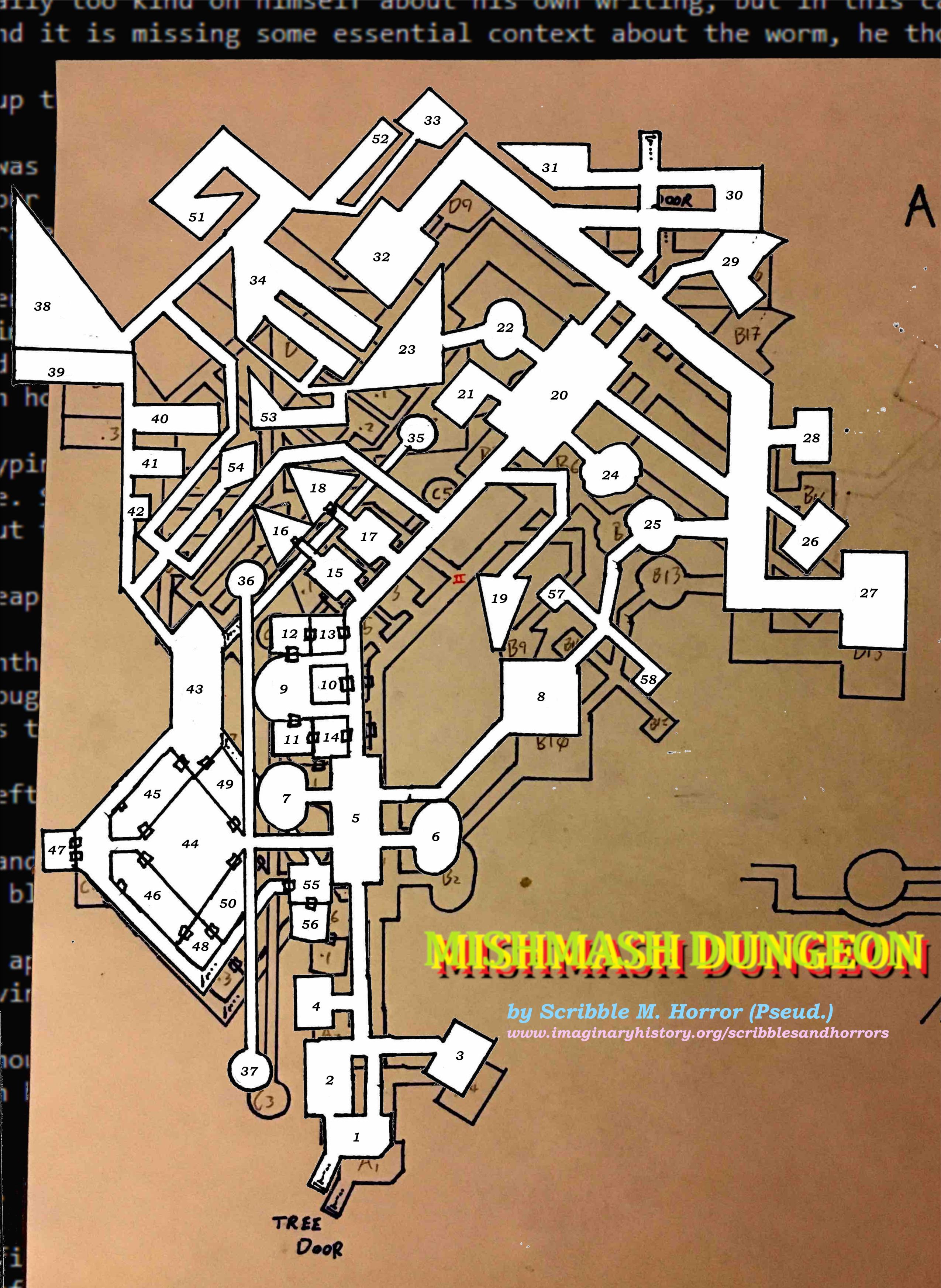
The dungeon key consists of fragments loosely selected from whatever reading material Idraluna and I had on hand. The point was to come up with a big mess of little snippets.
A crucial part of this project, in my mind, is approaching the randomly selected text here with the same rigor as you would a more responsibly written adventure. The key is not merely inspirational: the idea is to read it as substantial, or to try even if it doesn’t seem that way at first.
It was a lot of fun to make, and I’m excited to see how it holds up in play.
PDF of Key here: mishmash-dungeon-lvl1.pdf
Full color map: mishmash-dungeon_notprintable.png
Printable map: mishmash-dungeon_printable.png