Thursday, February 26, 2026
Rules are Bigger Than You Think
Here we have another essay by Pedantarius, in response to Fantasy Games are More Than Nested Rulesets. I urge readers to remember that I am posting these out of familial obligation rather than any opinionated zeal of my own. - Scribble
Rules are Bigger Than You Think
By Pedantarius Wobble
My illustrious cousin appears not to have a clear idea of what a rule is, and so doesn’t realize they are making the very same point I am: games are about player experience mediated through a constructed situation.
Largely this is my fault for not defining my terms properly. I do not disagree that players are experiential beings, and I also do not disagree that players’ imagining affects their rules-choices.
What I’m saying is that, when it comes down to it, what’s really happening during the activity of play (not to get too spiritual-psychological) is that players are reacting to a material-social scenario. The player would not imagine a forest at all unless they were prompted to by words or dice. The idea that an imaginary situation itself has any substance is a meta-fiction, and this metafiction isn’t particularly distinguishable from other metafictions within games.
For example, in games in which there are winners and losers players assume the roles of rivals. They intentionally act in such a way as to exceed the others as much as possible. This is a metafiction–the players all know that in the real world they are friends, and that play of the game is for mutual benefit.
Indeed, as Natura points out, the experience of this metafiction affects the way players interact with the game. How often in Diplomacy does a player feel feelings of betrayal, and begins to make reckless moves as a result of this emotional reaction?
The metafiction encompasses all its parts. This includes written rules and mechanical status, sure, but it also includes the metaphysical components, the most important of which, to be clear, is the players’ experience.
Why do the proponents of diegeses want to downplay the experience of one metafiction over another, for the sole purpose of reifying the Imagined Setting? You miss important and interesting components of play when you do this.
By expanding the term rule to what it really means–not mere writing, not simple agreement, but the whole defining context in which play occurs, I am allowing space to consider under-examined parts of games.
The rule “Natura decides what rules should be applied based on their experience imagining a character lost in a forest.” is a perfectly good one. But we should recognize it as a rule. We should pay attention to when we use it and when we discard it.
To be clear: I am not saying that human game activity is reducible to writable rules structures. What I’m saying is that depth of personhood is contained within my understanding of the term rule. Take the human player as a unit capable of experience, rationality, and creativity, put them in a rules situation, and a game comes out.
The diegetic vs. non-diegetic rule dichotomy limits conception of games to a very narrow paradigm, one which hides crucial aspects of all games. We have to stop thinking of games from entirely inside of their metafictions, and pay attention to play activity as a whole.
- Pedantarius Wobble
Fantasy Games are More Than Nested Rulesets
After the publication of Against Diegesis I have received a response written by another dear cousin, Natura. Not wanting to play favorites, I will share their essay here as well. Once again, I wish to stress that the opinions of my family members are their own. - Scribble
Fantasy Games are More Than Nested Rulesets
By Natura Moiety
My cousin Pedantarius believes they’ve discovered a fundamental truth about games after playing Nomic once. Their rigid too-stuck-up-to-play-make-believe ruleset nonsense ignores the most worthwhile aspect of fantasy games.
The shared imaginary is, in fact, vital to the substance of games. Being make believe doesn’t reduce the relevance of the imaginary, it enhances it. This is in fact the Great Mystery of these kinds of games. It’s the whole point.
For the sake of argument, I won’t dispute Pedantarius’ half baked philosophical position that imagined objects are inventions of the imaginer’s mind, wholly subject to it. Let’s say that’s true. I’ll also concede that applying rules to imagined objects requires wilful effort.
I disagree with their followup:
But, don’t you see that making tactical decisions in such a setup is merely interacting with the rules and not the object itself? The imagined object needn’t be there at all, in fact. It is only window-dressing for what you’re really doing.
I don’t see that, actually. Pedantarius is here forgetting the experience of imagination. Precisely because applying rules to the imaginary requires wilful effort, the player has to experience it. This experience directly affects the player’s mental state–they come away with observations, feelings, and wants.
Pedantarius claims that
We should not delude ourselves into thinking that imaginary worlds speak back to us.
Well, they do speak back to us, because we encounter worlds–even imaginary worlds–as experiencing beings.
When a player imagines being lost in a dark and foreboding forest, they actually experience feelings of dread, curiosity, and longing for home. This experience directly informs rule-selection choices. A player touched by dread may choose to explore this by incorporating diegetic rules about their character’s mental state. They may incorporate less-diegetic procedures for navigating home. The imaginary is a means by which a rules-situation can be mediated through human experience.
Don’t you see how this might be really important for a fantasy roleplaying game? For shitty unfun games like Nomic and Diplomacy where the goal is simply to use rules to enforce dominance over the other players, maybe the imaginary isn’t as important. But for many actually interesting games it’s absolutely necessary to frame them around the wellspring of imagined human experience.
By arguing against distinguishing between diagetic and non-diegetic rules Pedantarius is attempting to flatten what is in fact a spectrum of experiential rules–from abstract to relatable. What Pedantarius regards as liberatory and human actually dilutes and obscures what, for many of us, is the driving force of fantasy play.
- Natura Moiety
Wednesday, February 25, 2026
Against Diegesis
My cousin Pedantarius doesn’t have their own blog, but they wrote an essay and wanted me to share it here. I have obliged, mainly out of respect for my aunt. Please know that the opinions expressed by my dear cousin are not necessarily my own. - Scribble
Against Diegesis
By Pedantarius Wobble
Diegesis is a lie perpetuated by theater kids and simulationists in a desperate attempt to justify their crummy rules and paltry performances as corresponding to an imaginary world outside of them.
Here’s the truth: there is no shared imaginary world. The objects we engage with in games are mere collections of words, numbers, and drawings. Rules are literally a set of instructions for following procedures to manipulate these, either by writing or speech. The Game exists entirely on paper (or digitally), in what is said out loud, and the activity of altering these.
“But Pedantarius!” I hear you cry, “Isn’t it fun to pretend, for a little while at least, that we really are on a fantastic adventure in an amazing place? Wouldn’t it be interesting to imagine what it would be like to live in a world of magic and unknowable terrors, and furthermore, to make tactical decisions proceeding from these imaginings? Surely one cannot deny the importance of the imaginary in fantasy games.”
This objection seems reasonable on the surface, but falls apart under scrutiny. When we imagine something we invent an object. Due to its very nature as invention, an imagined object is not subject to the laws which govern the material world–indeed, an imagined object is subject only to the mind of the imaginer.
If we wanted to apply arbitrary rules to an imagined object (say, of an imagined person, that they are capable of jumping) we can, but the rules would not be directly affecting the object. Instead, the imaginer has to decide that the rules should govern how the imaginer imagines the object–the link between rules and imagined object is sustained only through wilful effort of the imaginer.
If you wanted to make anything like “tactical decisions” in an imagined world, you must first decide upon what tactically-rich rules to apply to the imagined object, and then wilfully connect the two. But, don’t you see that making tactical decisions in such a setup is merely interacting with the rules and not the object itself? The imagined object needn’t be there at all, in fact. It is only window-dressing for what you’re really doing.
This problem is compounded if you have multiple people supposedly imagining in tandem. The only possible way for this myriad of imagined objects to correspond is with a big set of rules and social conventions holding them together. In such a situation, you are really dealing with these rules and conventions, not the imagined objects at all.
The imaginary is added after the fact-–it is a personal interpretation, a reaction to the rules situation which actually exists at the table.
“Ah, Pedantarius!” you bluster, “You have too narrow an understanding of rules! My rules sprout upwards from the imaginary according to common-sense notions about the ways in which worlds work. The ‘top down’ rules you describe are non-diegetic, which are fine in themselves, but not what we are talking about.”
To this I say that it is simply untrue that these so-called diagetic rules are rooted in an imaginary world at all. Like what you call non-diagetic rules, they are decided upon socially and applied to a game situation. There is no distinction between them, other than aesthetically.
Consider two scenarios, in a hypothetical roleplaying game in which a player controlling a unit wishes to leap over a chasm.
A. There are no written rules for jumping a chasm. The GM decides to rule such an action succeeds according to several factors: the width of the chasm, the relatively unencumbered status of the unit, the desire to reward the player for taking an action, and an interest in what the player will do once beyond the chasm.
B. There are written rules. The GM pulls out the rulebook, finds the rule, and follows a procedure which is very abstract and is not very immersive.
I say that these are substantively indistinguishable from one another. The “rules for jumping the chasm” are in both cases brought in to the game situation and applied. In both, the rules were chosen because of the existing rules-situation. The only real difference is that in the case of A it is possible the rule was invented on the spot. In both cases the imaginary (character jumping over the chasm) only exists after the rules have been decided upon and applied.
Rule mutability, even extremely freeform mutability, is no argument for the existence of diegetic rules. This is evident.
Again I hear your complaints, “Surely you acknowledge that in your example a chasm described as ‘imposing, gaping, unimaginably vast’ should be more difficult to leap across than one described as ‘narrow and deep, scouring the bottom of the earth’? The fiction carries with it connotations and associations, which can be more or less easily transformed into outcomes.”
To this I say that I agree fully–it’s just that those words and phrases fit within an interpretive and social context. The game meta-rules for interpreting those words are not distinguishable from the game meta-rules for reading text like “Characters carrying less than 20# of equipment can leap chasms up to 15’ wide if they roll higher than 10 on a twenty-sided die.”
To claim that the artifacts of description, and the connotations carried by these, is a separable layer of rules, a “diegetic” layer, simply fails to acknowledge the real rules governing play: the social-interpretive rules. All games are sets of rules in action, and, while some of these are nested sets, all are determined exclusively by two components: text and player interpretation. The imaginary world doesn’t exist in any sense.
We should not focus on fiction. We should not delude ourselves into thinking that imaginary worlds speak back to us. What we should focus on is rules and procedures which are interesting and beautiful in themselves. Focus on the friends who play with you, and their creativity. Pay attention to what we are actually doing at the table, the rules you are actually following.
- Pedantarius Wobble
Friday, February 20, 2026
Level Delta-Zeta I
Nearly 5 years ago I kicked off this blog with a post about Level EPSILON in Redux. Well, I am happy to announce that I have finally completed drawing level Delta-Zeta I, which sits directly beneath Epsilon:
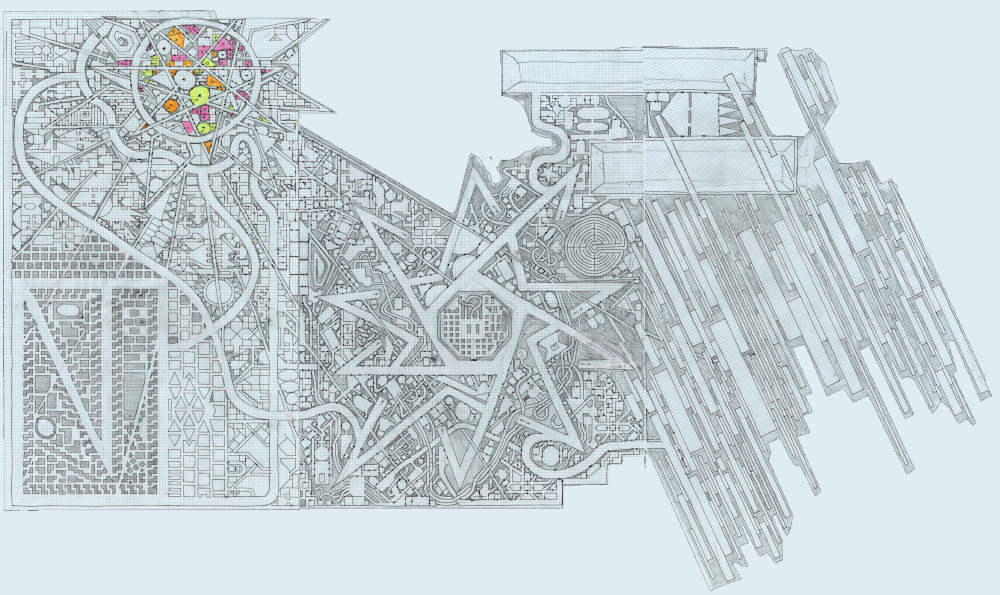
(in this map, as with Epsilon, North is to the left.)
The left third of this image is Level DELTA, right two-thirds are ZETA I. Underneath this map is ZETA II (still under construction) and ZETA III.
The Process
Level ZETA has been a long time coming. (It usually doesn’t take 5 years to finish level 2!) After drawing Epsilon in 2021, I immediately wrote up a schematic for Zeta, and got to work:
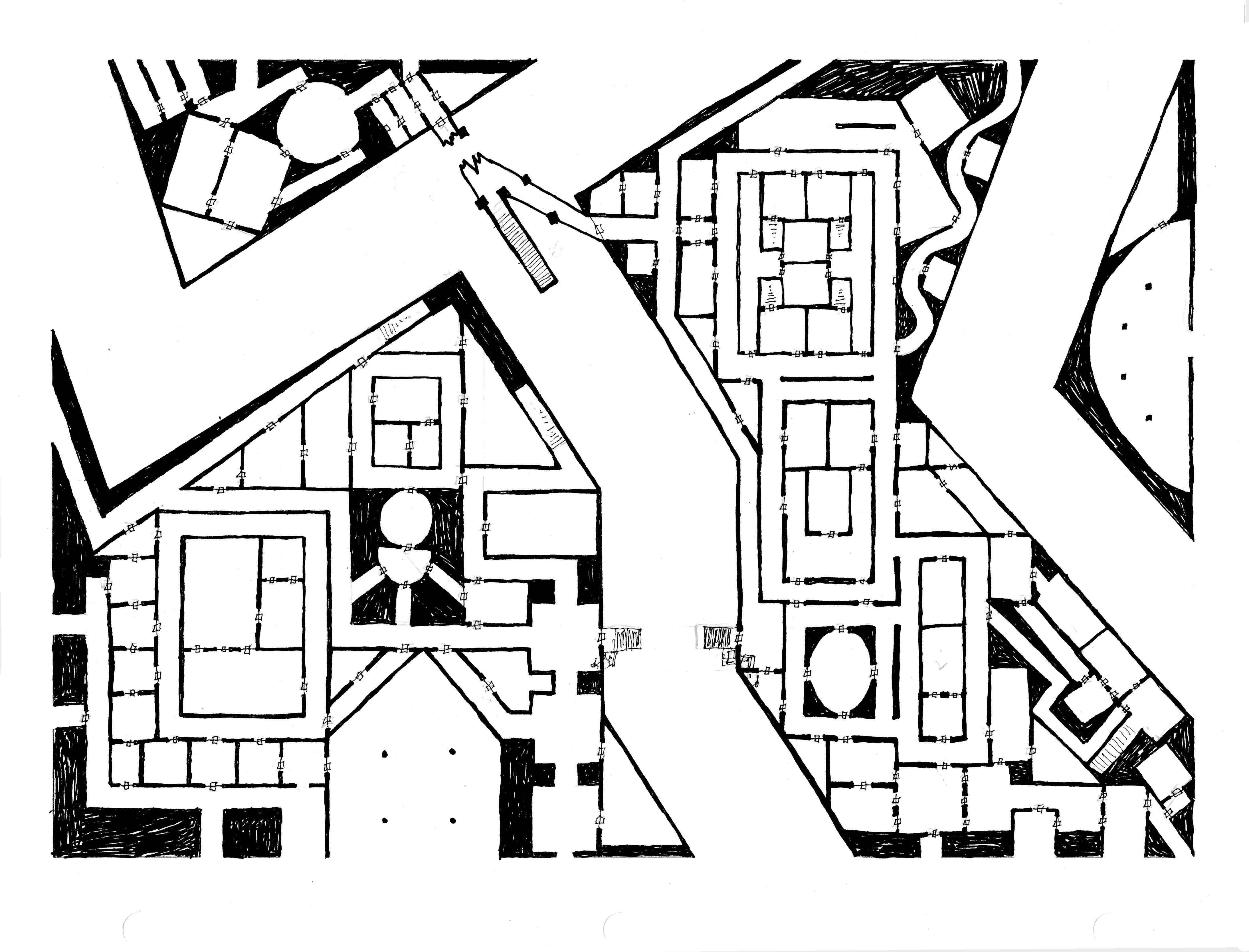
Quickly I lost steam–it just took too many sheets of 4-squares-per-inch inch graph paper to realistically have 50′ hallways. Over the years I kept returning, would get a little ways into it and then become overwhelmed.
I moved on to other maps at smaller scale–drawn on blank paper or index cards–which have become the main area of exploration for Redux. (One of these I slotted into the space beneath Epsilon and wrote about here: Defunct Dungeon Map.)
When the Redux campaign finally began in 2023 (with actual players!), I started them in my newer levels. Zeta has remained dormant as a Good Concept until now. Now it’s about ⅓ done.
Level Delta (the left side) I completed separately, but recently had the energy to expand connect a new Zeta portion to it. I did a very quick sketch in my notebook with the main features, and got to work.
I carefully sketched out the star first, trying several permutations, before copying it at scale on graph paper. This was entirely nerve-wracking. After this I filled in the space. I used a very fine ballpoint gel pen and a pencil on three 11” x 17” sheets of 10-squares-per-inch graph paper. I didn’t use a straightedge or a compass, everything is freehand with the graph paper as a guide.
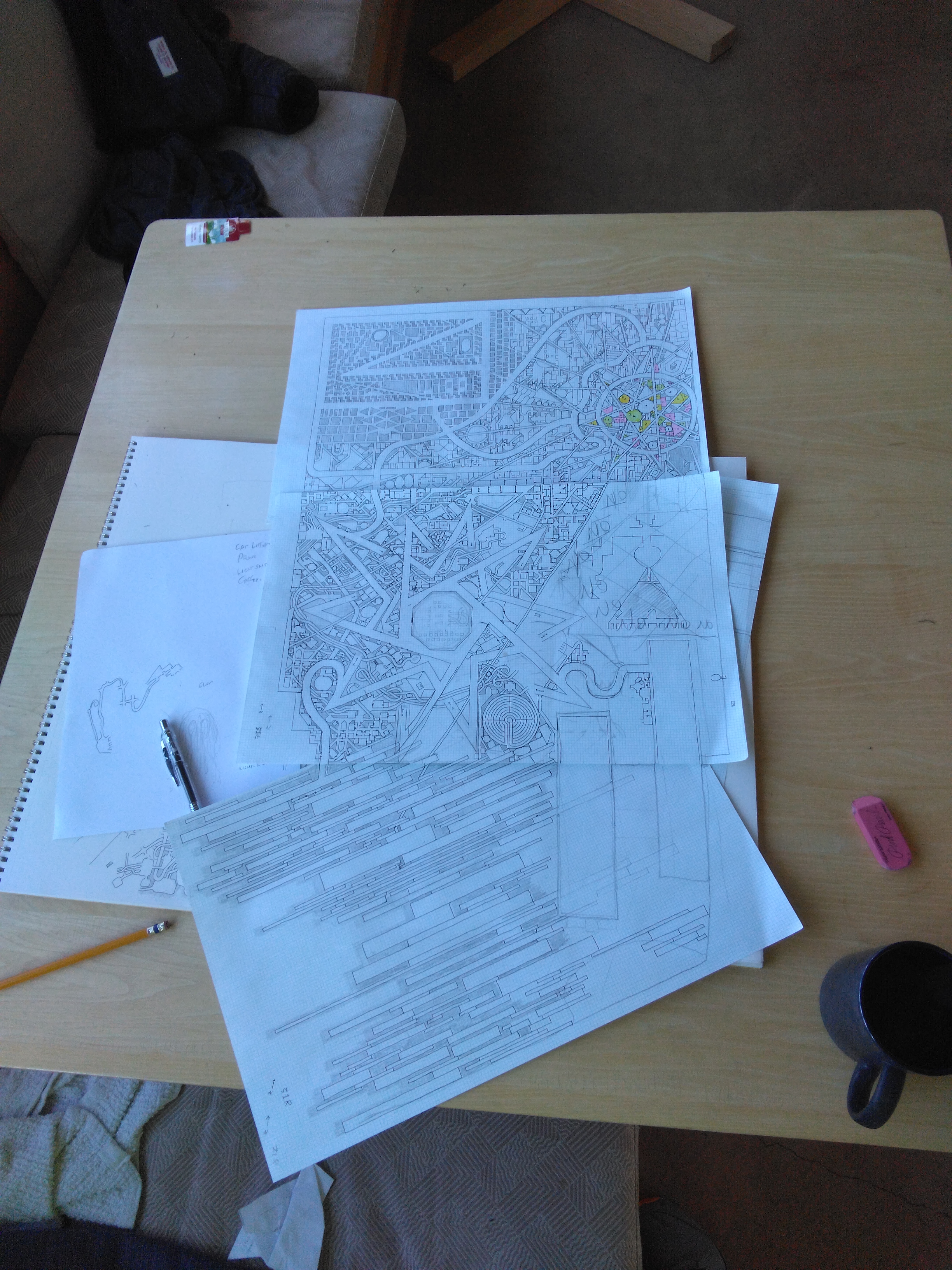
I did not count how many hours this took me to draw, and it’s complicated because I was simultaneously drawing portions of Zeta II and Zeta III, but quite a few. It’s been a fairly manic couple weeks. I find once I start working in earnest on levels like these it begins to dominate my thoughts. I see tangled passages when I close my eyes–glimpses of the fantastic. When I get home from work I immediately start drawing and wont stop for hours, don’t even notice when people ask me things.
Notes about the Layout
Many of the passages are knotted together–these are not upward- or downward-sloping passages, but are all level ground. Call it non-euclidean if you’d like. I imagine these sections will be hideous to map out, but that’s my players’ problem, not mine. I like how a topology can be so clearly readable when looking at it flat on the page, but be so bewildering once you try to make sense of it as a 3 dimensional space.
I do my best to make my dungeons fairly easy to navigate once you know where you’re going. Those big 30′ passages can take a party to any section of the map it wants to go if they’re willing to take the long way around, and then if they choose get into the weeds of things they can.
For this project I intentionally included a ton of stairs, elevators, and slopes. Likewise, I paid special attention to the stairways coming down from Epsilon, giving those locations plenty of navigation options. It’s fairly trivial to go from the up-stairs down a level or two.
The 10-pointed star turned out fairly well; half of its slopes go down 1 level to Zeta II, and the other half go down to Zeta III. The octagonal interior reminds me of Dark Souls, for some reason. Stars are neat features because they force a kind of outpouring and an inward tendency–I feel like the big one is sufficiently grand and overwhelming.
There aren’t very many choke points in this map, but there are a lot of shortcuts and longcuts. It’s possible to travel through this map by sort of choosing a direction and going towards it, but there will be resistance in the form of monsters/traps and doors. Lots of doors.
The long staggered parallel passageways to the south were surprisingly easy to draw, and I find them different and visually appealing. They remind me a little of crystalline rock structures, growing. In my D&D campaign before Redux, all the maps of which were lost in the mail, I had some really beautiful organic maps. Recently my maps have been fairly blocky and chunky (mostly because I’m using graph paper.) This isn’t a bad thing at all, but it’s nice to have found a structure which is both blocky and gives the impression of growth.
The big rectangles at the top are immense open spaces–about 100′-200′ down. They make me very uneasy, but they are necessary I think. It might be possible to run BITS in them.
The lower left corner of the Delta map came to me in a dream. I saw it in a flash, and then worked to make it real. I’m glad I did, turned out great.
Not everything worked. My linework in some places is less clean than I’d like it to be. Also I drew to the very edges of the graph paper to get the connections precise. This worked, but was sort of a pain to deal with. Some areas feel better than others, and there are a couple of places at least which I feel downright awful about. I made a few mistakes with the pen, and when I went to correct these with whiteout I whited out the correction instead of the error. I was blessed to only have to do this 3 times, though.
For me, the concept of the underworld includes immensity and unknowability: complete indifference to visiting inhabitants. I want viewers of this map to have to sit with the notion of these vast empty subterranean spaces. I want it to be a kind of struggle. The underworld is awe-inspiring and bewildering and strange, not because it is large, but because it is unyielding to interpretation. I paid attention to navigability when drawing this map, but haven’t worried too much about mapability. In part this is because I’m blessed with players who enjoy mapping, but also I’m beginning to question whether it’s important for my dungeon maps to be game-friendly at all. I’ve decided to begin focusing on things which I find to be beautiful and meaningful, and trusting the people I play games with to find them beautiful as well. This has been freeing.
It’s possible the best game with which to explore this map won’t be OD&D, perhaps it will be something like Conventional Dungeon Paradigm, or something else entirely. Regardless, only a tiny percentage of the spaces depicted on this map will ever see the light of a PCs torch. The exciting part is that any one of them could, and many will.
Notes about Contents
It takes a very long time for me to develop dungeon contents which are satisfying. Check back in like, uh, 4 years.
Wednesday, February 18, 2026
Faith and Games
When I sit down to play a game with someone, I am partaking in a kind of faith.
Let’s start with tic-tac-toe. When we play I agree to certain rules about how the gamestate can be altered. this is the ruleset of the game. Before the game begins our approach to the ruleset is one of agreement or disagreement. We say, either explicitly or implicitly, “Yes, I agree to play Tic Tac Toe with you, according to these rules.”
When actually playing the game, the relationship we have is no longer simple agreement, it is belief. When someone plays an illegal move (for example, placing an ‘X’ somewhere outside the grid) the first objection is “Hey, you can’t do that! That’s not a possible move!” My objection is one of possibility or impossibility, not agreement or disagreement. I do not (at least, not at first) accuse my fellow player of breaking our agreement to play this game. I instead contend that the illegal action is simply impossible. I have faith that the rules define what is possible. When this reality is challenged, my response is outright denial: you can’t do that–that sort of action simply doesn’t exist within this game.
To play a game of any kind is to have faith that the rules define what is and is not possible, and so long as I believe this to be true–so long as you and I and everyone act as though it is so, it is. The most important first step for playing a game is having faith that it is possible to play it.
Doubt arises when the rules appear contradictory, or when different players understand the rules to be different things.
In one of the early sessions of Verdun: A Dagger at the Heart of France (V:DaTHoFA) Idraluna and I discovered an apparent contradiction in the rules. The rules for Zones of Control in that game state:
The ZOC extends generally into the six hexes immediately adjacent to the unit. A ZOC does not, however, extend out of tunnels or forts, into city, town, fortress, partial forest, or forest hexes, or across trench or prohibited hexsides. (p. 2)
Clear enough. However, the rules for Fortresses state something contradictory:
Units in a fortress hex are quadrupled in defense against assault, but may not themselves make an assault attack. Units with a zone of control continue to exert it while in a fortress. (p. 6)
When I occupied one of Idraluna’s forts, this became a real question: does my 4-1-9 infantry exert its zone of control or doesn’t it? This caused some doubt about the rules–we were uncomfortable with the idea that two contradictory things could be true at once.
The doubt was so unpalatable to us that we paused play, had a discussion, and settled upon a decision which ignored the ZOC rules in favor of the fortress ones. We came to a new agreement as players (”We will play Verdun according to the ruleset, except that units in fortresses exert zones of control, despite what the rules say.”) This agreement made, we continued playing and had a good time.
The practice of coming to an agreement about interpretations of rules is common and good, but it demonstrates, I think, that we valued the comfortable notion that our game was playable more than we valued the rules as written. This is what it means to play games, after all. We had faith that the game would work without contradictions and continued under this belief until skepticism made it impossible. After we agreed on an interpretation, I think we both had a stronger faith that Verdun was playable in its new form.
Were we playing the same game after this? What was it that made us so uncomfortable about contradiction?
I should clarify that by “faith” I do not mean “high trust” in the RPG sense. Faith is as important in zero-trust games as it is in high-trust ones. What I mean is not faith in other players, but faith that the game itself is working, or will work.
I wrote a fairly unfun game a while ago called Revolution which in part was an attempt to explore these questions. I wanted to know what would happen if the players refused to play according to the ruleset. In this example, what would happen if a non-Sovereign player refuses to hand over their token. What happens in that moment, to the game, to play itself? Isn’t it possible to be still kind of playing a game even while ignoring the rules, so long as you believe you’re playing it? How much does the agreed-upon ruleset really define play?
Maybe you could say that, when you break free from a ruleset like that, you are simply bringing in new socially-defined meta-rules and interpreting the written ruleset as hypodiegetic. But what force do even these have, unless there is belief that moves made in the “Bully the player with the Sovereign role into changing the rules to make the game more fun” are valid? What’s the crossover-point between those towo?
I wonder whether there isn’t a continuum of dispositions to rulesets. I wonder if we couldn’t playtest rulesets which are progressively less coherent to see where the line is between “playable” and “not playable” is, in the true sense. When does it happen that we’re not playing a game anymore?
Mishmash is a game which does seem like fun and I do want to play about this question.
One final example:
I am working slowly on a wargame called Assault on Castle Slazzo. There is an artifact which operates according to the following rules-text:
Ø - APPLIANCE FOR THE DISILLUSION OF THE ANTITHETICAL
The APPLIANCE might better be described as a ridiculous concept or idea rather than any sort of physical manifestation. The militiaman who first sights the APPLIANCE carries it. The APPLIANCE concerns p and ~p. The militiaman carrying it can, once, for any unambiguous verifiable statement about the game state p, reveal that its logical negation ~p is also true. The strain of such a revealing invariably kills the carrier, thus removing the APPLIANCE from play.
In AOCS it is likely that there will be many statements about the gamestate which are both true and not true at the same time. Surprisingly, this was entirely playable in playtesting.
I’ve written previously that Nomic is a social game masquerading as a logic game. But now I’m starting to wonder if all games are sort of masquerading as themselves. All pen and paper games are notebook kayfabe.
…
This post was inspired by discussion around this one: https://kattkirsch.b … r-replaying-modules/


