Wednesday, February 18, 2026
Rule Mutability in Nomic and Dungeons & Dragons
In most games, play alters the gamestate only. Nomic and Dungeons & Dragons are unusual (though not unique) in that they require participants to constantly assess, critique, and modify the fabric of the games themselves.
The rules of Nomic and D&D are distinctively mutable: through the course of ordinary play, participants alter the ruleset. The emergent complexity produced by this rule mutability is crucial to the success of both games.
There are major differences, however. In D&D, mutability is expressed through the complete authority of the referee to present scenarios and resolve situations, either according to the logic of the fantasy world or their best judgement for playability. In Nomic, mutability is enforced through a strict set of rules-amending procedures effected by player vote, procedures to which all players are rigorously subject.
I wanted to share some thoughts and analyses about these two favorite games of mine. I don’t really have a coherent or paradigm-shattering argument—just musings and descriptions mostly. Much of what I say here about D&D is of course applicable to other wargames and RPGs, especially OSR and FKR-leaning playstyles. Likewise, Nomic has its peers in Diplomacy, real-world governance, drinking games, and the like.
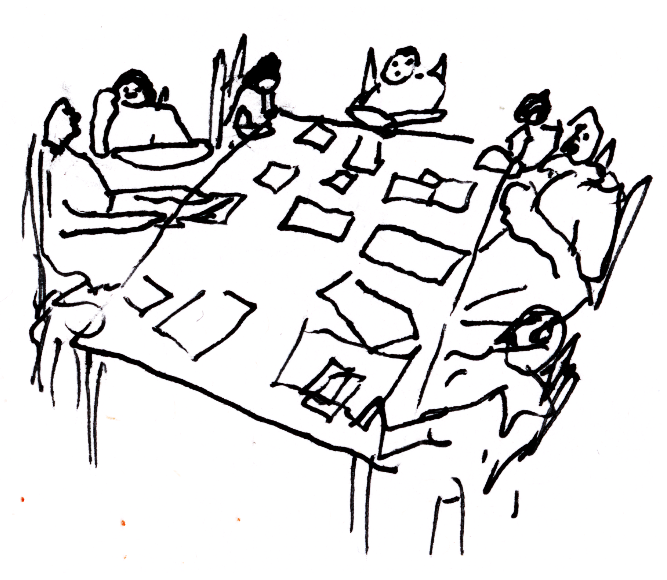
(Image is of a game of Nomic in progress on 7/9/2025)
It does seem to me these two share a kind of kinship–I do not know of any other pen and paper games so enthusiastically mutable as these two. (Write to me if you know any, I’ll be really intrigued!)
Nomic is also more obscure and often misunderstood, at least in my circles. I wish it were more widely known. Many of Nomic’s lessons are useful for thinking about the structure of game rules in general, even (or especially!) those which have no rule mutability whatsoever.
Which D&D?
By Dungeons and Dragons I mainly mean what I play: the three original booklets sans supplements. For me the 3LBBs amount almost to something like sacred texts, not because their authors were divinely inspired or virtuous (God no!), but because they carry a mysterious impenetrability, what Marcia B. calls “…the way in which it does not survive being read.” Accidental genius, I think. Lightning in a bottle stuff.
What is Nomic?
Nomic is “A Game of Self-Amendment” invented by Peter Suber in 1982 while working on his book on legal philosophy The Paradox of Self-Amendment: A Study in Logic, Law, Omnipotence, and Change. The book was published in 1990, and is available in full on Suber’s website, with the Initial Ruleset for Nomic making up Appendix 3.
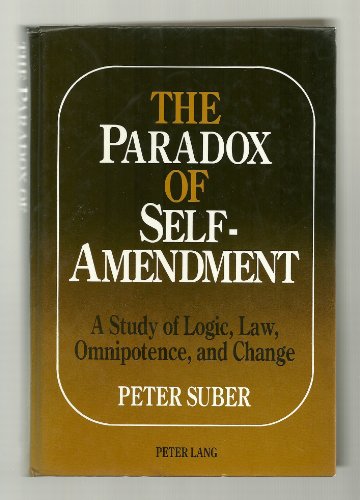
(Suber’s Paradox of Self Amendment could win an award for Ugliest Cover Imaginable, but I am fond of it.)
Nomic is designed more to be a teaching tool than amusement. It is intended to demonstrate Suber’s philosophical position on the nature of legal authority. The main question, if I understand it, is: Can a legal document grant amending authority to revoke its own amending authority?
According to formal logic the answer is supposedly paradoxical. (Quite possible that I’m misreading and/or dangerously oversimplifying Suber’s arguments here. I did my best, but Paradox of Self Amendment is a dense book.) It’s the same problem as Can an omnipotent God create a rock He can’t lift? A god who couldn’t create such a rock isn’t omnipotent, but a god who could wouldn’t be able to lift a rock, and thus also isn’t omnipotent. Does a legal document, then, really have the power to revoke its own authority?
In the real world of politics and laws these kinds of amendments plainly exist and are used all the time without difficulty, paradox or no paradox. Suber’s claim is that Law has its own reasoning system for dealing with logical inconsistencies: political will.
Nomic, then, is a test chamber for philosophical problems of legal reflexivity. It is purpose-built to raise difficult questions about the nature of rules themselves.
The Initial Ruleset for Nomic consists of 29 rules governing play, numbered 101-116 and 201-213. There is no imagined setting in Nomic, no role-playing, no referee or GM. The rules are written concisely and logically, with few explanatory remarks. Sometimes a concept or mechanism is split up into two or three rules, which can make it difficult to read at first, but makes the ruleset more modular for amending.
Rules are divided into two classes: Mutable Rules can be added, amended, or repealed by unanimous (later majority) vote. Immutable Rules cannot be amended, but can be transmuted into Mutable Rules by unanimous vote. Thus some rules are harder to alter than others (requiring more political will.) Generally the more important and fundamental rules are initially Immutable, while the substantive process rules are Mutable. It also seems like some of the more dangerous, exploitable rules (ex. Judgement, Win by Paradox) are mutable.
The main gameplay loop in Nomic is described with the following rules:
201. Players shall alternate in clockwise order, taking one whole turn apiece. Turns may not be skipped or passed, and parts of turns may not be omitted. All players begin with zero points.
…
202. One turn consists of two parts in this order: (1) proposing one rule-change and having it voted on, and (2) throwing one die once and adding the number of points on its face to one’s score.
Rule 203 sets the vote requirement for a proposed rule-change to be adopted, (unanimous, except after the second complete circuit of turns). Rule 103 defines a rule-change, (either the amendment, enaction, or repeal of a Mutable rule or the transmutation of an Immutable one.) 208 defines the winner as the first player to achieve 100 points.
Many of the other rules describe how to organize and interpret rules against one another. Rule 212, for instance, describes the process of Judgement, whereby disagreements about the interpretations of the rules are settled by one player acting as Judge. The Judge is supplied with somewhat binding parameters, and can be overruled by the other players.
The malleability of the Nomic rules is enforced. Since parts of turns can’t be skipped, players must propose rule-changes. The way points are allocated further means that a player cannot gain points unless their proposed rule-change is adopted–you lose 10 points each time one of your proposals is voted down. (Technically the net point loss per turn for your proposal failing is randomly between 9 and 4.)
It is, conversely, rarely the optimal choice points-wise to vote for another player’s proposal under the initial ruleset. Voting for someone else’s proposal gives them points and gives you nothing. The players are in a lose-lose situation until they work cooperatively to change the rules. Like Diplomacy, simple rules must be brought alive by the complicated nature of inter-personal relation. In order to make any progress at all players must work together against the situation presented by the Initial Ruleset.
Much of the gameplay of Nomic is trying to come up with neat rule ideas, trying to convince fellow players to vote for them, and watching these plans unravel. It’s delightful, devilish fun. A social game masquerading as a logic game.
Like D&D, the Nomic Initial Ruleset is clunky, sometimes dense, and occasionally frustrating. It seems to demand fixing. Elaine Scarry in her book On Beauty and Being Just said of beautiful things that they “…seem to incite, even to require, the act of replication.” I wonder if it isn’t true that well-made pen and paper game rulesets incite or even require one to play with it. As in D&D, whatever fixes get implemented usually break several more things, so it is a constantly churning patchwork rollercoaster.
I highly encourage any person interested at all in games of any kind to read the Initial Ruleset. It is a work of art. Since faith without works is dead, I also encourage you to actually play Nomic. It may surprise you.
Rule Mutability in D&D
Dungeons and Dragons states the attitude its participants should adopt to the rules text in the introduction and the afterword. The first paragraph of the Introduction begins:
These rules are as complete as possible within the limitations imposed by the space of three booklets. That is, they cover the major aspects of fantasy campaigns but still remain flexible. As with any other set of miniatures rules they are guidelines to follow in designing your own fantastic-medieval campaign. They provide the framework around which you will build a game of simplicity or tremendous complexity – your time and imagination are the only limiting factors…. New details can be added and old “laws” altered so as to provide continually new and different situations. (M&M, p. 4)
The rules position themselves as incomplete; a guideline-framework, pieces of a game which must be assembled. There are variations on the kind of game which can be built–simple, or complex–and the fundamental motive power for this kind of building is “…your time and imagination…”
The rules explicitly allow for enacting new rules (adding new details) and for amending existing ones (altering old “laws”) A purpose for the mutable approach is also made explicit: “…to provide continually new and different situations”
The Afterword restates these points:
There are unquestionably areas which have been glossed over. While we deeply regret the necessity, space requires that we put in the essentials only, and the trimmings will oftimes have to be added by the referee and his players. We have attempted to furnish an ample framework, and building should be both easy and fun. In this light, we urge you to refrain from writing for rule interpretations or the like unless you are absolutely at a loss, for everything herein is fantastic, and the best way is to decide how you would like it to be, and then make it just that way!…(U&WA, p. 36)
Here is added that the assembly of the game from essentials is part of the experience–easy and fun. The fantastic is to be the main driving force of the game, which pushes further into mutability. The recommended method for settling disputes is not writing for clarifications, but the far more freeing, fanciful, and uncharacteristically friendly “..the best way is to decide how you would like it to be, and then make it just that way!” The afterword thus cautions players against taking a non-mutable approach to the rules.
What Counts as Mutability?
Aren’t all games mutable, if you want them to be? You can always change or ignore the rules of any games you play. Moreover, it’s common to forget rules, and, once the mistake is discovered, to find a group consensus for how to proceed. Usually, though, these rule-change shenanigans operate outside the rules-as-written. The rules do not themselves account for these kinds of alterations. My definition for rule mutability is that the rules as written tell you to do it.
Rule mutability is not something which happens to Nomic and D&D, it is an essential component of playing those games.
Writing Down Rule-changes
Both Nomic and D&D have a rule instructing players to write down rule-changes. In Nomic, we have the following:
106. All proposed rule-changes shall be written down before they are voted on. If they are adopted, they shall guide play in the form in which they were voted on.
In D&D, the second paragraph of the Introduction, directed to non-referee players, reads:
.…If your referee has made changes in the rules and/or tables, simply note them in pencil (for who knows when some flux of the cosmos will make things shift once again!), and keep the rules nearby as you play. A quick check of some rule or table may save your in-game “life”. (M&M, p. 4)
In Nomic, players write down a rule-change before it is in effect, as a necessary component of the process of making a rule change. Proposed rule-changes can’t be voted on until they are written down, and the writing itself is essential for guiding play. Thus, in Nomic, writing down a rule is a crucial step beforehand.
In D&D, players write rules post facto. The referee has already altered the rules, and players are directed to mark down those changes. Writing is done in pencil in case those rules change again. The writing is for convenience, and perhaps for strategy, but in no way necessary for the rule to be in effect.
Written down rule-changes, in D&D are only an aid–not definite, but occasionally helpful. This reflects the whole of D&D’s approach to rule themselves, as a framework or guidelines.
Rule 0 vs. Immutable Rule 101
“Rule 0” isn’t present in the D&D rules text, but as I understand the sentiment is something very close to the idea that the “make it how you decide you want it” principle supersedes all the other text in the game. Namely: the Referee can ignore any or all of the rules text in order to play the game desired. In D&D, the principle of mutability is closely tied up with the authority of the rules in general. Under Rule 0, the same power which effects rule mutability decides which rules are in effect, and when.
I bring the term “Rule 0” up here to contrast it with Nomic’s first rule, which conveys exactly the opposite sentiment:
101. All players must always abide by all the rules then in effect, in the form in which they are then in effect. The rules in the Initial Set are in effect whenever a game begins. The Initial Set consists of Rules 101-116 (immutable) and 201-213 (mutable).
Nomic, the game about rule mutability itself, sets as its most fundamental concept the idea that playing a game means following all the rules currently in effect. No player or rule supersedes Rule 101, in the Initial Set, and it is the hardest rule to amend or repeal.
Nomic is thus D&D inside-out. If D&D is a skeleton of guidelines which must be fleshed-out by creative and industrious participants, Nomic is an exoskeleton: the players are the fleshy parts trapped inside the skeleton, and if they wish to escape the old structure must be molted. In D&D, participants play with the rules; in Nomic, participants are playing against the rules.
One troubling aspect of Rule 101 is that it can be repealed. What happens, the Initial Ruleset asks, if players are no longer obligated to abide by the rules of the game?
There is no such contingency in D&D. It’s not clear that a Referee could abdicate their authority so thoroughly to the point that the paradigm (Referee runs the game by deciding what the rules are and how to interpret them) is dissolved. Saying anything coherent about this will require getting deep into the weeds about how cultures of play affect the interpretation of rules texts, though, so I won’t go further here.
Reasons for Changing the Rules
As I’ve said before, in Nomic mutability is enforced: you cannot play without trying to make changes. In D&D, mutability is always available; a set of tools waiting for you to pick up. The differences between these are reflected in the kinds of rules-mutability which are most frequently engaged in. In this section I’m just going to describe a few different types of mutability, and how they show up in each game.
Playability Mutability
Changing the rules to make play easier, more interesting or run more smoothly, or according to some other game design principle like simulation.
Examples abound in D&D; combat interpretations, house rules adding meaning to ability scores, tuning monster stats up or down for balance reasons, developing mechanics to account for players trying new things.
Nomic is full of these as well–one of the first rules added in new Nomic games I’ve been in are clear voting procedures and other clarifications.
Diegetic Rule Mutability
Diegetic rule mutability occurs when a rule is made in order to have the rules correspond more fully to an imagined world. D&D exercises this kind of mutability and Nomic generally does not, because D&D has a setting and Nomic doesn’t. In fact, most of the action of D&D takes place within this setting. The rules, then, engage in a dialogue with that fantasy world, both creating it and operating within it. The Introduction and Afterword repeatedly express the desirability of new situations, sparked by player (non-referee) initiative. These new situations are undoubtedly situations in the imaginary world.
There is no fantasy in Nomic, no verisimilitude to defend. The malleability of Nomic’s rules is not a means to achieve a better, quicker, or more full experience: malleability is the experience Nomic offers. The dialectic in Nomic is not between Player and Gamestate, like in other games, not between Ruleset and Fantastical, like in D&D, but between Ruleset and Player.
Both games, in common phrasing, can “Be whatever you want”, but both have definite restrictions. D&D by enforcing a fantasy world in which the action happens; Nomic by doing the opposite.
Gonzo Rule Mutability
Gonzo rule mutability is changing the rules into something bizarre or extreme just to see what will happen. The Wikipedia page for Nomic lists a really tremendous quote describing one playstyle being “…the equivalent of throwing logical hand grenades.” I would say Nomic has the edge on this one, because in Nomic “new and interesting situations” are only ever rules-defined. It is fun in Nomic to require that every player compliment another player before taking a turn, or sing songs, or to set up mind-bending official hierarchies with overlapping powers.
In D&D the referee may very well come up with very strange, wild, or interesting scenarios, but these are often in-setting creations. If a monster or situation is outside of the norm expected by the rules enough, it will spur new mechanics to be developed for dealing with it.
Judgement and the God Complex
Nomic does actually have an authority role, a participant who makes binding decisions about the scope and interpretation of the rules: the Judge. Both D&D and Nomic have The OSR “Rulings, Not Rules” mantra.
The Judge is an interesting role in Nomic, because they have wide authority for rules-interpretation, but can be overruled by a unanimous vote from all other players.
Likewise, mutability might seem to be entirely in the hands of the Referee, but they are not in control of what situations will be brought about: the referee is beholden to the fantasy world and the gamestate describing it. Players will continue to produce new situations which need adjudication. As players interact with the world through the rules, they can and do push back on rules interpretations. Players frequently bring up points or clarifying questions which push the referee to enact rule-changes which fit the play at the table. In D&D rule mutability is a collaborative effort, although it is an asymmetrical one.
Unfolding Games and Patagaming
Both games start simply and expand. There is a sense that anything is possible, that a whole cosmos of playability is within reach, if only you tinker here and there. Both games are likewise chaotic, which is to say, they both frequently feature awful game mechanics; but in both this is besides the point: the point is how players react to these mechanical situations.
Process is more important than product. These are experiential games–the fundamental excitement is that the players do not even know what kinds of things will be possible.
Two terms come to mind to describe this:
One is unfolding game, a term from this Extra Credits Youtube video: The Waiting Game - W … mes Become Cult Hits. An unfolding game is one where new mechanics or systems are revealed over time, usually recontextualizing the older mechanics.
The other term is patagaming, which I pull from this ODD74.proboards.com thread. Patagaming describes a way of playing where a game draws other games into it: D&D is a dungeon mapping game and a combat simulation game and a castle maintenance game and an overland travel game. Each of these games are fairly separable from one another: the striking position D&D takes, a position which sets it apart from other games, is that it brings these together.
The practice of patagaming or unfolding involves bringing more and more different kinds of games into the mix. Need a way to resolve jousts? Use the jousting minigame from Chainmail. Have some flying creatures? Here’s an aerial combat system. Need to get information about the dungeon? Here’s fantasy roleplay. In Nomic, players pull from all kinds of mechanics and laws in order to accomplish their goals, resulting in a mish-mash of different kinds of rules operating all together.
Rule Mutability is important for patagaming or unfolding, since as it allows these games to mimic other games, it allows the grounding in which play occurs to shift.
Community and Continuity
Finally, both Nomic and D&D tend to develop a community of players. I think this is largely because the story of a rule-mutable game requires investment. A rule-mutable game is a community project. There’s probably more that can be said on this, especially on how the two games deal with onboarding new players. That might be another blog post, though.
Add comment
Fill out the form below to add your own comments


