Thursday, January 22, 2026
How to Locate a Secret Room
Idraluna Archives’s writeup The Mapping Game is a wonderful description of an aspect of D&D which is sometimes under-investigated.
My two cents to throw out into the world is a few thoughts about how to place secret doors in places where mappers might infer them.
For this exercise, I’m assuming secret doors which are impossible to find unless characters actively take several turns searching the walls for them (except for elves, of course.) The idea is that, solely through the dungeon topology, players get a hunch.
They are arranged from easiest to hardest to locate. I’m not too worried about secret rooms being missed–all that means is there’s treasure left for next time. If it’s a really important secret door, you can put a bookcase, statue, or fireplace in front of it. (Or a big flashing sign reading “SECRET DOOR HERE”, which would be fairly nasty, especially if the secret door was actually 50′ to the right.)
Void Space
This method is works for high-density dungeons, and it’s the simplest. Consider the following hypothetical player-drawn map:
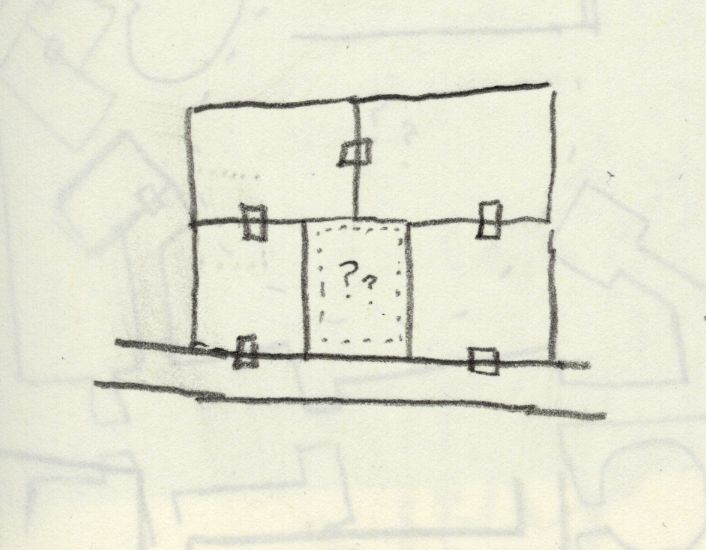
The rooms make a simple loop, but conveniently leave space for another rectangular room in the center. How could there not be a room there?
Pattern Interruption
Here you simply present a pattern and then supply its absence.
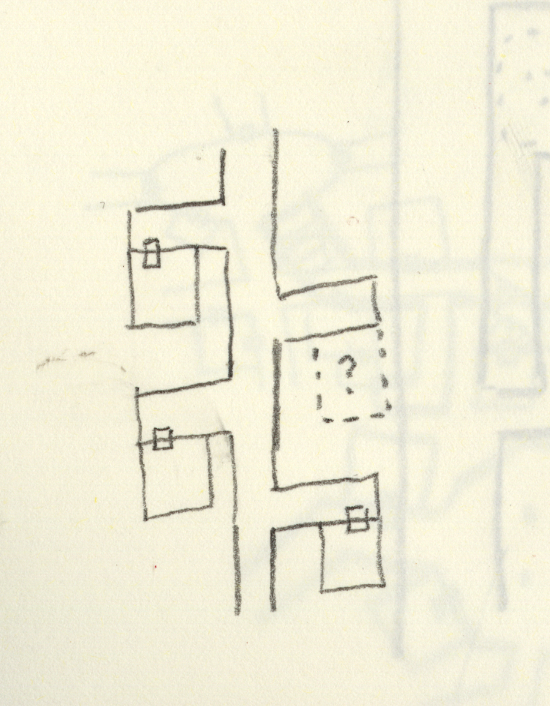
The pattern can be anything, but the key is to establish a trend and then buck it. Why would it suddenly change? Something fishy is going on…
Distance Discrepancies
In the novel House of Leaves by Mark Z. Danielewski one guy discovered his house is several inches bigger on the inside than the outside. While we can’t expect player characters to measure dungeons with such precision, it is possible for distance discrepancies to be noticed. Hey, this room is smaller than I’d expect it to be!
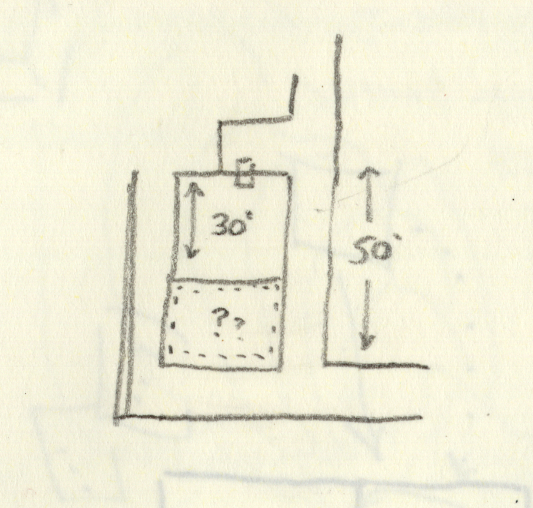
This can also be used with long parallel dead-end passages.
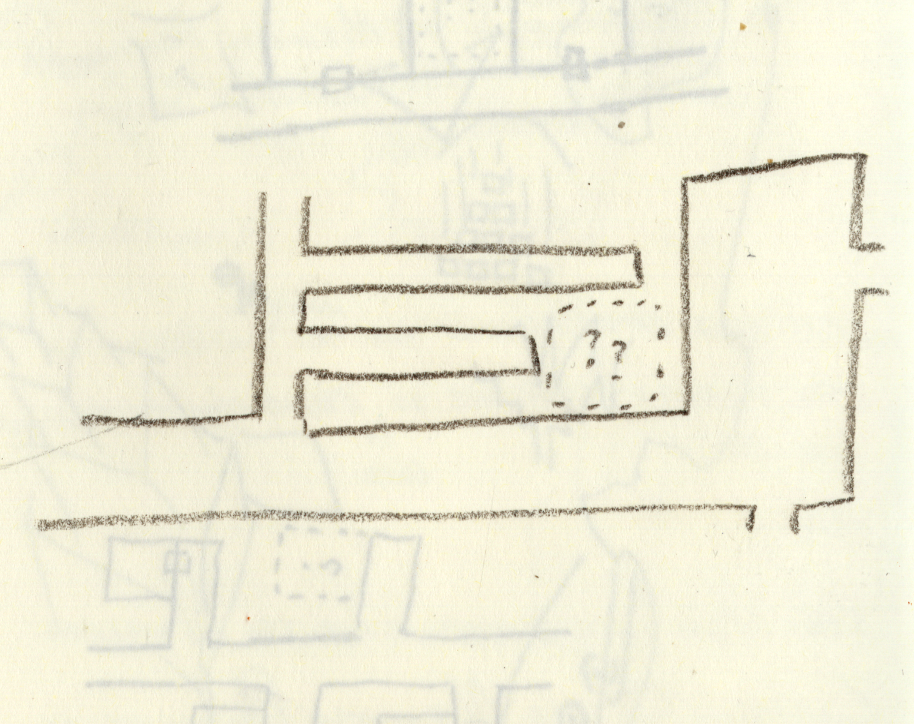
The Pincer Move
This method operates on a larger scale, where two apparent dead ends end up facing each other. Useful for telegraphing an entire secret area. Really the Pincer Move is a variation of Void Space.
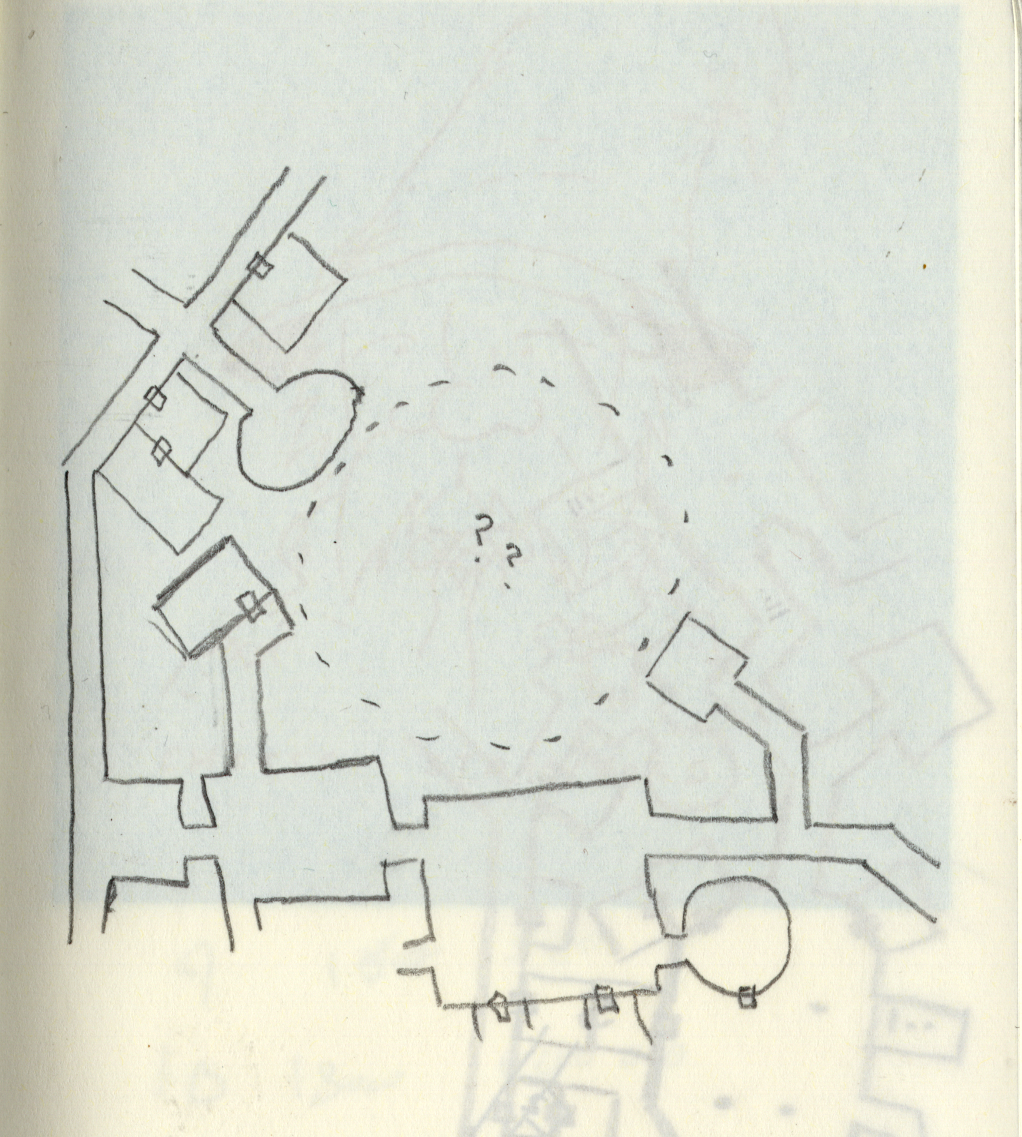
What on earth could be over there?
Shortcuts
Dungeons wind their way around each other in a frustrating fashion. To facilitate getting form one place to another quickly, (after an area has been cleared) I add shortcuts. Here we have a round-about way, and the room in the center would be a perfect point of egress into the adjacent area. A secret door conveniently located there will probably be missed, but if a thouhgtful party is poking around for shortcuts, it might be an excellent discovery. Monsters will also use it, of course, which may also tip the party off. There’s gotta be an easier way to get through!
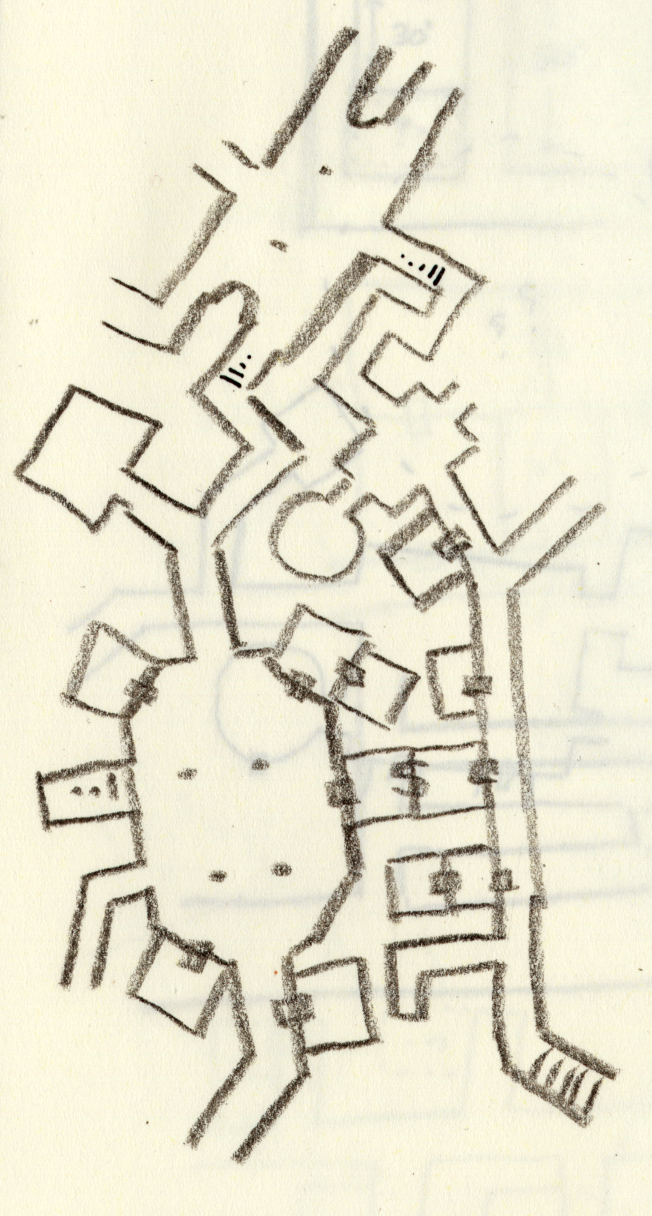
(Shortcuts can also be made solely with ordinary doors, as well. Since moving through passageways is less noisy and dangerous than rooms, hiding a shortcut behind several ordinary doors is viable.)
Random Location
These kinds of secret rooms are very difficult to locate using only the Mapping Game. Spells, hints, door mechanism clues, rumor, and old fashioned luck are needed to find secret doors like these.
Add comment
Fill out the form below to add your own comments


